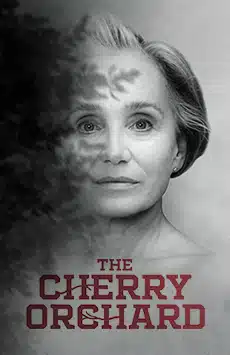
What happens in The Cherry Orchard?
Lyubov Ranevskaya returns to her family's grand estate in the Russian provinces after years living abroad. She comes home to the place she loves most in the world — and to a crisis. The estate is deep in debt, and the famous cherry orchard that gives the property its beauty and its name is about to be sold at auction unless the family can find a way to save it.
A solution nobody will take
Lopakhin, a self-made businessman whose family were once serfs on the estate, offers a practical answer: clear the orchard, lease the land for holiday cottages, and the debts are solved. But for Ranevskaya and her brother Gaev, cutting down the cherry orchard is unthinkable — it is bound up with memory, identity and a way of life. They talk, delay, and hope, while doing nothing.
A world in transition
Around the central dilemma, Chekhov assembles a houseful of characters caught between a fading aristocratic past and an uncertain modern future: the eternal student Trofimov, the adopted daughter Varya, the youthful Anya, and a gallery of servants and hangers-on. Comedy and melancholy run side by side, often in the same scene.
Letting go
As the auction approaches, the family's inability to act seals their fate. The play's ending — the sound of axes in the orchard, a house left empty — is one of the most quietly devastating in all of drama. The Cherry Orchard is, finally, a play about change, and about the human reluctance to face it until it is too late.
About the production
Chekhov's final masterpiece
The Cherry Orchard was Anton Chekhov's last play, first performed in 1904, shortly before his death. Chekhov himself called it a comedy, and the play's particular genius lies in how it holds laughter and heartbreak in the same frame. It remains one of the most performed and admired works in world theatre.
A new adaptation by Conor McPherson
This production uses a new adaptation by Conor McPherson, the Olivier Award-winning Irish playwright behind The Weir and Girl from the North Country. McPherson is celebrated for bringing fresh, immediate language to classic texts, and he previously adapted Chekhov's Uncle Vanya for the same creative partnership.
Ian Rickson directs
Director Ian Rickson — an Olivier and Tony Award nominee whose work includes Jerusalem, Uncle Vanya and The Weir — reunites with Kristin Scott Thomas, having previously directed her in The Seagull, Electra and Betrayal. Their Seagull won Scott Thomas the Olivier Award for Best Actress.
A starry reunion
Dame Kristin Scott Thomas leads as Lyubov Ranevskaya, with further casting announced in due course. Produced by Sonia Friedman Productions, the company behind Leopoldstadt and Jerusalem, the revival is designed by Chloe Lamford with lighting by Bruno Poet, and plays a strictly limited season at the Harold Pinter Theatre.
Performance schedule
- First performance: 3 October 2026
- Press night: 13 October 2026
- Final performance: 9 January 2027
- Running time: To be confirmed by the box office — typically around 2 hours 30 minutes including an interval
A strictly limited season
The Cherry Orchard plays a limited West End engagement at the Harold Pinter Theatre. With star casting and a high-profile creative team, demand is expected to be strong, so early booking is strongly recommended, particularly for weekend and festive-period performances.
Age guidance and content
Guideline recommendation: ages 12 and above.
The Cherry Orchard is a classic Chekhov drama dealing with adult themes of loss, debt, family and social change. It is best suited to older teenagers and adults. Families considering younger viewers should confirm the recommended minimum age with the box office before booking.
Cast
- Dame Kristin Scott Thomas as Lyubov Ranevskaya (The Seagull, Slow Horses, Four Weddings and a Funeral)
- Further casting announced in due course
Creative team
- Writer: Anton Chekhov
- New adaptation: Conor McPherson
- Director: Ian Rickson
- Set designer: Chloe Lamford
- Lighting designer: Bruno Poet
Getting there
- Tube: Piccadilly Circus (Piccadilly, Bakerloo) — 3 min walk
- Alternative: Leicester Square (5 min), Charing Cross (6 min)
- Bus: Routes along Haymarket and Piccadilly stop nearby
- Parking: Q-Park Whitcomb Street nearby
About the Harold Pinter Theatre
The Harold Pinter Theatre opened on Panton Street in 1881 and seats around 796 across four levels. Renamed in 2011 in honour of the playwright, it has become a natural West End home for major straight-play revivals — including the previous Rickson–McPherson Uncle Vanya.
Accessibility
The Harold Pinter Theatre offers wheelchair-accessible seating and access facilities, though as a Victorian building some areas involve stairs. Contact the box office in advance to discuss specific access requirements and to confirm the best seating positions for your needs.
Producers
The Cherry Orchard is produced by Sonia Friedman Productions, the company behind Leopoldstadt, Jerusalem and Harry Potter and the Cursed Child. The combination of producer, director, adaptor and star underlines the ambition behind this autumn revival.