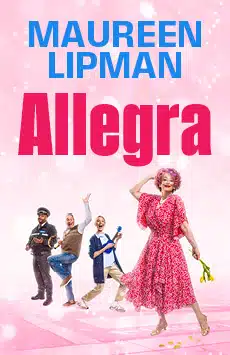
What happens in Allegra?
Allegra is an older woman living alone in a small community, and she sings. Not for an audience and not on cue: she bursts into song in the street, in shops, in the middle of conversations, whenever the feeling arrives. Most of her neighbours find it charming for about a week.
The complaints
Then the complaints start. A neighbour, Ronen, and a younger woman, Anna, are drawn into her orbit from different directions — one exasperated, one protective — and eventually the community calls the police. Officer Rogers is sent to have a word, and finds having a word with Allegra harder than expected.
The question
The second act turns to what should be done about her. The options on the table are the ones societies usually reach for with the inconveniently old — a quiet word, a doctor, a prescription — and the play's argument, made mostly through Lipman's refusal to stop singing, is that a person who is happy and harmless does not need to be cured of it.
This production
Directed and choreographed by Stephen Mear, with set and costumes by Justin Williams, lighting by Sam Biondolillo, sound by Russell Ditchfield and video by Ben Bull. Livi Van Warmelo was music director and Paul Schofield orchestrated. Two hours ten minutes including an interval; age guidance 12+.
Background: Quilter, Lipman, Mear and the tour
Peter Quilter
Quilter is the writer of End of the Rainbow, the Judy Garland play that earned Tony and Olivier nominations, and of Glorious!, about the famously tuneless soprano Florence Foster Jenkins, which starred Maureen Lipman in the West End in 2005. Allegra was a new play written with Lipman in mind and returns to his recurring subject: a woman who sings against the world's advice.
Maureen Lipman
Dame Maureen Lipman's stage career runs from the National Theatre in the 1970s through Oklahoma!, Re:Joyce!, Glorious! and Rose, alongside decades of television and film. She was 80 during the Allegra run. Her co-stars were John Middleton, best known for Emmerdale, Elizabeth Bower (Trollied, Midsomer Murders) and Bailey Patrick (Dear England, London Kills).
Stephen Mear and the production
Stephen Mear, a three-time Olivier Award winner for choreography, directed as well as choreographed. Producers Thomas Hopkins Productions and SAMS Entertainment, with Melissa & Bradford Coolidge and Trunfio McGill, opened the show on a UK tour in spring 2026 — High Wycombe, Aberdeen, Malvern, Richmond, Windsor, Glasgow and Bath — before the Harold Pinter Theatre run from 8 July. The 8 August closing performance was the 100th.
The Harold Pinter Theatre
Allegra was followed at the Panton Street theatre by Nadia Fall's Abigail's Party with Tamzin Outhwaite (12 August – 19 September) and then The Cherry Orchard, Conor McPherson's new version of Chekhov with Kristin Scott Thomas, from 3 October 2026.