
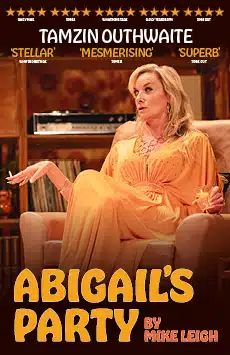
What happens in Abigail's Party?
A suburban living room, 1977. Beverly has invited the new neighbours round for drinks: Angela, a nurse, and her husband Tony, a former footballer who barely speaks. Also invited is Sue, divorced and nervous, whose fifteen-year-old daughter Abigail is holding a party at their house down the road. Beverly's husband Laurence, an estate agent, arrives late and irritable from work. The title character never appears.
Act one
Beverly pours drinks nobody wants, puts on Demis Roussos, hands round cheese-and-pineapple on sticks and steers every conversation back to herself. Laurence tries to talk about Van Gogh and Shakespeare and is mocked for it. Angela is eager, Tony is silent, Sue is polite to the point of pain. The comedy is in the gaps — between what the characters say, what they mean, and what they think the others think of them.
Act two
More drinks. Beverly dances with Tony. Laurence's temper frays. Sue is sick. The party next door grows louder and Tony and Laurence go to check on it. The evening's tensions — class, marriage, taste, envy — stop being funny at almost exactly the moment the audience expects them to peak, and the play ends on something closer to shock than a punchline.
This production
Nadia Fall directed on Peter McKintosh's set and costumes, lit by Howard Harrison with sound by Alexandra Faye Braithwaite. Approximately 2 hours 30 minutes including one interval, age guidance 12+.