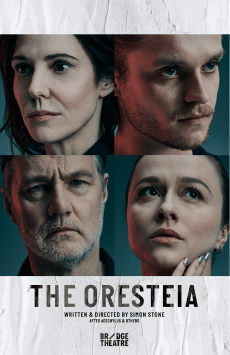
What happened in Simon Stone's The Oresteia?
Stone's version does not announce itself as Greek. It opens on a recognisable contemporary family in a glass-walled modern house, with the ordinary textures of money, marriage, ambition and resentment. The mythic structure reveals itself gradually, as the audience recognises where each character sits in the pattern — and what, therefore, is coming for them.
The sacrifice
The first movement turns on a decision a parent makes about a child, taken for reasons that seem defensible in the moment and become monstrous in retrospect. In Aeschylus this is Agamemnon at Aulis, killing Iphigenia to buy a favourable wind for the fleet. In Stone's telling it is a domestic and medical decision, and the horror is that the reasoning is entirely comprehensible.
The revenge
The second movement belongs to the wife and mother. She has waited, and she has not forgiven. Aeschylus gives Clytemnestra a net and an axe; Stone gives his version the slower instruments available to a modern family, and the audience watches through glass as the household arranges itself around a killing.
The judgement
The third movement asks the question the trilogy has always asked: who decides when revenge stops? In The Eumenides, Aeschylus invents the jury trial and hands the cycle of blood vengeance over to the law. Stone keeps the question and modernises the courtroom, and the production's most contested passages sit here — where several critics felt the argument thinned even as the staging intensified.
The staging
All of it played inside Lizzie Clachan's rotating glass structure, lit by Nick Schlieper, with sound by Peter Rice and music by Katrina Rose. The revolve meant no fixed vantage: scenes arrived, turned away, and returned changed. Three hours and thirty minutes, two intervals, 15+.
Background: Aeschylus, Simon Stone and the Bridge
The original Oresteia
Aeschylus's Oresteia — Agamemnon, The Libation Bearers and The Eumenides — was first performed in Athens in 458 BC and is the only complete tragic trilogy to survive from ancient Greece. It follows the house of Atreus through sacrifice, murder and retribution to the founding of a court of law, and it remains one of the most frequently reimagined texts in Western theatre.
Simon Stone's approach
Australian-born, Amsterdam-based, Simon Stone built his reputation on radical reworkings of canonical drama: Ibsen's The Wild Duck, Lorca's Yerma with Billie Piper at the Young Vic, Medea, and Phaedra at the National Theatre. His method is consistent — retain the dramatic architecture, discard the original language entirely, and write a new contemporary play that arrives at the same catastrophes. Audiences and critics have never fully agreed about whether this illuminates the originals or hollows them out.
The 2026 Bridge production
Stone both wrote and directed, with set by Lizzie Clachan, lighting by Nick Schlieper, costume by Emma White, sound by Peter Rice, music by Katrina Rose, casting by Jessica Ronane CDG and production by Wouter van Ransbeek. The company was led by Mary-Louise Parker and David Morrissey, with Tom Glynn-Carney, Rosie Sheehy, Archie Madekwe, Lloyd Hutchinson, John Macmillan, Alyth Ross and Rakhee Thakrar.
The Bridge Theatre
The Bridge opened in 2017 opposite Tower Bridge as the first major commercial theatre built in London in decades, founded by Nicholas Hytner and Nick Starr after their tenure at the National. Its 900-seat auditorium is fully reconfigurable, which has allowed productions from promenade Julius Caesar to immersive Guys and Dolls. In June 2026 Trafalgar Entertainment acquired London Theatre Company, bringing the Bridge under its ownership, with Hytner and Starr stepping down.
What came next
The Oresteia was among the last productions programmed under the outgoing regime. The Bridge's next major show is Pride the Musical, transferring from a sold-out National Theatre run and beginning performances on 12 November 2026.