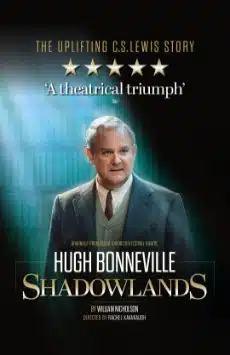
What happens in Shadowlands?
C.S. Lewis — known to his friends as Jack — is in his mid-fifties when the play opens. He is a celebrated Oxford don, a Christian apologist whose books have made him an internationally known voice on faith and suffering, and the author of The Chronicles of Narnia, then near the end of their composition. He lives quietly with his older brother Warnie in The Kilns outside Oxford. His life is ordered, intellectual, settled, and devout.
The American fan
Among Lewis's many correspondents is an American poet called Joy Davidman — younger, divorced, Jewish-born and recently converted to Christianity in large part through reading Lewis. They have been writing letters. When Joy arrives in Oxford with her young son Douglas, she and Lewis meet for the first time. The play tracks the slow, mutual, slightly embarrassed recognition that something has happened between them that neither of them was looking for.
The marriage of convenience
Joy's American immigration status comes under threat. Lewis agrees to a civil marriage to allow her to stay in Britain — initially, as he tells his appalled brother and Oxford friends, in name only. The Oxford common rooms react with the precise mixture of prurience and disapproval the script enjoys puncturing. Then Joy is diagnosed with cancer.
The real marriage
Faced with her illness and the prospect of losing her, Lewis recognises that what began as a kindness has become something else. They marry again, this time religiously, at her hospital bedside. The cancer goes briefly into remission. They have a few years of unexpected, deeply loved life together. Joy dies in 1960.
A Grief Observed
The play's closing movement draws heavily on the book Lewis wrote after Joy's death — A Grief Observed, originally published under the pseudonym N.W. Clerk. Bonneville's final scenes ask the question that has haunted Lewis's apologetic writing all his career: if the Christian account of suffering is true, why does it feel like this? The play does not give him an answer. It is, in its quiet way, one of the more honest pieces of theatrical writing about grief in the English language.
How Shadowlands became a modern West End classic
William Nicholson and the BBC television original
Shadowlands began as a 1985 BBC television film written by William Nicholson, starring Joss Ackland as Lewis and Claire Bloom as Joy. It won a BAFTA and an Emmy. Nicholson — who would later co-write Gladiator and Elizabeth: The Golden Age — adapted the script for the stage in 1989, where it opened at the Queen's Theatre with Nigel Hawthorne as Lewis. That production won the Evening Standard Best Play award and transferred to Broadway with a Tony nomination.
The 1993 film
Richard Attenborough directed a 1993 feature film adaptation starring Anthony Hopkins and Debra Winger, which won the BAFTA Award for Outstanding British Film and received two Academy Award nominations. For many people of a certain generation, the Hopkins/Winger film is Shadowlands; the 2026 revival was the first time many audience members had seen the play performed live.
Chichester 2019
The current production was first staged at Chichester Festival Theatre in 2019, directed by Rachel Kavanaugh, with Hugh Bonneville as Lewis. It played a sold-out limited season. Plans for a London transfer were interrupted by the pandemic and other commitments; the Aldwych run finally arrived seven years later, in February 2026.
The Aldwych production
The 2026 West End revival was directed by Rachel Kavanaugh, designed by Peter McKintosh, with lighting by Howard Harrison, sound by Fergus O'Hare, music by Catherine Jayes, and movement by Georgina Lamb. Casting was by Annelie Powell CDG and Jim Carnahan. The role of Joy's 8-year-old son Douglas was shared by Ayrton English, Nathan Jago and Louis Wilkins.
About the real C.S. Lewis and Joy Davidman
Clive Staples Lewis (1898–1963) was a Belfast-born Oxford academic, literary critic, novelist and Christian apologist. He is best known to general readers for The Chronicles of Narnia (1950–56) and to scholars for The Allegory of Love and A Preface to Paradise Lost. He met Joy Davidman, an American poet and convert to Christianity, in 1952 and married her — first civilly in 1956, then religiously in 1957. She died of cancer in 1960. He wrote A Grief Observed in the months following her death and died three years later himself, on 22 November 1963, the same day as the assassination of John F. Kennedy.
The Aldwych Theatre
The Aldwych Theatre on Aldwych, just east of Drury Lane, dates from 1905 and was for decades the London home of the Royal Shakespeare Company. It is the theatre where Hugh Bonneville saw his first Shakespeare — Peter Brook's legendary 1970 RSC A Midsummer Night's Dream — which made the venue a meaningful one for him to return to with this production.