What happens in The Weir?
A wet, windy autumn night on the north-west coast of Ireland. Jack, a local mechanic who runs a garage that's been bypassed by the main road, comes into Brendan's pub as he does every evening. Jim, an odd-job man who lives with his elderly mother, is already there. The conversation is the conversation of men who have had this conversation many times before.
The blow-in
Finbar — the closest thing the area has to a successful local — arrives with a guest: Valerie, a Dubliner in her thirties who has just moved into the old Nealon place down the road. Finbar has been showing her the area. Her arrival is, in the play's careful local terminology, that of a "blow-in," and the men are visibly conscious of having to perform civility for a stranger and a woman both.
The ghost stories
Drink is taken. Stories are told. Each man in turn offers an account of an encounter with the supernatural — a fairy fort that was disrespected, a knocking that came in the middle of the night, a graveyard sighting. The stories are partly competitive, partly an inheritance of a folklore that the men half-believe and half-treat as comedy. Each is more carefully told than the last; each pulls the temperature of the room a little tighter.
Valerie's story
And then Valerie tells hers. Hers is not folklore. Hers is a recent personal loss — a child, a phone call she may or may not have received afterwards — and it is the moment the play reveals what it has been preparing the audience for all evening. The men, having spent an hour and a half being asked to entertain her with ghost stories, are abruptly required to listen to something for which they have no equivalent reply.
The final beats
What McPherson does with the last ten minutes of the play is what gives The Weir its reputation. Jack stays behind after the others have left and tells Valerie his own story — not a ghost story but a regret — and the two of them, the play's two genuinely solitary people, share a small moment of connection that the play does not over-press. There is no resolution. There is, just, a recognition that hope is possible. It is one of the most quietly affecting closing scenes in late twentieth century Irish drama.
How The Weir became a modern Irish classic
Conor McPherson at twenty-five
McPherson was twenty-five when The Weir premiered at the Royal Court's temporary home at the Ambassadors Theatre in 1997. The Court was undergoing refurbishment at Sloane Square; The Weir was originally programmed for the smaller studio space and was extended several times before transferring to the West End for a two-year commercial run. McPherson had written several monologue plays before — This Lime Tree Bower, St Nicholas — and The Weir's combination of monologue-storytelling within a naturalistic ensemble drama was a structural refinement of what he had been doing all along.
The 1998–99 awards run
The play won the Evening Standard Award and the Critics' Circle Award for Best New Play in 1998, followed by the Olivier Award for Best New Play in 1999. It was the year McPherson became one of the most internationally produced new Irish playwrights of his generation. Subsequent works — Port Authority, Shining City, The Seafarer, The Veil, Girl from the North Country (the Bob Dylan musical), The Brightening Air — have kept him near the centre of British and Irish theatre.
The 2013 Donmar revival
The Weir's first major London revival came in 2013 at the Donmar Warehouse, directed by Josie Rourke and starring Brian Cox as Jack. That production was widely admired for its intimacy — the Donmar's smaller scale suiting the play's pub-bound dimensions — and confirmed The Weir's status as a play that travels well across casts and venues. The Guardian's review called it a study in the persistence of the supernatural in a modern materialist Ireland.
The 2025 Dublin and London revival
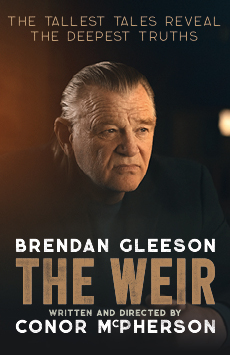
The decision to bring McPherson back to direct his own play, with Brendan Gleeson as Jack, was announced in early 2025. The production opened at the 3Olympia Theatre in Dublin — Gleeson's home city, and the venue where he began his stage career — before transferring to the Harold Pinter Theatre in London for a strictly limited 12-week run from mid-September to 6 December 2025. The full company was Brendan Gleeson, Kate Phillips, Owen McDonnell, Seán McGinley, and Tom Vaughan-Lawlor. Rae Smith designed.
The film adaptation
Principal photography on a film adaptation of The Weir began in Ireland on 13 February 2026. McPherson is directing the screen version, with the stage cast reprising their roles. UK distribution has been secured by Curzon; Ireland by Break Out Pictures. An expected festival or theatrical release is anticipated in 2027. The Weir has had previous proposed screen adaptations over the years; this is the first to actually go into production.