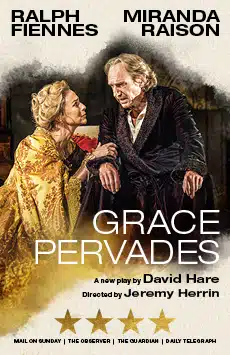
What happens in Grace Pervades?
The play unfolds across 25 scenes spanning 24 years, from Henry Irving's first season as manager of the Lyceum Theatre in 1878 to his death in 1905. Title cards announce the year and location of each scene — Boston in 1883, Hamburg in 1904, Kent in 1922 — and the narrative moves between the public triumphs of the Lyceum and the private compromises of the people who made it happen.
The Lyceum partnership
Irving, already a leading actor, becomes manager of the Lyceum and recruits Ellen Terry to be his leading lady. The play opens as their professional partnership begins. Where Irving is taciturn, mannered, and obsessed with the dignity of theatre, Terry is luminous, witty, and dismissive of his pretensions. Their early scenes together are some of Hare's funniest writing in years. Terry teaches Irving to look his fellow actors in the eye; Irving teaches Terry the discipline of repertoire. Hare suggests, without quite stating, that the partnership was also a romantic one — and that the romance ended long before the professional collaboration did.
The cost of the Lyceum
Irving's tenure at the Lyceum was financially catastrophic. He spent extravagantly on staging — historically accurate sets, full orchestras, hundreds of costumes — and the company was always one season away from collapse. Hare gives this material its proper weight: Irving's artistic obsession is real and admirable, but the people around him bear the cost. Terry, who could have been working anywhere, gives him the best two decades of her career. The play earns its sympathy for Irving without pretending he was easy to live with.
Terry's children: Edith and Edward Gordon Craig
The play's second strand follows Terry's two illegitimate children with the married designer Edward William Godwin. Edward Gordon Craig (Jordan Metcalfe) declares himself a genius, refuses to compromise, and goes on to influence Konstantin Stanislavski (Guy Paul) and the entire modernist theatre tradition while accomplishing relatively little of his own. Edith Craig (Ruby Ashbourne Serkis) stages feminist plays, builds a queer creative community in Kent, and quietly does more useful work than her brother. The Craig children represent the future that Irving's Lyceum refused to acknowledge — and Hare clearly knows whose side history was on.
The end of the era
Irving dies in Bradford in 1905, after performing in The Bells the night before in Wolverhampton — the play that had made his name three decades earlier. Terry outlives him by twenty-three years, dying at home in Smallhythe in 1928 at the age of eighty. Edith Craig founded the museum at Smallhythe Place that still preserves Terry's costumes and papers. Edward Gordon Craig lived until 1966. The play's epilogue, set in Kent in 1922, brings the strands together in one of Hare's most quietly moving final scenes.
What the play is really about
Beneath the biography, Grace Pervades is asking a question: what is the theatre actually for? Irving thinks it's everything. Terry's son Edward thinks it's vanity. Terry herself is too busy living to bother answering. Hare doesn't resolve the question, but he gives each character their best version of the argument, and lets the audience choose. For anyone sitting in the Theatre Royal Haymarket — itself a Georgian theatre Irving played in — the question lands with particular force.
How Grace Pervades got here
The Bath premiere (2025)
Grace Pervades premiered at the Theatre Royal Bath in summer 2025 as part of the Ralph Fiennes / Theatre Royal Bath Season, an ongoing curated programme that has produced several of Fiennes's most acclaimed recent stage performances. The production was a sell-out and prompted an immediate West End transfer announcement. Director Jeremy Herrin and the entire creative team transferred with it; key cast — Fiennes, Raison, Ashbourne Serkis, Metcalfe — reprise their original roles.
The Hare/Fiennes partnership
Ralph Fiennes and David Hare have collaborated repeatedly over the past decade. Hare wrote the screenplay for The White Crow (2018), the biopic of Rudolf Nureyev directed by Fiennes. Fiennes starred in Hare's Straight Line Crazy at the Bridge Theatre and Off-Broadway in 2022, playing the New York urban planner Robert Moses. And in Hare's solo play Beat the Devil (2020), Fiennes — fifteen years Hare's junior — actually played Hare himself, dramatising the playwright's near-fatal experience of COVID. Grace Pervades is the most ambitious project of the partnership to date.
David Hare's 32nd play
Sir David Hare (born 1947) is one of the defining British playwrights of the last fifty years. His earlier work — Slag (1970), Knuckle (1974), Teeth 'n' Smiles (1975), and the National Theatre's Plenty (1978) — established him as a state-of-the-nation writer with a sharp political edge. His later plays — The Secret Rapture, the Trilogy (Racing Demon, Murmuring Judges, The Absence of War), Skylight, Amy's View, The Vertical Hour, The Power of Yes, Stuff Happens, and now Straight Line Crazy and Grace Pervades — have made him the chief chronicler of post-war British and American public life. He was knighted in 1998.
Irving, Terry, and the Lyceum
Sir Henry Irving (1838–1905) was the first English actor to be knighted (1895) and the dominant figure of the late-Victorian stage. He took over management of the Lyceum Theatre in 1878 and ran it until 1902, mounting lavish productions of Shakespeare and Victorian melodrama with Ellen Terry as his leading lady. His most famous role was Mathias in Leopold Lewis's The Bells, which he played hundreds of times.
Ellen Terry (1847–1928) was the most loved and highest paid actress in England, and a major influence on the next generation of stage performers (including her great-nephew John Gielgud — to whom Fiennes himself was often compared early in his career). Her Lady Macbeth, immortalised in John Singer Sargent's famous 1889 painting wearing the iridescent "beetlewing" dress, remains one of the great images of Victorian theatre. The dress itself, restored in 2011, is preserved at Smallhythe Place in Kent — the museum founded by her daughter Edith Craig.
The Craig children and twentieth-century theatre
Edith Craig (1869–1947) and Edward Gordon Craig (1872–1966) were Ellen Terry's children with the architect-designer Edward William Godwin. Edward Gordon Craig became one of the most influential theatre theorists of the twentieth century, despite directing very few productions himself; his treatise The Art of the Theatre (1905) shaped modernist staging from Stanislavski to Brecht. Edith Craig was a director, costume designer, and feminist activist who staged hundreds of plays and built a queer artistic community at Smallhythe. The play treats the siblings with the affection and exasperation they probably deserve.
The Hare/Teeth 'n' Smiles coincidence
The 2026 West End is hosting an unusual David Hare moment: Grace Pervades at the Haymarket and a 50th anniversary revival of his 1975 play Teeth 'n' Smiles at the Duke of York's, less than ten minutes' walk apart. The two productions run alongside each other from late April through early June. Most major critics have reviewed them together, and the contrast — angry young Hare vs reflective late-career Hare — has become part of the conversation around both shows.
Performance schedule
- Booking period: 24 April – 11 July 2026 (12-week limited season)
- Press night: 30 April 2026
- Running time: Approximately 2 hours 30 minutes, including one 20-minute interval
- Schedule: Confirm specific performance times when booking
Schedule may vary around bank holidays. Confirm specific dates when booking.
Age guidance and content
Recommended for ages 12 and above. Children under 5 are not admitted. Under-16s must be accompanied by an adult.
The play deals with adult themes including infidelity, illegitimate parenthood, financial ruin, and on-stage deaths, but is not graphic. The language is literary and the pacing is unhurried — most younger teenagers will need genuine interest in the subject matter to follow the full 2h 30m.
Tickets and pricing
Grace Pervades tickets range from £25 to £281 depending on seat and performance. Saturday evenings and premium Stalls/Royal Circle seats sit at the higher end. The production runs an excellent 16-24 ticket scheme at £25 — these can only be purchased by 16-24 year-olds, all attendees must be in that age range, tickets must be collected at the box office with valid photo ID from 60 minutes before the performance, and maximum 2 per booking. Day-seat and rush availability varies by performance.
Cast
- Ralph Fiennes as Sir Henry Irving
- Miranda Raison as Ellen Terry
- Ruby Ashbourne Serkis as Edith Craig
- Jordan Metcalfe as Edward Gordon Craig
- Guy Paul as Konstantin Stanislavski
- Youness Bouzinab
- Giulia Innocenti
- Tom Kanji
- Saskia Strallen
Cast information correct at time of publication and subject to change. Confirm current cast on the official Grace Pervades website.
Creative team
- Writer: David Hare
- Director: Jeremy Herrin
- Set design: Bob Crowley
- Costume design: Fotini Dimou
- Lighting design: Peter Mumford
- Sound design: Elizabeth Purnell
- Video design: Akhila Krishnan
- Composer: Paul Englishby
- Wigs, hair and make-up: Susanna Peretz
- Movement director: Lucy Cullingford
- Casting director: Jessica Ronane CDG
Getting there
- Tube: Piccadilly Circus (Piccadilly, Bakerloo) — 3 minute walk; Charing Cross (Bakerloo, Northern) — 5 minute walk; Leicester Square (Piccadilly, Northern) — 5 minute walk; Embankment (District, Circle) — 8 minute walk
- Mainline rail: Charing Cross — 5 minute walk
- Bus: Routes along Haymarket include 3, 6, 9, 12, 13, 15, 19, 23, 38, 53, 88, 139, 159
- Night buses: 6, 12, 23, 88, 139, 453, N8, N19, N38, N97, N3, N13, N15, N136, N159
- Parking: Q-Park Whitcomb Street — 2 minute walk; Leicester Square NCP — 5 minute walk
About the Theatre Royal Haymarket
The Theatre Royal Haymarket is one of London's oldest and most prestigious theatres. The current Grade I-listed building, designed by John Nash, opened in 1821 — though a theatre has stood on the site since 1720. Its handsome Corinthian portico is one of the West End's most recognisable architectural features. The venue has hosted some of the greatest names in English theatre history, including — as it happens — Henry Irving himself, who performed here regularly in the 1860s before becoming actor-manager at the Lyceum. The 888-seat auditorium retains its Georgian atmosphere with excellent sightlines throughout.
Accessibility
The Theatre Royal Haymarket offers wheelchair-accessible seating in the Stalls (limited spaces — book in advance), hearing assistance systems via infrared, accessible toilets, and trained staff. The theatre is a Grade I-listed Georgian building (1821) with some access limitations — including stairs to certain seating levels. Contact the venue access line in advance to discuss specific requirements.
Producers
The West End production is presented by Theatre Royal Bath Productions (the producing company behind multiple Ralph Fiennes Bath transfers), Access Entertainment (the production company of Sir Leonard Blavatnik and Danny Cohen, also behind The Lehman Trilogy and the National Theatre's The Inheritance), and Jeremy Herrin's own company Second Half Productions.