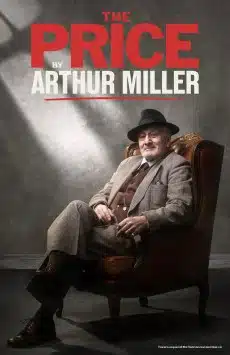
What happens in The Price?
The Price takes place entirely in a single afternoon in the attic of a condemned New York brownstone, among the accumulated possessions of the Franz family — furniture, objects, and memories that have been sitting undisturbed for years. Victor Franz, a New York police officer approaching fifty and eligible for retirement, has arranged to sell the furniture. His wife Esther has come with him. The furniture dealer who has agreed to appraise the lot is Gregory Solomon, a 90-year-old man of formidable energy and enigmatic intent.
The brothers meet
Walter Franz, Victor's brother and a successful surgeon, arrives unexpectedly. The two men have not spoken in sixteen years. The proximate cause of their estrangement runs deeper than the family's financial collapse during the Depression: Victor gave up his ambitions and his chance at education to support their father, while Walter left, built a career, and became wealthy. The furniture sale becomes the occasion for relitigating that decision — not to reverse it, but to establish, once and for all, what it actually meant.
The first act: Solomon's show
Much of the first act belongs to Gregory Solomon, who arrives with a battered briefcase, a hard-boiled egg, and a lifetime of accumulated pragmatism. His negotiation with Victor over the value of the furniture is comedic on the surface — Solomon is by turns vaudevillian and piercing — but Miller uses it to introduce the play's central question: how much is anything actually worth, and who decides? Solomon has lived through a century of loss and come out the other side still functioning. His presence is a reminder that most things survive.
The second act: the reckoning
With Solomon in the background, the second act focuses on the confrontation between Victor and Walter. Walter has come partly to offer Victor money, partly with a project of revisionism: the story of their father's helplessness, Walter argues, was exaggerated. The money could have been found. Victor's sacrifice wasn't necessary. What he gave up, he gave up for nothing. Whether Walter is right — and Miller declines to say definitively — becomes less important than what Victor chooses to do with the information. Cowan's Victor understands, by the end, how he has allowed himself to be manipulated for decades. The question is whether understanding changes anything at all.
The ending
The closing image is Solomon's: left alone with the furniture after the brothers leave, he puts on an old record and laughs. It is one of Miller's most ambiguous endings — a laugh that could be pleasure, absurdity, relief, or simple persistence. In a play about the weight of the past, the old man who has outlasted it all gets the final word.
Arthur Miller and The Price
A response to the avant-garde
Miller wrote The Price in 1967 as a deliberate counter to the direction he felt theatre was taking. The late 1960s saw the rise of absurdist drama and theatrical experimentation, and Miller was sceptical. He wanted to write a play that was entirely conventional in form — single setting, continuous action, naturalistic dialogue — and use that conventionality to ask genuinely difficult questions. The result was The Price: four characters, one room, one afternoon, no escape.
The Depression as subject
The play's backstory is rooted in the 1929 Wall Street Crash and the Great Depression that followed. Victor Franz's decision to give up his ambitions and support his father is a decision shaped by that catastrophe — a sense that financial security, once lost, could never be fully trusted again. Miller saw the Depression not merely as an economic event but as a formative psychological experience for an entire generation of Americans, producing a particular kind of fearfulness and self-sacrifice that persisted long after the emergency ended. The Price is his examination of what that legacy cost.
The play in context
The Price premiered on Broadway in February 1968, directed by Ulu Grosbard, and ran for 429 performances — a solid run that nonetheless failed to generate the critical excitement of Miller's earlier work. The play was nominated for two Tony Awards but lost Best Play to Tom Stoppard's Rosencrantz and Guildenstern Are Dead, a loss that perhaps reinforced the sense that Miller's conventional approach felt dated at a moment when Stoppard's theatrical games felt urgent. In subsequent decades, as the fashions shifted, The Price has been increasingly reassessed. A 2019 revival at Wyndham's Theatre, starring David Suchet, drew strong reviews and renewed interest in the play.
Miller on the American Dream
Like all of Miller's major work, The Price is a drama about the American Dream — specifically, about what happens when the Dream's central promise (that sacrifice and hard work will be rewarded) turns out to be false. Victor sacrificed and wasn't rewarded. Walter refused to sacrifice and succeeded. The play refuses to make this a simple moral lesson. Victor's sacrifice was real and his resentment is legitimate, but Miller also shows how it may have been partly a choice — a way of avoiding the risks of ambition by clinging to the security of duty. The furniture sale strips away the last cover.
Gregory Solomon
The character of Gregory Solomon is one of Miller's most remarkable creations — an 89-year-old Jewish furniture dealer whose sheer vitality is a rebuke to the brothers' paralysis. Solomon has survived the same Depression, the same century, and remained functional. He doesn't agonise over the price of things: he names a figure and moves on. Miller uses him partly as a comic counterweight to the brothers' heaviness, and partly as a living argument that the past doesn't have to be definitive. His final laugh is the play's most hopeful note — and its most equivocal.
Performance schedule
- Final performance: 7 June 2026
- Evenings: Tuesday to Friday, 7:30pm
- Matinees: Saturday and Sunday, 2:30pm
- Running time: Approximately 2 hours 30 minutes, including one interval
The schedule may vary — confirm your specific date when booking. The run is strictly limited; advance booking is strongly recommended.
Age guidance and content
Recommended for ages 14 and above. Children under 16 must be accompanied by and seated next to a ticketholder aged 18 or over.
The Price deals with themes of family resentment, financial failure, self-deception, and the cost of choices made under pressure. There is no graphic content, but the emotional intensity is real and the play demands sustained attention from its audience. It is not recommended for younger children.
Cast
- Henry Goodman as Gregory Solomon (two-time Olivier Award winner: Assassins, The Merchant of Venice; other credits include The Resistible Rise of Arturo Ui, Fiddler on the Roof, Yes Prime Minister)
- Elliot Cowan as Victor Franz (A Little Life, 2:22 A Ghost Story)
- John Hopkins as Walter Franz (Dr Strangelove, The 39 Steps)
- Faye Castelow as Esther Franz (Leopoldstadt, After the Dance)
Cast information correct at time of publication and subject to change.
Creative team
- Writer: Arthur Miller
- Director: Jonathan Munby
- Designer: Jon Bausor
- Sound: Max Pappenheim
Tickets and pricing
Tickets start from £30, with a range up to £94 depending on seat location and performance. Group discounts of 10 or more are available for Tuesday to Thursday evening performances — contact the box office directly for group rates.
Getting there
- Tube: Baker Street (Bakerloo, Jubilee, Hammersmith & City, Circle, Metropolitan lines) — 5 minute walk east along Marylebone Road, then south on Park Road
- Alternative tube: Regent's Park (Bakerloo line) — 5 minute walk south
- Train: London Marylebone station — approximately 10 minute walk
- Bus: Routes 13, 113, 139, 189, 274, N113 stop nearby
- Parking: The theatre is outside the congestion zone; street parking and nearby car parks on Park Road
About Marylebone Theatre
Marylebone Theatre opened in 2022 within the historic Rudolf Steiner House, a distinctive 1920s building just north of Oxford Street. The venue seats approximately 270 across a proscenium-arch auditorium and has quickly developed a reputation for staging work of exceptional quality at competitive prices. In its short history it has won praise from critics for consistently delivering productions of a calibre more often associated with larger subsidised venues. The Price is among its most acclaimed productions to date.
Accessibility
Marylebone Theatre offers step-free access from the main entrance, one designated wheelchair space (seat N5) with an adjacent companion seat (N4), and accessible toilet facilities. If you wish to transfer out of your wheelchair, the accessible space is not on an aisle — contact the box office on 020 7723 7984 or email boxoffice@marylebonetheatre.com in advance to discuss the best options for your visit.
Producers
The Price is presented by Marylebone Theatre, Patrick Myles and David Luff, Alexander "Sandy" Marshall, in association with Anthology Theatre and Tulchin Bartner Productions.