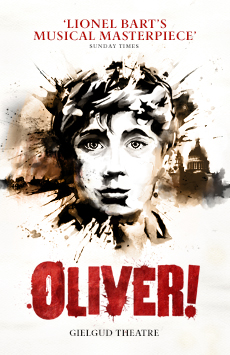
What happens in Oliver!?
Oliver! is set in 1830s England and faithfully follows the spine of Charles Dickens' Oliver Twist, distilled into one of the most loved British musical scores ever written. The show opens in a brutal Victorian workhouse and ends with one of musical theatre's most affecting reunions. In between are some of the most singable songs in the canon.
The workhouse
Nine-year-old Oliver Twist has been raised in a parish workhouse run by the appalling Mr Bumble and Widow Corney. The orphans are fed thin gruel and treated with calculated cruelty. After the famous "Food, Glorious Food" opening — a number that finds genuine pathos in starving children fantasising about a proper meal — Oliver draws the short straw and asks for more. The crime is unthinkable. He is sold off to the local undertaker, Mr Sowerberry.
Sowerberry's funeral parlour
Oliver's brief apprenticeship to the Sowerberrys is no improvement. He sleeps among the coffins, is bullied by their senior apprentice Noah Claypole, and finally — after Noah insults Oliver's dead mother — fights back. The Sowerberrys lock him in a coffin overnight. He escapes the next morning and sets out on foot for London, sustained by little more than determination and Lionel Bart's score.
Fagin and the Dodger
On the road to London, Oliver meets the Artful Dodger, a precocious, swaggering young pickpocket dressed in a battered top hat far too large for him. The Dodger offers Oliver a place to sleep ("Consider Yourself") and brings him back to the East End hideout of Fagin, the ageing fence and pickpocket-master who runs a "school" of child thieves. The first act's centrepiece is Fagin's lesson — "You've Got to Pick-a-Pocket or Two" — and the show's most explosive full-company sequence in the streets of Clerkenwell.
Nancy, Bill Sikes and Mr Brownlow
Fagin's gang is loosely connected to the criminal Bill Sikes, a violent burglar, and to Sikes's lover Nancy — a tough, big-hearted young woman who has grown up in the underworld and adores both Sikes and the boys. Oliver's first pickpocketing expedition with the Dodger goes wrong: he is wrongly accused, arrested, then taken in by Mr Brownlow, the kind elderly gentleman who was robbed. For the first time in his life, Oliver experiences kindness, cleanliness, and a real home. The first act ends with Nancy and her friends in the Three Cripples pub ("Oom Pah Pah"), and with Sikes determined to recover Oliver before he can identify the gang to the police.
"As Long As He Needs Me"
The second act centres on Nancy. Forced by Sikes to recapture Oliver, she begins to realise the cost of her loyalty — Sikes' violence is escalating, the boy in her care is in real danger. Her great song "As Long As He Needs Me", one of the most demanding numbers in the musical-theatre soprano-belt canon, is the show's emotional core: a woman who knows she is in an abusive relationship and has chosen it anyway, and is now confronting whether that choice can be extended to a child. Eventually she resolves to get Oliver back to Mr Brownlow.
The ending
The final scenes — Nancy's confrontation with Sikes, the bridge sequence, Sikes's pursuit of the boys, the climactic chase across London Bridge, and the final reunion of Oliver with Mr Brownlow — are some of the most cinematic in any West End musical. The production handles the violence faithfully but never gratuitously. Fagin, ever the survivor, is left with his ambiguous final number, "Reviewing the Situation" — a song that asks whether redemption is possible for a man who has lived by theft and exploitation, and refuses to answer.
How Oliver! got here
Dickens, 1838
Oliver Twist was Charles Dickens' second novel, serialised in Bentley's Miscellany between 1837 and 1839 and published in three volumes in 1838. Drawing on Dickens' own experiences as a 12-year-old in a London blacking factory, it was the first English-language novel to take a child as its central character and the first to depict the lives of the urban Victorian poor with anything approaching realism. The figures of Fagin, the Artful Dodger, Nancy and Bill Sikes have been part of the English cultural imagination ever since. The novel has been adapted for stage and screen continuously since 1838 — most famously in David Lean's 1948 film with Alec Guinness as Fagin.
Lionel Bart, 1960
Lionel Bart (1930–1999) was an East End-born songwriter, the son of Jewish Galician immigrants, who had already had hits with Tommy Steele and Cliff Richard when he turned to Dickens. Working as composer, lyricist and librettist (a triple credit unusual in musical theatre then or since), Bart adapted the novel into Oliver! in 1960. The show opened at the New Theatre (now the Noël Coward) on 30 June 1960, directed by Peter Coe with Ron Moody as Fagin and Georgia Brown as Nancy. It ran for 2,618 performances, transferred to Broadway in 1963 where it won three Tony Awards, and inspired Carol Reed's six-time Oscar-winning 1968 film. Bart sold the rights at a financial low point in the 1970s; Cameron Mackintosh later bought them back.
The 1994 Palladium revival
Cameron Mackintosh first produced Oliver! in revival at the London Palladium in 1994, directed by Sam Mendes — a production widely credited with rediscovering the show's stagecraft potential. Jonathan Pryce played Fagin, Sally Dexter played Nancy. It ran for two and a half years and re-established Oliver! as a flagship British musical of its era. Matthew Bourne first joined the Mackintosh / Oliver! creative team as choreographer at this stage.
The 2008 Drury Lane revival
Mackintosh's 2008 revival at the Theatre Royal Drury Lane, directed by Rupert Goold and choreographed by Bourne, starred Rowan Atkinson as Fagin and the BBC talent-show winner Jodie Prenger (selected via Andrew Lloyd Webber's I'd Do Anything) as Nancy. It ran for over two years and included a 50th-anniversary performance in 2010 with the original Fagin Ron Moody joining the cast for the finale. Bourne would continue to work on the choreography for over thirty years total.
Chichester 2024 — the new production
The current revival began life as a co-production with Chichester Festival Theatre, opening there in summer 2024 as part of the theatre's main-house season. Cameron Mackintosh "fully reconceived" the show with Matthew Bourne now directing as well as choreographing — a first for Bourne on a Mackintosh musical of this scale. Co-director Jean-Pierre van der Spuy, designer Lez Brotherston, lighting designers Paule Constable and Ben Jacobs, sound designer Adam Fisher, and video designer George Reeve completed the creative team. Stephen Metcalfe adapted William David Brohn's original orchestrations for a 12-piece pit band. The Chichester run was, in Mackintosh's words, "the biggest success in that theatre's history" — a complete sell-out before previews ended.
The Gielgud transfer and the awards
The production transferred to the Gielgud Theatre (a Delfont Mackintosh house) on 14 December 2024, with most of the Chichester company intact. The London opening was, in a near-historic departure from West End norms, almost entirely sold out before press night. Press night on 15 January 2025 delivered a near-clean-sweep of five-star reviews. The production won the 2025 WhatsOnStage Award for Best Musical Revival and received four Olivier nominations: Best Musical Revival, Best Actor in a Musical (Simon Lipkin), Best Theatre Choreographer (Matthew Bourne), and Best Set Design (Lez Brotherston). The run has now been extended four times — initially to March 2026, then October 2026, then March 2027.
The second-year cast change
In December 2025 / January 2026 the production renewed most of its principal cast for a second year, with two key changes: Ava Brennan (Hamilton, Les Misérables) replaced the acclaimed Shanay Holmes as Nancy, and Aaron MacGregor took over from Billy Jenkins as the Artful Dodger. Simon Lipkin (Fagin), Aaron Sidwell (Bill Sikes), Philip Franks (Mr Brownlow), Oscar Conlon-Morrey (Mr Bumble), Katy Secombe (Widow Corney) and the remainder of the principal company stayed. Lipkin has now been in the role for over a year — a long run for an Olivier-nominated lead in a role this demanding.
Performance schedule
- Dates: 14 December 2024 – 14 March 2027 (currently booking; extended four times)
- Press night: 15 January 2025
- Running time: Approximately 2 hours 40 minutes, including one interval
- Schedule: Tuesday–Saturday at 7.30pm; Wednesday and Saturday matinees at 2.30pm; periodic Sunday matinees at 3pm. No Monday performances. Confirm exact times when booking — Sunday performances vary.
Group, education and family discounts
- Education rate (Grand Circle): Tickets up to £85 reduced to £29.50 plus one free teacher place per 10 students, Tuesday–Thursday evenings
- Education rate (Grand Circle, midweek matinees): Seats reduced to £32.50 plus one free teacher place per 10 students
- Accelerator rate (10+): Stalls/Dress Circle up to £99.50 reduced to £57.50 for Tuesday–Thursday evenings (book and pay by 17 July 2026)
- Bands A & B (10+): Reduced to £65 for Tuesday–Friday evenings and midweek matinees
- Family of 4 ticket: Available in dedicated seating zones, online only, must include at least one person aged 16 or under
Age guidance and content
Recommended for ages 7+. Everyone must have their own ticket; under-16s must be accompanied by and sat next to a ticketholder aged 18 or over. Under-3s will not be admitted. The production contains:
- Mild and period-discriminatory language reflective of the era (1830s)
- Depictions of violence towards men, women and children including domestic violence
- Gunfire and smoke effects
- Themes of poverty, child labour, hunger, and crime in Victorian society
- The death of a major character (faithful to Dickens' novel)
- Pickpocketing and theft depicted as central plot mechanic
Tickets and pricing
Oliver! tickets range from £24 (Grand Circle) to £209 (premium Stalls and Dress Circle) depending on seat and performance. Saturday evenings and Friday evenings are at the higher end; Tuesday and Wednesday evenings and weekday matinees offer the best value. Delfont Mackintosh offers a range of "Experience Packages" combining tickets with pre-theatre dining at nearby restaurants — contact the theatre directly to add an experience package to existing tickets.
Principal Cast (second-year company)
- Simon Lipkin as Fagin (Olivier nominated)
- Ava Brennan as Nancy
- Aaron Sidwell as Bill Sikes
- Aaron MacGregor as the Artful Dodger
- Philip Franks as Mr Brownlow
- Oscar Conlon-Morrey as Mr Bumble
- Katy Secombe as Widow Corney
- Stephen Matthews as Mr Sowerberry / Dr Grimwig
- Jamie Birkett as Mrs Sowerberry / Mrs Bedwin
- Oliver Twist — rotating role between three young performers
Originating cast (2024–25)
Shanay Holmes (Nancy), Billy Jenkins (the Artful Dodger), with the remainder of the company as listed above.
Creative team
- Book, music & lyrics: Lionel Bart, freely adapted from Charles Dickens' Oliver Twist
- Produced & revised by: Cameron Mackintosh
- Director & choreographer: Matthew Bourne
- Co-director: Jean-Pierre van der Spuy
- Set design: Lez Brotherston
- Lighting design: Paule Constable & Ben Jacobs
- Sound design: Adam Fisher
- Video design: George Reeve
- Original orchestrations: William David Brohn
- Orchestral adaptation: Stephen Metcalfe
- Music supervision & conductor: Graham Hurman
- Casting: Felicity French CDG & Paul Wooller CDG
- Children's casting: Verity Naughton CDG
Getting there
- Tube: Piccadilly Circus (Piccadilly, Bakerloo) — 3 minute walk; Leicester Square (Northern, Piccadilly) — 5 minute walk; Tottenham Court Road (Central, Northern, Elizabeth) — 8 minute walk; Oxford Circus (Bakerloo, Central, Victoria) — 8 minute walk
- Mainline rail: Charing Cross — 10 minute walk
- Bus: Routes 14, 19, 38 stop directly on Shaftesbury Avenue; many additional routes nearby on Piccadilly and Regent Street
- Parking: Q-Park Chinatown (3 min walk); Q-Park Soho (4 min walk); on-street parking heavily restricted
About the Gielgud Theatre
The Gielgud Theatre opened in 1906 as the Hicks Theatre, named after the Edwardian actor-manager Seymour Hicks who commissioned it. Designed by W.G.R. Sprague (who also designed the Wyndham's, Aldwych and Strand theatres), it sits on Shaftesbury Avenue in the heart of theatreland. Renamed the Globe in 1909 to avoid confusion, it was renamed again in 1994 in honour of Sir John Gielgud — partly to prevent confusion with Shakespeare's Globe on Bankside. With approximately 994 seats across Stalls, Royal Circle and Grand Circle, it is one of the most elegant Edwardian houses in the West End. It is owned and operated by Delfont Mackintosh Theatres, Cameron Mackintosh's theatre-owning arm (which also runs the Wyndham's, Noël Coward, Prince Edward, Prince of Wales, Sondheim, Victoria Palace and Novello). The theatre is Grade II-listed.
Accessibility
The Gielgud Theatre offers wheelchair-accessible seating in the Stalls, hearing assistance via infrared system, accessible toilets, and trained staff. The theatre is a Grade II-listed Edwardian building (1906) with stairs to Royal Circle and Grand Circle levels. The Delfont Mackintosh access line is the contact point in advance of booking — they can confirm wheelchair-accessible seating availability, audio-described and captioned performance dates, and any specific access requirements. Companion seats are available at no extra charge for ticketholders with eligible access needs.
Producers
The production is produced by Cameron Mackintosh Ltd — the producing arm of one of the most influential figures in the modern history of musical theatre, whose other current credits include Les Misérables, The Phantom of the Opera, Hamilton (UK), Mary Poppins, and Miss Saigon. The production originated as a co-production with Chichester Festival Theatre under artistic director Justin Audibert. The Gielgud Theatre is operated by Delfont Mackintosh Theatres, Mackintosh's theatre-owning arm.