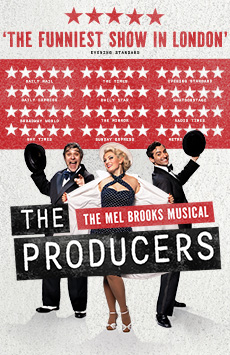
What happens in The Producers?
It's 1959, and Broadway producer Max Bialystock is washed up. His latest opus — Funny Boy, a musical based on Hamlet — bombs during its opening number. Max pays the rent by seducing little old ladies for "investment" cheques he never uses on actual productions. Enter Leo Bloom, a meek accountant from Whitehall & Marks sent to audit Max's books.
The premise
Going over Max's chaotic accounts, Leo realises something curious: a producer could theoretically make more money from a flop than a hit. Raise far more than you need, ensure the show closes on opening night, pocket the difference, and the IRS never asks questions. Max seizes on the idea. He bullies a panicked Leo into joining him as his partner. Their plan: find the worst script ever written, the worst director in New York, the worst possible cast, and raise two million dollars to put it on.
The worst script in the world
They find their script in Springtime for Hitler: A Gay Romp with Adolf and Eva at Berchtesgaden, written by an unrepentant German nationalist named Franz Liebkind who keeps pigeons on a Greenwich Village rooftop and still wears his old uniform. Max and Leo flatter, cajole and finally pressure Liebkind into signing over the rights. The first act builds methodically: their worst director (the gloriously camp Roger DeBris), their worst cast (a hippie called LSD as Hitler), their Swedish bombshell secretary Ulla, and the steady accumulation of cheques from Max's little old ladies, set to one of the funniest numbers in the show, "Along Came Bialy".
Opening night
The end of the first act is the gloriously offensive showstopper itself: Springtime for Hitler, the staging within the staging. Goose-stepping chorines, a dancing swastika formation, Roger DeBris stepping in as Hitler at the last moment in full sequined fabulousness. Max and Leo, watching from the back of the house, are horrified for all the wrong reasons: the audience isn't walking out. They're laughing. They think it's brilliant satire.
The aftermath
The second act is Max and Leo realising they have a smash hit on their hands and owe their investors two million dollars they spent on a Rolls-Royce. The plot accelerates into farce: a courtroom showdown, a stint in prison, a desperate attempt by Leo to recover the money by running away to Rio with Ulla. The act builds to one of musical theatre's most affectionate buddy-reconciliations — "'Til Him", the homage to Hello, Dolly!'s "It Only Takes a Moment" — before resolving in a final scene that's all the more satisfying for being entirely silly.
What the show is really about
Underneath the gags, The Producers is a love story — between two desperate, unloved men who find in each other the partnership neither has had before. It's also Mel Brooks' most personal piece of writing: a Jewish-American comedian, who served in the US Army in WWII, insisting that the most effective response to fascism is to laugh at it. The Patrick Marber revival foregrounds both: the buddy-romance element is unusually tender, and the satire lands with curious new force in 2026.
Why the show matters
Brooks' 1968 film The Producers won the Academy Award for Best Original Screenplay and established his career as a comedy filmmaker. The 2001 musical, written when Brooks was 75, became the most-Tonyed show in Broadway history (12 wins from 15 nominations). The 2004 London production transferred to Drury Lane and won the Olivier for Best New Musical. This 2026 revival — the first in nearly 20 years — has been nominated for four Oliviers including Best Musical Revival. Few shows have such a continuous trail of awards and acclaim.
How The Producers got here
The 1968 film
The Producers began as a low-budget independent film, written and directed by Mel Brooks — his directorial debut — and starring Zero Mostel as Max Bialystock and Gene Wilder as Leo Bloom in his breakthrough screen role. Released in November 1968, it was initially a commercial disappointment and divided critics. Some reviewers were horrified by the central comedic premise; others, including Peter Sellers, championed it loudly. Brooks won the 1969 Academy Award for Best Original Screenplay, and the film grew steadily in cult reputation through the 1970s and 1980s, eventually being preserved by the United States National Film Registry as a culturally significant American work. Gene Wilder received an Oscar nomination for Best Supporting Actor.
The 2001 Broadway musical
The musical adaptation was the result of Mel Brooks finally being persuaded — by friends including David Geffen — to turn his film into a stage show. Brooks, then 75, wrote his first Broadway score himself: music and lyrics, with a book co-written by Thomas Meehan (the librettist behind Annie and later Hairspray). It opened at the St. James Theatre on Broadway on 19 April 2001, directed and choreographed by Susan Stroman, starring Nathan Lane as Max Bialystock and Matthew Broderick as Leo Bloom. The reviews were ecstatic. At the 2001 Tony Awards, the show won 12 of its 15 nominations — still the record for any musical — including Best Musical, Best Book, Best Original Score, Best Direction of a Musical, Best Choreography, and acting wins for Lane, Broderick and Cady Huffman as Ulla.
The 2004 London production
The first West End production opened at the Theatre Royal Drury Lane on 9 November 2004, with Lee Evans as Leo Bloom and a rotating Max played first by Nathan Lane reprising the role, then by Brad Oscar, then by Cory English. It won the 2005 Olivier Award for Best New Musical and ran for two years before transferring to a UK tour. The 2,200-seat Drury Lane is a vastly larger venue than the Garrick, and several London critics noted at the time that the show might have played better in a smaller, more intimate house — an instinct that the Menier and Garrick productions have now vindicated.
The 2005 film and the wilderness years
A 2005 film adaptation of the musical, also directed by Stroman and starring Lane and Broderick reprising their roles, was a critical and commercial disappointment despite a heroic supporting turn from Uma Thurman as Ulla. After the closure of the original Broadway run in April 2007 and the London tour in 2008, The Producers was rarely revived. The show was widely felt — including by Brooks himself — to need a different kind of staging than the conventional big-Broadway approach. It took another 17 years to find one.
The 2024 Menier Chocolate Factory revival
Patrick Marber — Tony winner for directing Tom Stoppard's Leopoldstadt, playwright behind Closer and Dealer's Choice, co-creator of Alan Partridge — had never directed a musical when David Babani, artistic director of the Menier Chocolate Factory, approached him with the idea. Marber agreed on conditions: the production would be intimate, non-glossy, would trust the script and score rather than rely on spectacle, and would be cast for comedy rather than vocal power. The 180-seat Menier opened the production in December 2024 with Andy Nyman as Max, Marc Antolin as Leo, and most of the cast now at the Garrick. It sold out instantly, was nominated for an Olivier for its limited Menier run, and a West End transfer was confirmed within weeks.
The 2025 Garrick transfer and 2026 Olivier nominations
The Garrick production opened on 30 August 2025, with press night on 15 September. Reviews were overwhelmingly four-star with several fives; the run has since been extended twice and is now booking to 19 September 2026. American actor Richard Kind — known for Mad About You, Spin City, Curb Your Enthusiasm, and the West End Guys and Dolls — joined for a seven-week visiting season as Max Bialystock ending 6 May 2026, with Andy Nyman returning to the role from 11 May 2026 for the rest of the run. The production received four 2026 Olivier nominations: Best Musical Revival, Best Director (Patrick Marber), Best Actor in a Musical (Andy Nyman), and Best Actress in a Supporting Role in a Musical (Joanna Woodward).
The political backdrop
Several London critics noted that the timing of this revival is unintentionally pointed. The play opened in a year when far-right rhetoric returned visibly to the streets of London, Berlin and other European capitals, and to American politics. The Producers in 2001 functioned as outrageous comedic escapism; in 2026, the same script with the same staging acquires a curiously serious resonance. The production doesn't reach for that meaning; it simply lets the comedy land in a context that gives it new weight. Mel Brooks — who served in the US Army during WWII and remembers very clearly what fascism actually was — has always insisted that ridicule is the most effective weapon against authoritarianism. The Marber revival is a 2026 demonstration of the thesis.
Performance schedule
- Dates: 30 August 2025 – 19 September 2026 (currently booking; extended twice)
- Press night: 15 September 2025
- Running time: Approximately 2 hours 30 minutes, including one interval
- Schedule: Tuesday–Saturday at 7.30pm; Wednesday and Saturday matinees at 2.30pm; periodic Sunday performances. No Monday performances. Confirm exact times when booking.
Access performances
- BSL interpreted: 22 January 2026 (7.30pm), 2 May 2026 (2.30pm), 7 August 2026 (7.30pm)
- Captioned: 24 January 2026 (2.30pm), 4 April 2026 (7.30pm), 23 July 2026 (7.30pm)
- Audio described: 4 February 2026 (7.30pm), 18 April 2026 (7.30pm), 15 July 2026 (7pm)
Age guidance and content
Recommended for ages 13+. Children aged 14 and below must be accompanied by an adult aged 18 or over and seated next to them. The production contains:
- Extensive satirical use of Hitler and Nazi imagery (the central comedic premise)
- Scenes of a sexual nature and sexual humour throughout
- Strobe lighting effects
- Strong language
- Camp and overtly sexualised dance sequences
- References to elderly women being seduced for financial gain (comedic context)
Tickets and pricing
The Producers tickets range from £25 to approximately £150 depending on seat and performance. Saturday evenings and prime midweek slots sit at the higher end; Tuesday and Wednesday evening performances and weekday matinees offer the best value. The Garrick offers a "Mel Brooks at 99" dinner-and-show package with Brasserie Max — two-course meal, glass of sparkling wine, plus a Band A ticket for £99. Special group rates are available for parties of 10 or more.
Principal Cast
- Andy Nyman as Max Bialystock (from 11 May 2026)
- Richard Kind as Max Bialystock (visiting season ended 6 May 2026)
- Marc Antolin as Leo Bloom
- Joanna Woodward as Ulla
- Trevor Ashley as Roger DeBris
- Raj Ghatak as Carmen Ghia
- Harry Morrison as Franz Liebkind
- Alex Lodge as Storm Trooper
- Kelsie-Rae Marshall as Hold-Me-Touch-Me
- Ryan Pidgen — Standby Max
Ensemble
Megan Armstrong, Olly Christopher, Gabrielle Cocca (Dance Captain), Nolan Edwards, Michael Franks, Matt Gillett (Resident Director), Esme Kennedy, Sinead Kenny, Josh Kiernan (Assistant Dance Captain), Kate Parr, Emma Robotham-Hunt, Pierce Rogan, Hollie Jane Stephens, Jermaine Woods.
Creative team
- Book: Mel Brooks & Thomas Meehan
- Music & lyrics: Mel Brooks
- Director: Patrick Marber
- Choreographer: Lorin Latarro
- Set design: Scott Pask
- Costume design: Paul Farnsworth
- Lighting design: Richard Howell (originally Tim Lutkin at the Menier)
- Sound design: Niamh Gaffney & Terry Jardine for Autograph
- Musical supervision & dance arrangements: Gareth Valentine
- Musical direction: Matthew Samer
- Orchestrations: Larry Blank & Mark Cumberland
- Original Broadway direction & choreography: Susan Stroman
- Producers: Menier Chocolate Factory (David Babani, artistic director); presented at the Garrick by Nimax Theatres
Getting there
- Tube: Leicester Square (Northern, Piccadilly) — 3 minute walk; Charing Cross (Bakerloo, Northern) — 5 minute walk; Embankment (District, Circle, Bakerloo, Northern) — 7 minute walk; Covent Garden (Piccadilly) — 8 minute walk
- Mainline rail: Charing Cross — 5 minute walk
- Bus: Routes 24, 29, 176 along Charing Cross Road; 3, 6, 9, 12, 13, 15, 87, 91 along Trafalgar Square / The Strand
- Parking: Q-Park Chinatown (5 min walk); Q-Park Trafalgar (8 min walk); on-street parking heavily restricted
About the Garrick Theatre
The Garrick Theatre opened in 1889 on Charing Cross Road, designed by Walter Emden and C. J. Phipps and named after the legendary 18th-century actor David Garrick. It's a mid-sized Victorian theatre with an ornate Italianate interior and approximately 718 seats across three levels: Stalls, Royal Circle, and Upper Circle. Owned and operated by Nimax Theatres (the family-owned operator that also runs the Palace, Lyric, Apollo, Vaudeville and Duchess), the Garrick has hosted productions ranging from Twelfth Night with Kenneth Branagh and Judi Dench to recent acclaimed runs of The Mousetrap, Doctor Faustus with Kit Harington, and The Lehman Trilogy. The theatre is Grade II*-listed.
Accessibility
The Garrick Theatre offers wheelchair-accessible seating in the Stalls, hearing assistance via infrared system, accessible toilets, and trained staff. The theatre is a Grade II*-listed Victorian building (1889) with some access limitations — including stairs to the Royal Circle and Upper Circle. Contact the Nimax Theatres access team in advance to discuss specific requirements and book accessible seating. BSL, captioned and audio-described performances run periodically through the booking period (see Access performances above).
Producers
The production originated at the Menier Chocolate Factory, the off-West End venue in Southwark led by artistic director David Babani — long established as one of London's most successful incubators of musical theatre revivals (previous Menier transfers include Sunday in the Park with George, Merrily We Roll Along and La Cage aux Folles). The West End run is presented at the Garrick Theatre, operated by Nimax Theatres. The original Broadway production was produced by Rocco Landesman, SFX Theatrical Group, The Frankel-Baruch-Viertel-Routh Group and others.