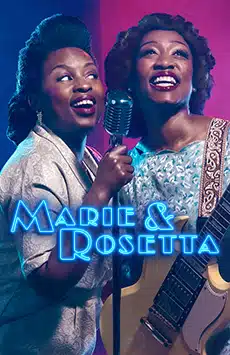
What happens in Marie and Rosetta?
Mississippi, 1946. Sister Rosetta Tharpe — already a star, already controversial — is on tour in the segregated American South. She is between bookings, and she has summoned a young gospel singer named Marie Knight to a funeral parlour to rehearse. It is the only place a Black touring artist can find privacy and a piano in the Mississippi of 1946; the coffin in the corner is part of the setting throughout. The play's hour and forty-five minutes is the time the two women spend in that room.
The audition
Marie, devout and trained in pure church-style gospel, is initially shocked by Rosetta's approach. Rosetta plays the electric guitar — an instrument many in the church regard as worldly, even ungodly. She sings in nightclubs alongside the rhythm-and-blues bands of the era. She has been criticised from the pulpit for it. Marie has come because she has been told to come, and because Rosetta is offering her real money to join her tour.
The conversion
What Rosetta needs is for Marie to swing. The play's central musical and dramatic arc is Marie's slow, sceptical, then ecstatic discovery that the gospel music she has grown up with becomes something else when it leans into syncopation and electric blues. The lines between sacred and secular music — Rosetta will say repeatedly — were drawn by men, and only relatively recently. The piece argues that to swing the gospel is not to betray it but to free it.
The arguments
Brant's script is not just musical. Rosetta and Marie argue about everything — about race, respectability, what Black women should and should not do, what the church will accept, what their mothers will say, what touring with each other will mean for both of them. There is a frankness about sexuality and class in the script that critics have praised as both period-honest and theatrically alive.
The reveal
The play has a final structural turn that the production team have asked critics not to spoil. It recontextualises the rehearsal we have just watched and brings the music — and the relationship — into sharper focus. Audiences leaving the theatre have repeatedly cited the final ten minutes as the moment that lifts the play above conventional biographical drama. Marie Knight, who lived until 2009, was buried wearing a piece of Rosetta's jewellery.
How a forgotten music history became a West End hit
Sister Rosetta Tharpe
Rosetta Nubin was born in Cotton Plant, Arkansas, in 1915, to mother Katie Bell Nubin — herself a singer and mandolin player in the Church of God in Christ. By the age of six, Rosetta was already touring as a performer. She learned the guitar from her mother and developed a percussive, distorted, blues-inflected electric style in the 1930s and 1940s that prefigured almost every rock 'n' roll guitarist who would follow. Her 1944 recording of Strange Things Happening Every Day has been described by some music historians as the first rock 'n' roll record. She influenced Elvis Presley, Johnny Cash, Chuck Berry, Little Richard, Jerry Lee Lewis and Bob Dylan, all of whom cited her by name. She was inducted into the Rock and Roll Hall of Fame in 2018, forty-five years after her death.
Marie Knight
Marie Knight was born in Sanford, Florida in 1925. She was singing in church by her teens. In 1946 she met Sister Rosetta Tharpe at a gospel concert in New York's Golden Gate Auditorium, and over the next four years the two toured the United States together, releasing duets including Up Above My Head (I Hear Music in the Air) and Didn't It Rain. The partnership ended in tragedy in 1948 when Knight's two children died in a house fire while she was on tour. Marie Knight continued to record into the 2000s, dying in Harlem in 2009.
George Brant's play
American playwright George Brant — best known in the UK for Grounded, his Fringe First-winning monologue about an American drone pilot — wrote Marie and Rosetta in 2016. It premiered Off-Broadway at the Atlantic Theater Company. Brant's other plays include Salvage and The Mourners' Bench. The play has been produced internationally and is increasingly regarded as the definitive theatrical treatment of Tharpe's life.
The UK production journey
This Marie and Rosetta production was created by Jonathan Church Theatre Productions and Chichester Festival Theatre in association with Nica Burns. It opened at the Rose Theatre in Kingston, then toured to Wolverhampton Grand and Chichester Festival Theatre's Minerva auditorium, then transferred to the West End @sohoplace in February 2026. Beverley Knight and Ntombizodwa Ndlovu were with the production throughout.
About the cast
Beverley Knight has had a thirty-year career as one of the UK's most acclaimed soul singers, with multiple top-ten albums and three MOBO Awards. Her West End credits include Memphis (Olivier nomination), The Drifters Girl, Sylvia (Old Vic) and Sister Act. Ntombizodwa Ndlovu's earlier theatre credits include Cat On a Hot Tin Roof, The Space Between Us, Mixtape, Nothing and The Mountain Top at the Royal Exchange Theatre, Manchester.
About @sohoplace
@sohoplace, on Charing Cross Road, opened in 2022 as Nica Burns's third West End theatre (alongside the Sondheim and the Apollo). It is the first new West End theatre to open in fifty years, with a flexible 602-seat in-the-round auditorium that has previously hosted Brokeback Mountain, The Pillowman, As You Like It, Hangmen and Every Brilliant Thing.