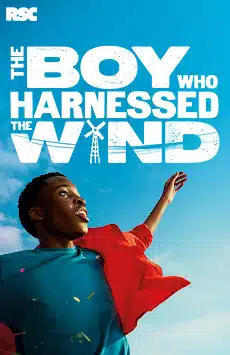
What happens in The Boy Who Harnessed the Wind?
The show opens in a village in Malawi, where William Kamkwamba grows up as the son of a tobacco farmer. The village is alive with community spirit: shared labour, music, the rhythms of agricultural life. When a tobacco company strips the trees that have protected the land for generations, the conditions are set for catastrophe.
The drought arrives
When the rains fail, crops wither and the community faces hunger. William's father Trywell — a proud, practical man — finds himself unable to keep the family fed or pay William's school fees. Expelled from school, William spends his days in the local library, where he comes across books on physics and electrical engineering. He begins to see something the adults around him cannot: a possible solution.
The windmill project
William's plan to build a wind turbine from scrap metal and bicycle parts seems absurd to his community. His father is furious at the idea that his bicycle might be sacrificed for an untested machine. His friends find it hard to believe in something they have never seen. Only gradually, as William's conviction holds and his understanding deepens, does the atmosphere begin to shift. The construction of the windmill becomes a community act.
The turning point
When the windmill works — powering a pump that draws water from the earth in the middle of a drought — it changes everything. Not just for the Kamkwamba family, but for an entire community that had run out of options. The water means crops can grow. The crops mean survival. The production captures this moment with full ensemble force: one of the most emotionally generous curtain calls running anywhere in London.
Family at the centre
Running through the action is the relationship between William and his father. Trywell is not a villain — he is a man shaped by a lifetime of hard work who has learned not to trust miracles. His journey from scepticism to belief is as important to the show as William's own. The musical understands that the courage to believe in your child can be as hard-won as the courage to build a windmill out of rubbish.
William Kamkwamba: the real story
The windmill
William Kamkwamba was born in 1987 in Kasungu, Malawi. In 2001, aged 14, he was forced out of school when his family could no longer afford the fees following a devastating famine that cut the country's maize harvest by a third. Spending time in the local library, he found a copy of a physics textbook called Using Energy. Within it was a diagram of a wind turbine. With no formal engineering knowledge and using materials from a local scrapyard — fan blades made from PVC pipe, a dynamo from a bicycle wheel, and a homemade tower of blue gum poles — he built a functioning turbine that lit four light bulbs and powered a radio. He was 14.
From local story to global attention
Word of William's windmill spread beyond the village. He was invited to speak at a TEDGlobal conference in Arusha, Tanzania in 2007, and his short, uncertain talk went viral. It led directly to a book deal — The Boy Who Harnessed the Wind, co-written with journalist Bryan Mealer, was published in 2009 and became an international bestseller. A young adult version followed. A documentary film, William and the Windmill, directed by Ben Nabors, won the Grand Jury Prize at the 2013 South by Southwest festival.
Chiwetel Ejiofor's film
In 2019, Chiwetel Ejiofor — British actor, Oscar nominee for 12 Years a Slave — wrote, directed, and starred in a feature film adaptation of Kamkwamba's memoir for Netflix. Ejiofor played Trywell, William's father, with Maxwell Simba as William. The film premiered at Sundance, received warm critical reviews, and was submitted as the British entry for the Academy Award for Best International Feature Film. It remains on Netflix and is a significant part of the story's ongoing reach.
The musical's origins
The musical was commissioned by the RSC and Kenny Wax Limited, with Chuchu Nwagu Productions as a producing partner. Richy Hughes (whose credits include Superhero at Southwark Playhouse) wrote the book and lyrics, with Tim Sutton composing the music. Lynette Linton — formerly Artistic Director of the Bush Theatre, where she led one of London's most consistently adventurous programming periods — was appointed as director. Ejiofor joined as Executive Producer, connecting the film to the stage version. The world premiere ran at the RSC's Swan Theatre in Stratford-upon-Avon from 10 February to 28 March 2026, before the full company transferred to @sohoplace for the West End run.
William Kamkwamba today
Kamkwamba earned a degree in environmental studies from Dartmouth College in the United States and founded the Moving Windmills Project, a charity that supports development projects in Malawi and uses the windmill model to encourage innovation in communities with limited resources. He was present at the RSC press night in February 2026, taking a bow at the curtain call alongside the company.
Performance schedule
- Previews from: 25 April 2026
- Press night: 25 May 2026
- Final performance: 18 July 2026
- Evenings: Monday to Saturday, 7:30pm
- Matinees: Thursday and Saturday, 2:30pm
- Running time: Approximately 2 hours 30 minutes, including one interval
The schedule may vary — confirm your specific date when booking. The run is strictly limited to 12 weeks.
Content notes
This production contains loud music and flashing lights. Themes include famine, drought, death, political violence, and family conflict. Age guidance is 11+. Children aged 14 and under must be accompanied by and seated next to an adult aged 18 or over. A valid ticket is required for all persons attending, regardless of age.
Cast
- Alistair Nwachukwu as William Kamkwamba (The Line of Beauty, Almeida Theatre; Choir Boy, RSC)
- Madeline Appiah as Agnes Kamkwamba (The Winter's Tale, RSC; Tina: The Tina Turner Musical)
- Sifiso Mazibuko as Trywell Kamkwamba (Girl From the North Country)
- Tsemaye Bob-Egbe as Annie Kamkwamba (Six the Musical; Tina: The Tina Turner Musical)
- Choolwe Laina Muntanga as Mika Kamkwamba
- Idriss Kargbo as Gilbert Mofat
- McCallam Connell as Chief Wimbe
- Yana Penrose as Khamba (dog puppetry)
- Owen Chaponda as Mike Kachigunda and Blessings
- Newtion Matthews as Mister Ofesi
- Tomi Ogbaro as Mizeck
- Shaka Kalokoh as Charity
- Eddie Elliott as Jeremiah Kamkwamba and Patience
- Helena Pipe as Edith Sikelo
Cast information correct at time of publication and subject to change.
Creative team
- Book & lyrics: Richy Hughes
- Music & lyrics: Tim Sutton
- Based on: The Boy Who Harnessed the Wind by William Kamkwamba and Bryan Mealer, and Chiwetel Ejiofor's film
- Director: Lynette Linton
- Choreography: Shelley Maxwell
- Set & costume design: Frankie Bradshaw
- Lighting design: Oliver Fenwick
- Sound design: George Dennis
- Video design: Gino Ricardo Green
- Puppet design: Nick Barnes
- Puppetry direction: Laura Cubitt
- Music director: Ashton Moore
- Executive Producer: Chiwetel Ejiofor
Getting there
- Tube: Tottenham Court Road (Central, Northern lines) — 1 minute walk; the theatre is visible from the station exit
- Alternative: Leicester Square (5 min walk); Oxford Circus (8 min walk)
- Bus: Routes 1, 8, 14, 24, 29, 73, 98, 134, 176, 242 and night routes stop on Tottenham Court Road and Oxford Street
- Car park: YMCA Great Russell Street (2 min walk); Holborn Selkirk House, Museum Street (5 min walk)
About @sohoplace
@sohoplace opened in 2022 as the first major new West End theatre to be built in central London in over 50 years. Designed by Sir Peter Cook and located on the corner of Tottenham Court Road and Oxford Street, the venue seats approximately 600 in a flexible in-the-round configuration. Owned and operated by Nica Burns, the theatre has hosted productions including the world premiere of Prima Facie and a landmark revival of Macbeth starring Ralph Fiennes. The intimate auditorium layout places audiences close to the performance on all sides, making it one of the most immersive theatrical spaces in London.
Accessibility
@sohoplace is fully accessible with step-free access throughout the building, including to the auditorium. Wheelchair spaces, accessible toilets, and hearing assistance systems are available. The box office can advise on the best access routes and seating options — contact them in advance to plan your visit.
Producers
The production is presented by the Royal Shakespeare Company, Kenny Wax Limited, and Chuchu Nwagu Productions, in association with Nica Burns/@sohoplace.