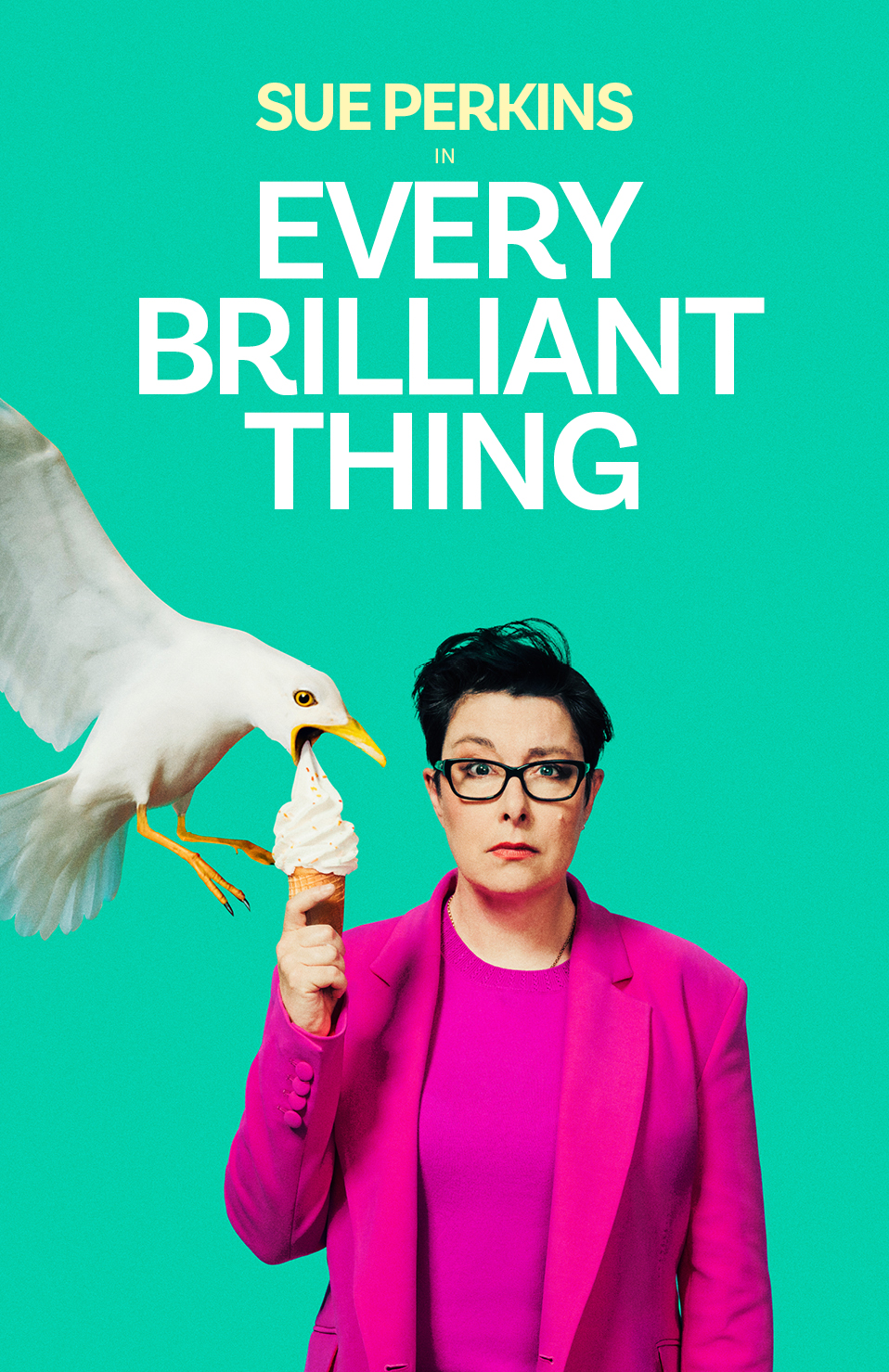
What happens in Every Brilliant Thing?
The narrator is seven years old. Their mother is in hospital — their father has said she has "done something stupid" — and the narrator decides to start a list of every brilliant thing in the world, every single thing worth living for, to leave on her pillow. The list begins: ice cream. Kung fu movies. Burning things. Laughing so hard you shoot milk out your nose. Me.
The list grows
The play unfolds as the narrator ages from seven into adulthood and the list grows with them. As a child, the entries are immediate and physical. As a teenager, they get sharper and more rueful. As an adult, they get more specific and more precise — the things that someone who has actually had to think about staying alive includes on a list of reasons to stay alive. The narrator's mother is hospitalised again. And again. The list grows.
The audience as cast
The play's structural conceit is that the audience reads the list aloud, line by line, as the narrator calls out numbers. Other audience members are brought into the action to play key figures in the narrator's life — the disapproving teacher, the long-suffering father, the partner the narrator eventually meets and marries. The casting is unrepeatable; the same scene is played slightly differently every night, depending on who happens to be in seat F12.
The vet scene
One of the play's signature moments is the scene in which the narrator's childhood dog, Sherlock Bones, must be put down. An audience member is pulled up to play the vet. The scene is almost always funny — strangers do not usually expect to be asked to mime a euthanasia — and almost always becomes unexpectedly moving. It is the play in microcosm: comedy, vulnerability, kindness, all in the same five minutes.
The closing
The list, by the end, is approaching a million. The narrator has not solved depression — not theirs, not their mother's, not their own — but they have built the documentary record of a life worth being inside. The play closes with the audience reading the final entries together. It is, in the end, an unmistakably life-affirming piece of theatre. That is the entire point of it.
How Every Brilliant Thing became a global phenomenon
Edinburgh 2014
Every Brilliant Thing began as a monologue Duncan Macmillan was working on, which he then developed in collaboration with director George Perrin (then joint artistic director of Paines Plough) and the musical-comedy performer Jonny Donahoe, who has a strong improvisational background. It premiered at Paines Plough's Roundabout at Summerhall during the 2014 Edinburgh Fringe, with Donahoe performing. Its run sold out and the reviews were unusual: the play was being recognised as something simultaneously very funny and very serious.
The off-Broadway and HBO years
An off-Broadway transfer followed, at the Barrow Street Theatre in New York. Donahoe was nominated for a Drama Desk Award, a Lucille Lortel Award, and an Off-Broadway Alliance Award. The Barrow Street performance was recorded by World of Wonder for an HBO special, which gave the play a very wide audience. International productions followed — Australia, Canada, Germany, Italy, Brazil — and by 2024 the show had been staged in more than 80 countries.
The 2024 anniversary revival
A tenth-anniversary revival opened in 2024, off-Broadway at the Roundabout, with a rotating-cast model that became the template for the @sohoplace West End premiere. That revival sold out and confirmed the play's stamina across long-time intervals — the script has not been updated, and it does not feel dated.
The @sohoplace West End premiere
The London run opened at @sohoplace on 5 August 2025, with Lenny Henry as the first performer. Subsequent rotations brought in Jonny Donahoe (returning to the original role), Ambika Mod (One Day, This Is Going to Hurt), Sue Perkins, and Minnie Driver, who closed the run on 8 November 2025. The production was co-directed by Jeremy Herrin (Best of Enemies, Wolf Hall Trilogy) and Duncan Macmillan, with set and costume design by Vicki Mortimer.
Broadway with Daniel Radcliffe
The Broadway premiere of Every Brilliant Thing opened at the Hudson Theatre on 21 February 2026, with Tony Award-winner Daniel Radcliffe leading the production. The run is scheduled to close on 24 May 2026. As of writing, no further UK or international productions have been formally announced, though given the play's eleven-year history of continuous global staging, further runs are likely to be programmed in due course.