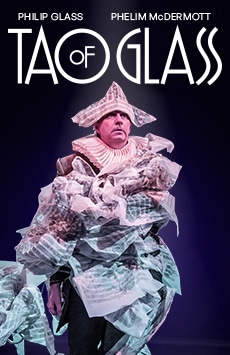
What is Tao of Glass?
Tao of Glass resists easy description — which is, in part, the point. It is a piece in ten parts, each pairing a meditation written and performed by Phelim McDermott with a newly composed piece of music by Philip Glass. The meditations circle around a set of questions: what does it mean to create? What happens to the things we make when we are gone? How do we hold grief alongside the ongoing work of living? The Taoist thread running through the piece offers a philosophical framework, but the show wears its philosophy lightly — it is felt rather than argued.
McDermott as performer
Phelim McDermott performs throughout, narrating and inhabiting the piece's autobiographical elements. His text draws on his long creative relationship with Glass — a relationship that has produced some of the most acclaimed opera stagings of the past two decades — and on his own experience of loss and artistic process. He is a performer of unusual warmth and intelligence, and the intimacy of @sohoplace suits his mode of address.
The Glass score
The ten compositions Glass wrote for Tao of Glass are performed live by a small ensemble: clarinet, violin, piano, and percussion, directed by Chris Vatalaro. Glass's music here has the characteristic quality of his best chamber work — it appears simple, even minimal, but rewards close listening with layers of emotional complexity. Heard in a small theatre rather than a concert hall, the music has an immediacy and vulnerability that recording cannot capture.
Puppetry and image
Improbable's trademark use of puppetry is central to the piece's visual language. Puppet designer Lyndie Wright and her team create figures and images that inhabit the borderland between the animate and inanimate — appropriate to a work meditating on what persists after things end. The puppetry is not decorative; it is doing narrative and emotional work that the text and music alone could not achieve.
The question at the centre
Tao of Glass builds towards a single question: where does true inspiration come from? It does not offer a definitive answer — that would be contrary to its spirit — but it creates the conditions in which the question can be genuinely felt rather than merely considered. Audiences who surrender to its slow, careful accumulation of music, image, and story tend to find it unexpectedly moving.
How Tao of Glass came to be
Glass and McDermott: a long collaboration
Philip Glass and Phelim McDermott have worked together on opera productions for more than two decades. McDermott directed Glass's Satyagraha at English National Opera in 2007 — a production subsequently seen at the Metropolitan Opera in New York — and his production of Akhnaten at ENO in 2016 won the Olivier Award for Best Opera Production. The Glass-McDermott partnership is one of the most celebrated in contemporary opera, built on a shared belief in the power of theatrical image and a deep mutual respect between composer and director.
The dream that started it
Tao of Glass began, unusually, with a dream. McDermott describes the piece as having grown from an image that arrived in sleep and which neither he nor Glass could quite leave alone. The development process involved periods of what McDermott describes as play — Glass and McDermott in a room in downtown New York, improvising, riffing, discovering how music and story could grow from the same source. The result is more intimate and more personal than either of their previous collaborations.
Manchester International Festival, 2019
Tao of Glass received its world premiere at Manchester International Festival in July 2019. It was commissioned by MIF alongside Improbable, Perth Festival, and several other international partners. The premiere production played at the Royal Exchange Theatre in Manchester and received five-star reviews from the Guardian, The Times, WhatsOnStage, and multiple other publications, as well as a Critics' Pick from the New York Times during its international engagements.
International tour
Following Manchester, the production toured internationally to Perth Festival in Australia (February 2020), Ruhrfestspiele in Germany (June 2022), and Hong Kong New Vision Arts Festival. Each engagement brought the work to new audiences and consolidated its reputation as one of the most singular theatrical achievements of the post-pandemic cultural landscape. The West End premiere at @sohoplace in summer 2026 represents, as McDermott has said, the completion of a circle — the piece finally arriving in the city that has been home to so much of his work with Glass.
Philip Glass
Born in Baltimore in 1937, Philip Glass studied at the University of Chicago and the Juilliard School before spending formative years in Paris studying with Nadia Boulanger and working with Indian musician Ravi Shankar. By the mid-1970s he had developed the minimalist language — built on repetition, gradual change, and interlocking patterns — that would define his career. His works include the operas Einstein on the Beach, Satyagraha, and Akhnaten; film scores for Koyaanisqatsi, The Truman Show, and The Hours (Golden Globe); and a vast body of symphonic and chamber music. He remains one of the most performed living composers in the world.
Phelim McDermott and Improbable
Phelim McDermott co-founded Improbable in 1996 with Julian Crouch and Lee Simpson. The company's work is characterised by a commitment to process-led creation, improvisation, and an integration of puppetry, visual art, and live performance. McDermott's production of My Neighbour Totoro for the RSC and Barbican won six Olivier Awards including Best Director. His opera work with Glass at ENO and the Met has made him one of the leading opera directors of his generation.
Performance schedule
- Run: Friday 25 July – Saturday 12 September 2026
- Press night: Thursday 30 July 2026, 7pm
- Performances: Monday to Saturday evenings; matinee schedule varies by week
- Running time: Approximately 2 hours 30 minutes, including one interval
Tao of Glass does not perform every day of the week. Confirm your specific date on the @sohoplace website when booking.
Age guidance
Recommended for ages 14 and above. The show deals with themes of grief, mortality, and philosophical inquiry. It is not suitable for young children. The meditative pace and absence of interval require sustained attention.
Tickets and pricing
Tickets range from £30 to £132. Groups of ten or more can book at £49.50 (valid Monday to Thursday on bands A and B). Contactless ticketing is in operation at @sohoplace — tickets are issued electronically 48 hours before the performance.
Cast and ensemble
- Phelim McDermott — Performer
- Jack McNeill — Ensemble (Clarinet)
- Rakhi Singh — Ensemble (Violin)
- Katherine Tinker — Ensemble (Piano)
- Chris Vatalaro — Ensemble (Percussion) & Musical Director
- David Emmings — Puppeteer
- Janet Etuk — Puppeteer
- Sarah Wright — Puppeteer & Puppet Co-ordinator
Creative team
- Composer: Philip Glass
- Writer & Co-Director: Phelim McDermott
- Co-Director: Kirsty Housley
- Designer: Fly Davis
- Lighting Designer: Colin Grenfell
- Sound Designer: Giles Thomas
- Musical Director: Chris Vatalaro
- Puppet Designer & Puppet Maker: Lyndie Wright
- Producers: Factory International, Improbable and Nica Burns
Getting there
- Tottenham Court Road station: Central line and Elizabeth line — approximately 1-minute walk to the theatre entrance at 1 Soho Place
- By bus: Numerous routes serve Tottenham Court Road
- On foot: A short walk from Oxford Street, Covent Garden, and Soho
About @sohoplace
@sohoplace opened in 2022 as London's first new West End theatre in fifty years, built above Tottenham Court Road station. Designed by architect Charcoalblue, the 602-seat flexible auditorium is one of the most acoustically sophisticated rooms in London, with excellent sightlines from all positions. The theatre is positioned directly above the Elizabeth line ticket hall and is accessible from the station concourse.
Accessibility
@sohoplace offers wheelchair access on stalls level, wider seats for patrons with access needs, and a large cloakroom available to all patrons free of charge. Contact the box office in advance to discuss specific access requirements. Large bags are requested to be checked into the cloakroom out of respect for the auditorium.