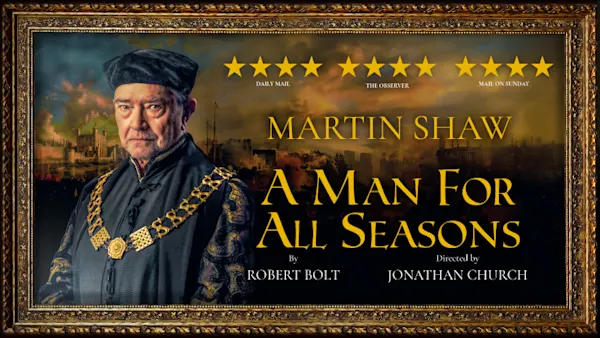
What happens in A Man for All Seasons
The play is set in England between 1529 and 1535. Sir Thomas More — scholar, lawyer, devout Catholic, and friend to King Henry VIII — is appointed Lord Chancellor after the fall of Cardinal Wolsey. The king wants a divorce from Catherine of Aragon, who has failed to produce a male heir, so that he can marry Anne Boleyn. The Pope refuses to grant the annulment. Henry's response is to break the English church from Rome, declaring himself Supreme Head of the Church of England, and demanding that all senior officials swear an Oath of Supremacy to confirm it.
More — believing the king's authority over the Church to be theologically illegitimate — cannot take the oath. Crucially, he also refuses to publicly state why, preferring legal silence. This stance is engineered by Bolt as a study of conscience: More is not a martyr seeking confrontation but a careful lawyer trying to survive by saying nothing. The play's antagonist is the rising Thomas Cromwell, who, frustrated by More's refusal to be drawn into open opposition, eventually arranges for his trial on perjured evidence. Found guilty of treason, More is executed in July 1535.
Bolt's structural innovation is The Common Man — a figure who steps in and out of multiple supporting roles (More's servant, the boatman who takes him across the Thames, the foreman of the jury that condemns him, the executioner, the gravedigger) and who addresses the audience directly. The Common Man closes the play by reminding the audience that survival, not heroism, is most people's natural response to power.
Robert Bolt and the 1960 premiere
Robert Bolt wrote A Man for All Seasons for BBC radio in 1954 before adapting it for the stage. The play premiered at the Globe Theatre (now the Gielgud) in 1960 with Paul Scofield as Thomas More. It transferred to Broadway in 1961, where it won five Tony Awards including Best Play, with Scofield winning Best Actor. The 1966 Fred Zinnemann film, again starring Scofield, won six Academy Awards including Best Picture, Best Director and Best Actor — making it one of the most decorated productions in British theatre history. Bolt himself was a Tony, Academy Award and BAFTA winner whose other credits include the screenplays for Lawrence of Arabia and Doctor Zhivago.
The historical Thomas More
Sir Thomas More (1478–1535) was a lawyer, humanist scholar, author of Utopia (1516), and Lord Chancellor of England from 1529 to 1532. His refusal to acknowledge Henry VIII's break with Rome led to his imprisonment in the Tower of London and execution by beheading at Tower Hill on 6 July 1535. He was canonised by the Catholic Church in 1935. Bolt's portrait was widely understood as a Cold War-era parable about individual conscience under state pressure — a theme that has retained its force across subsequent revivals.
Jonathan Church and the 2025 production
Jonathan Church directed this production as part of his Jonathan Church Theatre Productions slate in association with Theatre Royal Bath Productions. Church was previously artistic director of Chichester Festival Theatre (2006–2016), where he oversaw a celebrated decade of work, and is now artistic director of the Sydney Theatre Company. He had previously directed Martin Shaw in a 2003 production of Hobson's Choice. The creative team — Simon Higlett (sets and costumes), Mark Henderson (lighting), Paul Groothuis (sound) and Matthew Scott (music) — represented a roll-call of senior West End designers.