
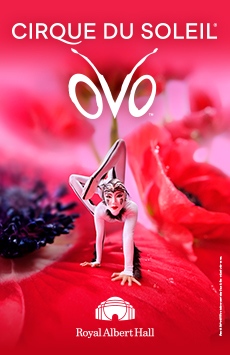
Cirque du Soleil: OVO at a glance

Show
Cirque du Soleil: OVO
Writer/director/choreographer
Deborah Colker
Artistic director (tour)
Lydia Harper
Producer
Cirque du Soleil Entertainment Group
Venue
Royal Albert Hall, Kensington Gore, London SW7 2AP
London dates
9 January 2025 – 1 March 2026 (extended)
Original premiere
23 April 2009, Montreal (Big Top show)
Arena adaptation
2016 (the touring arena format that came to London)
Cast
53 performers — acrobats, musicians, contortionists, jugglers, dancers and aerialists — from 25 countries
Running time
Approximately 2 hours 20 minutes, including a 25-minute interval
Age guidance
All ages; under-14s must be accompanied; children aged 2+ require own ticket
Music style
Live Brazilian-inspired score with Latin, electronic and acoustic elements
Signature acts
Trampoline wall, foot juggling, aerial silks, contortion (the spider), 14-metre high-flying trapeze, slackwire, Chinese pole, hand-balancing
Show language
Non-verbal (suitable for all language backgrounds)
OVO meaning
"Egg" in Portuguese; the two Os and V form a hidden insect face in the logo

Retrospective Review: Cirque du Soleil: OVO at Royal Albert Hall

4.7
★★★★★

LTH Expert Rating

The Verdict

OVO is now seventeen years old. Yet at the Royal Albert Hall it filled the building for fourteen months — a run length almost unheard of for an arena circus show. The reason, on the evidence of the production in performance, is that Deborah Colker's choreography ages unusually well: rooted in the biological logic of how insects actually move, the show's set-pieces feel observational rather than show-business. Crickets really do explode upward (a trampoline-wall set-piece staged against a 19-metre vertical structure); a contortion-spider really does fold and unfold along impossible lines; a 14-metre high-flying trapeze sequence by butterflies reads as choreography first and stunt second.

Cirque du Soleil's Royal Albert Hall residency is itself now an institution — 30 years old in 2025, the milestone the OVO run was timed to celebrate. The fit between the Hall's circular auditorium and Cirque's in-the-round staging is one of the great matches in London theatre. With 53 performers from 25 countries, a live Brazilian-inspired score, and dazzling costume design from Liz Vandal, OVO offered the production polish that distinguishes Cirque from its many imitators. Audience members ranged from very small children to first-time theatregoers to lifelong Cirque fans — and the production worked for all of them.

What made it notable

  • Deborah Colker's biological choreography. Colker — Brazil's most internationally acclaimed contemporary choreographer — built every act around how a real insect moves. The result is that the spectacle feels grounded rather than gratuitous: each acrobat is "playing" a species, not just performing tricks.
  • The signature acts. The trampoline-wall (crickets jumping vertically up a 19-metre wall), the contortion spider, the 14-metre high-flying trapeze, the foot juggling with sweetcorn, the slackwire walked by a single tightrope-spider — these became OVO's calling cards across its global tour.
  • The Brazilian-inspired score. Performed live by a small on-stage band, the music draws on samba, forró and bossa nova alongside more conventional Cirque electronic textures. It is non-verbal, like the show itself.
  • The Royal Albert Hall residency tradition. Cirque has visited the Hall annually for thirty years (2025 marked the 30th anniversary). The OVO residency was the longest single Cirque run the venue has hosted.
  • The all-ages reach. Genuine three-generation appeal: the non-verbal narrative makes it accessible to very young children; the choreographic sophistication satisfies adult dance audiences. Reviewers consistently noted that no-one is bored.

Critical Reception (Royal Albert Hall, 2025–26)

The reviews were unanimously positive. The Times, the Telegraph and the Standard all gave five stars; the Guardian and Time Out gave four. Critics consistently picked out the contortion-spider, the trampoline-wall and the 14-metre flying trapeze as highlights. A handful of long-term Cirque attendees noted that OVO is now a 17-year-old show and some acts have been retired or modified over time, but the consensus was that the central choreographic vision has held its quality. Audience ratings were exceptionally high.

  • The Times ★★★★★
  • The Telegraph ★★★★★
  • Evening Standard ★★★★★
  • The Stage ★★★★★
  • WhatsOnStage ★★★★★
  • The Guardian ★★★★
  • Time Out ★★★★

Source: published reviews of the Royal Albert Hall residency (January 2025 – March 2026). Star ratings indicative.

About the Production

What happens in OVO

OVO is non-verbal. The "story" is a thin scaffolding — a love story between two insects, framed by the mysterious arrival of a giant egg — onto which the show's set-pieces are hung. A bustling community of insects (crickets, ants, beetles, butterflies, fleas, spiders, dragonflies, ladybugs) goes about its colourful daily life on a vibrant ecosystem stage. A Foreigner — a clumsy, oversized insect carrying an egg of unknown provenance — arrives. The community is wary. The Foreigner falls in love with the community's elegant Ladybug. As they negotiate this relationship, the egg becomes both the symbol of their potential future together and the question that drives the show: what is inside?

This narrative arc is interspersed with the signature acts that have made OVO one of Cirque du Soleil's most successful touring productions. Crickets perform a trampoline-wall sequence against a 19-metre vertical wall; ants juggle pieces of corn with their feet; a flea acrobat performs a slackwire walk; spiders perform contortion acts (most famously the single-spider contortion that has become OVO's most iconic image); butterflies fly on a 14-metre high-flying trapeze; dragonflies hand-balance. Each act has its own musical theme in the live Brazilian-inspired score. Costume designer Liz Vandal's bright, character-specific designs make each species instantly readable from the back row of the Royal Albert Hall.

The show resolves — without words — into the egg hatching, the community celebrating, and the Foreigner and the Ladybug united. Without giving away the final reveal, it is one of Cirque's most genuinely uplifting endings, and explains why the production has been a family favourite for nearly two decades.