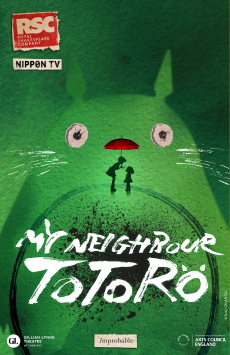
What happens in My Neighbour Totoro?
The plot of My Neighbour Totoro is simple by Western family theatre standards. There is no villain. No quest. No race against time. The story takes its time, observes small moments closely, and finds emotional resonance in the unexpected. This is faithful to Miyazaki's original film, which has the same structural quietness.
The arrival
Tatsuo Kusakabe moves with his two daughters — eleven-year-old Satsuki and four-year-old Mei — to a country house in rural Japan. The year is roughly 1958. They are moving to be closer to the hospital where the girls' mother Yasuko is convalescing from a long illness. The house is old, dusty, slightly tumbledown. The first scenes establish the family dynamic — Tatsuo gentle and slightly distracted, Satsuki responsible and protective of Mei, Mei small and curious and brave.
The soot sprites and the camphor tree
As the girls explore the old house, they discover the soot sprites — small black creatures that scatter from the corners when the children look at them. These are puppets operated by visible puppeteers in black, and their first appearance is among the show's most-loved sequences. Granny, a neighbour, tells the girls that the soot sprites only live in houses where children are happy. Outside the house stands an enormous camphor tree, the home of the area's protective forest spirit. The girls meet Kanta, a local boy their age.
Mei meets Totoro
One day, while Satsuki is at school and her father is working, Mei follows a small mysterious creature into the undergrowth and tumbles into a clearing at the base of the camphor tree, where she finds the sleeping form of Totoro — a giant, ancient forest spirit, furry and soft, with extraordinary teeth and tongue. He is sleeping. Mei climbs onto his stomach and falls asleep too. When she wakes she is back at the house and the creature is gone. Her father and sister listen carefully but don't quite believe her — though Tatsuo, in one of the show's most quietly moving moments, takes her to thank the camphor tree for hiding her.
The bus-stop scene
The most famous sequence in both film and show: Satsuki and Mei are caught in heavy rain at a country bus stop, waiting for their father. Mei falls asleep on Satsuki's back. After a long, patient silence, Totoro materialises next to them at the bus stop. He is unfamiliar with the concept of an umbrella; Satsuki, polite, gives him one. Totoro is delighted by the sound of raindrops on it. After a long pause, the Catbus arrives — a cat that is also a bus (or vice versa) — and Totoro climbs aboard. The Catbus departs at speed. Their father's actual bus arrives moments later.
Mei's disappearance
Towards the end of the second act, a telegram arrives at the house: there is a problem with Mei and Satsuki's mother in hospital. Mei, frightened and overwhelmed by what this might mean, decides to take corn from the garden to her mother herself, and sets off on foot. By the time Satsuki and the village realise Mei is missing, she has been gone for hours. The villagers search. Satsuki, desperate, runs through the fields and eventually finds her way to the camphor tree, where she calls on Totoro for help. The Catbus appears. It takes her to find her sister, and then both girls together to the hospital window where they leave the corn and watch their mother sleeping safely.
The ending
The mother is going to recover. The family is going to be together. The Totoros — Catbus, Granny, the soot sprites, the camphor tree itself — fade back into the world of childhood imagination from which they emerged, with the suggestion that they were always real and always there, and that the children's belief in them is what made them visible. The show ends quietly, with a sense of the world being slightly more magical than it was before.
How My Neighbour Totoro got to the stage
The 1988 Studio Ghibli film
Hayao Miyazaki's My Neighbour Totoro (Tonari no Totoro) was released in Japan on 16 April 1988 as a Studio Ghibli double bill with Isao Takahata's devastating Grave of the Fireflies. It was Miyazaki's third feature for Ghibli (after Nausicaä of the Valley of the Wind and Laputa: Castle in the Sky). The film was a moderate commercial success initially but became the studio's most enduringly beloved property — Totoro himself became the Ghibli logo. The film has been widely cited as one of the greatest animated films ever made and is among Miyazaki's most personal work.
Joe Hisaishi
The original score was composed by Joe Hisaishi, who has scored every Hayao Miyazaki film since Nausicaä and is one of Japan's most beloved film composers. Hisaishi's Totoro score is among his most loved work — the main theme is recognised across the world. His involvement in the stage production as Executive Producer is the single most important factor in the production's authenticity to the source material.
The road to the stage (2018-2022)
The first conversations about a stage adaptation began around 2018 between Studio Ghibli, Nippon TV, and the Royal Shakespeare Company. The collaboration was unusual for both sides: Studio Ghibli is famously protective of its IP, the RSC is best known for Shakespeare. Joe Hisaishi was personally involved in selecting the creative team. They chose Phelim McDermott to direct (based on his Improbable / Met Opera record) and Tom Morton-Smith to adapt (after his RSC Oppenheimer). The puppetry assignment went to American master puppeteer Basil Twist, with construction subcontracted to Jim Henson's Creature Shop and additional work by Mervyn Millar (the puppeteer behind War Horse).
The 2022 Barbican premiere
The production premiered at the Barbican Theatre, London, on 8 October 2022 — running until 21 January 2023. It broke the Barbican's box office records before opening and sold out before press night. The critical reception was rapturous: near-universal five-star reviews. The show won six Olivier Awards in 2023, the most of any production that year, including Best Entertainment or Comedy Play, Best Director (Phelim McDermott), Best Set Design (Tom Pye), Best Costume Design (Kimie Nakano), Best Lighting Design (Jessica Hung Han Yun), and Best Sound Design (Tony Gayle). Five WhatsOnStage Awards followed.
The 2023-24 Barbican return
A second Barbican season ran from 21 November 2023 to 23 March 2024, again to sell-out audiences. By this point the production had effectively become a cultural event — its tickets were among the hardest to obtain in London theatre.
The 2025 Gillian Lynne transfer
The decision to transfer to a permanent West End venue rather than continue Barbican seasons was made in 2024. The Gillian Lynne Theatre — a 1,108-seat LW Theatres venue, formerly the New London Theatre, named in 2018 after the late choreographer Gillian Lynne (the first West End theatre named after a non-royal woman) — was chosen for its flexibility and central location. The production opened at the Gillian Lynne on 19 March 2025, with press night on 20 March, and was extended twice: first to 29 March 2026, then in October 2025 to a final closing date of 30 August 2026.
Phelim McDermott and Improbable
Phelim McDermott is the British director and performer who co-founded the theatre company Improbable in 1996 with Lee Simpson and Julian Crouch. Improbable's work has ranged from puppetry (Shockheaded Peter) through opera direction (Met Opera's Akhnaten, Satyagraha, The Magic Flute) to political theatre (Open Space). His approach is characteristically collaborative and patient, often working in long developmental processes — Totoro was reportedly four years in development.
Basil Twist and the puppetry
Basil Twist is one of America's most celebrated puppeteers. His credits include The Petrushka Variations (Stravinsky/New York), the Metropolitan Opera's Hansel and Gretel, the Broadway revival of The Pee-Wee Herman Show, and the National Theatre's Caucasian Chalk Circle. His Totoro design is generally considered his most ambitious work to date. The puppets were built by Jim Henson's Creature Shop, the legendary Los Angeles facility responsible for many of cinema's most loved creatures from The Dark Crystal onwards.
Performance schedule
- Dates: 19 March 2025 – 30 August 2026 (final London run; no further extensions confirmed)
- Press night (Gillian Lynne): 20 March 2025
- Running time: Approximately 2 hours 30 minutes, including one 20-minute interval
- Schedule: Monday to Saturday evenings at 7pm; Thursday, Saturday and Sunday matinees at 2pm. Times may vary by week — confirm exact times when booking.
Access performances
- Audio Described: Saturday 4 July 2026, 2pm
- Captioned: Sunday 5 July 2026, 2pm
- BSL Interpreted: Saturday 24 May 2026, 2pm
- Chilled Performance (sensory-friendly): Thursday 18 June 2026, 2pm
- Acorn Performances (relaxed/family-friendly format): Wednesday and Thursday evenings from 13 April to 20 July 2026, excluding the week of 25 May
Age guidance and content
Recommended for ages 6+. Children under 4 will not be admitted, including babies in arms. All persons aged 16 or under must be accompanied by, and seated next to, an adult aged 18 or over. Every audience member regardless of age must have a valid ticket.
- Live music and some loud noises
- Scenes set in a hospital with a sick parent (sensitively handled but worth noting)
- Very large puppets that may briefly look intimidating to younger or more sensitive children
- Pyrotechnic effects, smoke and haze
- Gentle themes of family illness, growing up, and the supernatural
- No content unsuitable for confident 6-year-olds; many 5-year-olds with parental support also enjoy the show
Tickets and pricing
My Neighbour Totoro tickets range from £17 (Upper Circle restricted view) to £180 (premium Stalls and Royal Circle at peak performances). Weekday matinees and Tuesday-Wednesday evening performances offer the best value. The RSC and producers have committed to keeping a significant proportion of tickets at £25 and under across the run — at the most recent extension announcement, over 20,000 tickets were released at this price. Day seats are available from 10am on the day at the box office. School and group rates (10+) are available — contact the venue directly.
Principal Cast (from 10 March 2026)
- Victoria Chen as Mei (continues from previous cast)
- Helen Chong as Satsuki (West End debut, replacing Ami Okumura Jones)
- Dai Tabuchi as Tatsuo (father)
- Jacqueline Tate as Granny
- Ai Ninomiya as Singer
- Phyllis Ho as Yasuko (mother)
- Steven Nguyen as Kanta
- Jamie Zubairi as Hiroshi
- Kumiko Mendl as Nurse Emiko
Kazego Puppetry Ensemble (from 10 March 2026)
Karen Barredo, Melisa Camba, Jeffrey Chekai, Chui Yen, Eero Chen Liu (Principal puppeteer), Natsumi Kuroda (Tsukiko), Yui Minari, and rotating ensemble members. The Kazego Puppetry Ensemble collectively brings Totoro, the Catbus, the soot sprites, the smaller Totoros and the spirits of the forest to life across the production.
Creative team
- Adapted from: Hayao Miyazaki's 1988 Studio Ghibli film
- Adapted by: Tom Morton-Smith
- Director: Phelim McDermott (Improbable Co-Founder)
- Set design: Tom Pye (Olivier winner)
- Costume design: Kimie Nakano (Olivier winner)
- Puppetry design & direction: Basil Twist (Olivier winner)
- Puppets built by: Jim Henson's Creature Shop
- Additional puppetry: Mervyn Millar / Significant Object (War Horse)
- Lighting design: Jessica Hung Han Yun (Olivier winner)
- Sound design: Tony Gayle (Olivier winner)
- Music: Joe Hisaishi (original Ghibli composer)
- Music adaptation: Will Stuart
- Movement: You-Ri Yamanaka
- Producers: Royal Shakespeare Company, Nippon TV, Improbable
Getting there
- Tube: Covent Garden (Piccadilly) — 5 minute walk; Holborn (Central, Piccadilly) — 5 minute walk; Tottenham Court Road (Central, Elizabeth, Northern) — 10 minute walk; Temple (District, Circle) — 10 minute walk
- Mainline rail: Charing Cross — 10 minute walk; Euston — 15 minute walk via Russell Square; King's Cross / St Pancras — 15 minute walk
- Bus: Drury Lane / Aldwych served by many routes including 1, 4, 6, 9, 11, 13, 15, 23, 26, 59, 68, 76, 77A, 91, 139, 168, 171, 172, 176, 188, 243, 341, 521, X68
- Cycle: Santander Cycles docking station at Drury Lane
- Parking: Drury Lane car park (5 min walk); Parker Street car park; on-street parking heavily restricted
About the Gillian Lynne Theatre
The Gillian Lynne Theatre opened in 1973 as the New London Theatre, designed by Sean Kenny on the site of the former Winter Garden Theatre. The 1,108-seat auditorium has the unusual distinction of being one of the few modern (post-war) West End theatres. It famously housed the original run of Andrew Lloyd Webber's Cats from 1981 to 2002, during which time the theatre's stage was substantially reconfigured for the production. The venue was renamed in May 2018 in honour of the late choreographer Dame Gillian Lynne, who choreographed the original Cats — making it the first West End theatre to be named after a non-royal woman. The theatre is owned and operated by LW Theatres, Andrew Lloyd Webber's group. Recent productions include School of Rock and The War of the Worlds.
Accessibility
The Gillian Lynne Theatre has step-free access to the auditorium, dedicated wheelchair spaces, hearing assistance via infrared, accessible toilets, and trained access staff. It is part of the LW Theatres Access Scheme — register in advance to discuss specific requirements and book accessible seating. Audio-described, captioned, BSL-interpreted and Chilled (sensory-friendly) performances are scheduled regularly across the run (see Access performances above), and the dedicated Acorn Performances series provides a more relaxed setting for families with sensory or neurodevelopmental needs.
Producers
The production is a collaboration between three major organisations: the Royal Shakespeare Company (the UK's foremost classical theatre company, currently led by Co-Artistic Directors Daniel Evans and Tamara Harvey); Nippon TV (the major Japanese broadcaster, which holds a significant interest in Studio Ghibli and has produced numerous Ghibli-related projects); and Improbable (Phelim McDermott's UK theatre company). The Executive Producer credit is held by Joe Hisaishi, the original composer, and Griselda Yorke. The Gillian Lynne Theatre is owned and operated by LW Theatres.