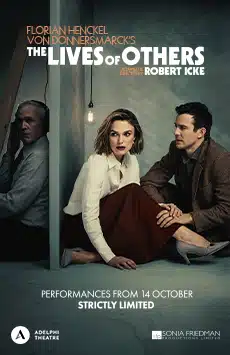
What happens in The Lives of Others?
East Berlin, 1984. The Berlin Wall has another five years to stand, although nobody yet knows that. Gerd Wiesler is a Stasi officer — Hauptmann Wiesler, by rank — a man who has built a career on the careful suppression of his own interior life and the careful exposure of other people's. He teaches interrogation. He believes in the state. He is good at his job.
The assignment
Wiesler is ordered to conduct round-the-clock surveillance on Georg Dreyman, a celebrated East German playwright, and his actress partner, Christa-Maria Sieland. The order comes from above and the justification is thin — Dreyman is the rare cultural figure whose loyalty to the regime has never seriously been doubted. Wiesler doesn't ask why. He installs microphones in their apartment and sets up an observation post in the attic. He listens.
The shift
At first it is routine. Dreyman writes. Christa-Maria rehearses. They argue, they make up, they love each other. Friends visit. Conversations are had. Wiesler records everything. And then, slowly, something starts to happen to him — not in any single moment that he could point to, but as a gradual reorientation. He begins to hear the apartment below not as a target but as a life. Music starts to mean something. The texture of someone else's existence starts to register on him. He doesn't yet know what to do with the fact that he is changing.
The pressure
The assignment, it becomes clear, is not what Wiesler was told. The motivations behind it are political and personal in ways that have nothing to do with state security. Christa-Maria is being pressured by a senior official. Dreyman is being set up. Wiesler holds the surveillance reports that will determine what happens to them — and finds himself, for the first time in his career, beginning to omit, to soften, to lie.
The cost
The play examines the question that gives the source film its quiet, devastating power: what is the price of empathy inside a system that has been engineered to extinguish it? Wiesler does not become a hero. He becomes a man who chooses to risk himself for two people he has never met, who do not know he exists, and who will, for years, never understand what he did. The Lives of Others is, in the end, a play about the smallest possible moral act — and the size of the life it costs.
From film to stage
The 2006 film
Florian Henckel von Donnersmarck's debut feature, Das Leben der Anderen, was released in 2006 and went on to win the Academy Award for Best Foreign Language Film, the BAFTA in the same category, and the European Film Award for Best Film. Two decades on, it sits alongside The Conversation, The Conformist and Three Colours: Red in the small group of post-war European films widely regarded as masterpieces. Its central performance, by Ulrich Mühe as Wiesler, remains one of the most admired pieces of screen acting of the century.
The adaptation
The stage version has been more than a decade in the making. Donnersmarck first approached Tom Stoppard, who said adapting it was not his form but suggested that Sonia Friedman should produce it. It took Friedman years to find the right creative partner before the project came together with Robert Icke, who adapts and directs.
The interesting structural question — how to translate a film whose power depends on long passages of quiet observation, of a single face in close-up, into a live theatrical experience — is exactly the kind of question Icke specialises in. His previous adaptations (Oresteia, Hamlet, The Doctor) have all involved finding stage equivalents for cinematic intimacy. Whatever this production does with the surveillance frame, it will not be a literal transcription of the film.
Robert Icke
Olivier Award winner and former associate director at the Almeida Theatre, Icke is known for psychologically precise, emotionally exposed productions of classical and contemporary material, frequently using minimal sets, contemporary dress and a refusal to underline meaning. His Almeida productions of Oresteia, Hamlet and The Doctor all transferred to the West End.
The cast
Keira Knightley last appeared on a London stage in The Children's Hour at the Comedy Theatre in 2011, opposite Elisabeth Moss. She earned an Olivier nomination for her West End debut in The Misanthrope in 2009. Her film career — Pride and Prejudice, Atonement, The Imitation Game, Colette, Black Doves — is one of the most consistent of her generation. Stephen Dillane is a Tony Award winner for The Real Thing on Broadway and an Emmy winner for John Adams; his screen work also includes Game of Thrones. Luke Thompson, an Olivier Award nominee, became internationally known for Bridgerton. The full company also includes Jamie Ankrah, Jake Benson, Matt Ray Brown, Lucy Doyle, Calum Finlay, Josh Gordon, Paul Higgins, Leda Hodgson, Nick Holder, Sibylla Meienberg, Irfan Shamji, Richard Sutton and Andrew Woodall.
Performance schedule
- Previews begin: 14 October 2026
- Press night: 29 October 2026
- Final performance: 9 January 2027
- Performance times: Evenings 7:30pm, matinees 2:30pm on selected days
- Running time: To be confirmed closer to opening
A strictly limited season
The Lives of Others plays a strictly limited season at the Adelphi Theatre, and with the star casting attached, early booking is recommended. The producers have made more than 36,000 seats across the run available at £35 or under, over a quarter of the total, so it pays to look beyond the headline prices.
Age guidance and content
Recommended for ages 14 and above.
The production contains adult themes including state surveillance and coercion, sexual coercion, and references to suicide. The material is handled with the seriousness the source demands, but it is not light viewing. Parents should consider the content carefully for younger teenagers.
Cast
- Keira Knightley as Christa-Maria Sieland
- Stephen Dillane as Hauptmann Gerd Wiesler
- Luke Thompson as Georg Dreyman
With Jamie Ankrah, Jake Benson, Matt Ray Brown, Lucy Doyle, Calum Finlay, Josh Gordon, Paul Higgins, Leda Hodgson, Nick Holder, Sibylla Meienberg, Irfan Shamji, Richard Sutton and Andrew Woodall.
Creative team
- Adaptation: Robert Icke, from the film by Florian Henckel von Donnersmarck
- Director: Robert Icke
- Designer: Hildegard Bechtler
- Lighting: Jon Clark
- Sound: Giles Thomas
- Video: Tal Yarden
- Original music: Max Richter
Getting there
- Tube: Charing Cross (Bakerloo, Northern) — 3 min walk
- Alternative: Covent Garden (5 min), Embankment (5 min), Temple (8 min)
- Bus: Strand routes 6, 9, 11, 13, 15, 23, 87, 91, 139, 176
- Parking: St Martin's Lane Hotel car park (4 min walk)
About the Adelphi Theatre
The Adelphi is one of the West End's larger and most commercially significant venues, seating approximately 1,500 across the Stalls, Dress Circle, Upper Circle and Balcony. Its current building dates from 1930, with a striking Art Deco interior. The theatre has housed many of the West End's biggest hits.
Accessibility
The Adelphi Theatre offers wheelchair-accessible seating in the Stalls and accessible toilet facilities. Hearing assistance systems are available, and signed and audio-described performances are scheduled on selected dates. Some areas of the building involve steps. The box office can advise on the best access routes and seating positions — contact in advance to plan the visit.
Producers
The West End production is produced by Sonia Friedman Productions, whose credits include Paddington the Musical and Harry Potter and the Cursed Child. Friedman previously produced Keira Knightley in The Children's Hour.