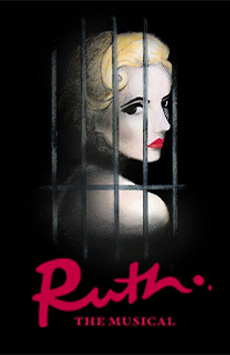
What happens in Ruth?
It is the night of 12 July 1955. In her cell at Holloway Prison, the 28-year-old Ruth Ellis is waiting for the morning. She will be hanged shortly after nine the following day. A man enters the cell. Ruth assumes he is a reporter or a prison official. He is, in fact, Albert Pierrepoint — the hangman who will execute her in the morning.
The flashbacks
Pierrepoint, half-curious and half-haunted, draws Ruth into recounting her life. The musical moves between three Ruths: Mei-Li Yap as the young Ruth being abused by her father Arthur in childhood; Hannah Traylen as the adult Ruth working in London's vice clubs; and Bibi Simpson as the Ruth of the cell, narrating everything from the threshold of her own execution.
The Hollywood Club
Ruth has moved to London and become a nightclub hostess at the fictional Hollywood Club — a "gentlemen's club" of the sort where drinks came with various extras, at a price. The musical does not flinch from the sexual exploitation faced by Ellis and her friends, and the ensemble number "Hypocrites" satirises the moneyed men whose double lives propped up the trade.
David Blakely
Ruth meets David Blakely (Connor Payne), an upper-class amateur racing driver. The relationship is immediately destructive — physically abusive, financially exploitative, repeatedly broken off and resumed. He causes her to miscarry. Throughout it, the devoted Desmond Cussen (John Faal) hovers in the background, hopelessly in love with her. The musical's most affecting number — "You See Me Like This" — captures Ruth's awareness that she is trapped in a love she cannot bring herself to leave.
Easter Sunday 1955
On the evening of 10 April 1955, Ruth waited for Blakely outside the Magdala Tavern in Hampstead and shot him with a Smith & Wesson revolver. She made no attempt to flee and gave a full confession. At her trial, the question of how she obtained the gun — whether from Desmond Cussen and whether under duress — was not properly explored. She was convicted and sentenced to death.
The morning
The musical ends as it began — in the cell, with Ruth and Pierrepoint. The closing moments find an unexpected compassion for both of them: the hangman who never wanted the job, the woman who refused to plead diminished responsibility. Ruth Ellis was hanged at 9.00am on 13 July 1955. She was the last woman executed in Britain. Capital punishment for murder was abolished a decade later.
How a 70-year-old hanging became a 2026 musical
The case
Ruth Ellis was born Ruth Hornby in Rhyl, north Wales, in 1926. After a wartime childhood marked by paternal abuse, she moved to London, worked as a photographer's model and then as a hostess in West End clubs. She had two children, married briefly, and entered into a relationship with the racing driver David Blakely in 1953. The relationship was violent. On Easter Sunday 1955, Ellis shot Blakely outside the Magdala Tavern in Hampstead. She made no attempt to escape, gave a complete confession, and refused at trial to portray Blakely as the abuser he was. The jury took twenty-three minutes to convict. She was hanged at Holloway by Albert Pierrepoint on 13 July 1955.
The public reaction
Public opinion turned sharply against the verdict in the days that followed. A petition for clemency reached the Home Secretary; the case was discussed in Parliament; Raymond Chandler wrote from California denouncing the British legal system. The execution helped accelerate the campaign for the abolition of capital punishment in Britain — abolished for murder in 1965 and finally for all peacetime offences in 1998.
Earlier dramatisations
The Ellis case has been the subject of books (Robert Hancock's Ruth Ellis: The Last Woman to Be Hanged), documentaries, multiple stage plays (including Shelagh Stephenson's A Dance With a Stranger and Amanda Whittington's Ladies' Day spin-off), Mike Newell's BAFTA-winning 1985 film Dance With a Stranger starring Miranda Richardson and Rupert Everett, and a 2024 ITV drama A Cruel Love: The Ruth Ellis Story with Lucy Boynton.
Caroline Slocock and the writing
Ruth was the debut musical theatre work of Caroline Slocock, a former senior civil servant and longstanding campaigner on women's issues. Her co-lyricist John Cameron is a film and theatre composer with credits including orchestrations on Les Misérables and the score for Jeff Wayne's Musical Version of The War of the Worlds. The musical was developed over several years with Ruth Theatre Productions and the Cahoots Theatre Company, in consultation with Ellis's surviving family.
Wilton's Music Hall
Wilton's, in Graces Alley between Cable Street and the Highway, is the world's oldest surviving grand music hall. It opened in 1859, was a Methodist mission for most of the twentieth century, and was rescued from demolition and restored in stages from the 1990s. Its peeling-paint interior and Victorian atmosphere made it a fitting venue for a noir piece set in 1950s London.
The cast
The eleven-strong ensemble included Bibi Simpson (in her professional debut after Guildford School of Acting), Hannah Traylen (Boiling Point feature film), Mei-Li Yap (Rose Bruford American Theatre Art programme graduate 2025), Ian Puleston-Davies (Tin Star, The Responder), Connor Payne (Royal Academy of Music graduate 2025), Garth Bardsley, Paddy Duff (The Mousetrap), John Faal, Sarah Lawn (Noises Off, Blithe Spirit West End), Alice Redmond and Freddy Williams.