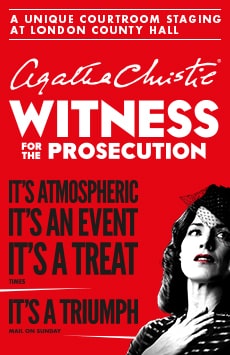
What happens in Witness for the Prosecution?
Witness for the Prosecution is structured in three acts and unfolds, with a single chambers-scene exception, entirely as a courtroom drama. A young man, Leonard Vole, is on trial for the murder of an elderly heiress who had recently changed her will to leave him a substantial inheritance. The play asks the question that every Christie does — did he do it? — but the way it asks it is unusual: almost in real time, almost entirely through testimony, with the audience cast as the jury that has to decide.
The accusation
The play opens in the chambers of Sir Wilfrid Robarts QC, a senior barrister, as Leonard Vole is brought in by his solicitor. Vole is engaging, anxious, and apparently bewildered — he had become friendly with an older woman, Emily French, who had unexpectedly left him most of her estate. The police consider this motive enough. Vole insists his wife Romaine can confirm his alibi for the night of the murder. Sir Wilfrid agrees to defend him. Then Romaine arrives. She is composed, controlled, and not the loyal wife Sir Wilfrid was expecting.
The trial begins
Act Two opens in the Old Bailey — in this production, in the actual Council Chamber around the audience. The prosecution case is led by Mr Myers QC; Sir Wilfrid leads the defence. The first half of the trial is built around the forensic and circumstantial evidence: the will, the time of death, Vole's financial situation. The defence case appears to be holding. Then the prosecution calls its key witness — Romaine Vole — and the trial pivots completely.
The witness for the prosecution
Romaine's testimony is the play's title and its turning point. Christie's stagecraft in this sequence is some of her sharpest — Romaine takes the stand not for her husband's defence but for the Crown, and her evidence appears to destroy the alibi entirely. Sir Wilfrid cross-examines her with increasing desperation. The act ends with Vole's case in apparent collapse and a chance late-night encounter setting up the play's reversal.
The verdict
Act Three returns to the courtroom for closing speeches and the verdict, which lands as a surprise to roughly half the room. The play does not end there. The final scene — a coda, almost — contains one of the most famous double-twists in courtroom drama, and it is the reason Christie always cited this as her favourite of her own adaptations. The chamber-staging gives the closing moments an unusual collective intensity; you can hear other audience members reacting around you.
A note on the famous twist
Christie was insistent that audiences shouldn't be spoiled, and the producers ask audiences to keep the ending to themselves. The 1957 film of the play, directed by Billy Wilder and starring Marlene Dietrich and Charles Laughton, closes with an on-screen plea to that effect. We'll observe the same convention here — but if you've never encountered the story before, the final five minutes are genuinely something.
The play, the source, and the chamber
From short story to stage
Christie first published the story as Traitor Hands in 1925, in Flynn's Weekly magazine. She later renamed it The Witness for the Prosecution for inclusion in her 1933 collection The Hound of Death. The original short story has a sharper, colder twist than the stage version — Christie's 1953 adaptation rewrote the ending substantially, adding both an additional revelation and a final moment of dramatic justice. She always said this was her favourite of her own theatre adaptations, partly because the revisions were entirely hers.
The 1953 West End opening
The play opened at the Winter Garden Theatre, London, on 28 October 1953, directed by Wallace Douglas and produced by Peter Saunders — the same producer behind The Mousetrap, which had opened a year earlier and was already running indefinitely. Witness ran for 468 performances in its original West End engagement and transferred to Broadway in December 1954, where it won the New York Drama Critics' Circle Award for Best Foreign Play and was nominated for Best Play at the Tony Awards.
The 1957 Billy Wilder film
Billy Wilder's 1957 film adaptation, starring Tyrone Power as Leonard Vole, Marlene Dietrich as Romaine, and Charles Laughton as Sir Wilfrid Robarts, secured the play's place in popular culture. The film received six Academy Award nominations including Best Picture, Best Director, Best Actor (Laughton) and Best Supporting Actress (Elsa Lanchester). Christie reportedly preferred it to any other screen adaptation of her work.
The chamber and the venue
London County Hall was the seat of London's local government from 1922 until the GLC was abolished in 1986. The building's Council Chamber — a Grade II*-listed interior in Edwardian Baroque, with timber panelling, a high vaulted ceiling, and a horseshoe-shaped seating arrangement — sat unused for years before being reactivated as a theatre space in 2017. The horseshoe seating layout, originally designed for elected councillors, is almost identical to a 1950s courtroom jury arrangement, which is why the production works in the room as well as it does.
The Lucy Bailey production
The current production opened on 23 October 2017, with Lucy Bailey directing and design by William Dudley. Bailey's previous work includes acclaimed productions at the Royal Shakespeare Company, Shakespeare's Globe, and the Almeida. The production was commissioned specifically for the chamber and has not been staged in this form anywhere else; the audience-as-jury staging is exclusive to County Hall.
Where it sits in the long-runner pantheon
Witness is now one of three long-running Agatha Christie productions in London, alongside The Mousetrap (running since 1952 at St Martin's Theatre) and the various touring revivals of her work. With nearly a decade in the chamber and a current booking line through April 2027, it sits comfortably behind The Mousetrap and The Woman in Black as one of the longest-running plays in the West End — and, by some distance, the most architecturally distinctive of them.
Performance schedule
- Currently booking until: 25 April 2027
- Evenings: Tuesday to Saturday, 7:30pm
- Matinees: Wednesday, Saturday and Sunday, 2:30pm
- Dark: Mondays (typically)
- Running time: Approximately 2 hours 20 minutes, including one 20-minute interval
Schedule may vary around bank holidays and special events at County Hall. Confirm specific dates and times when booking.
The audience-as-jury experience
The production seats the audience around the actual horseshoe of the Council Chamber, in the positions originally designed for council members. Different seating zones offer different experiences: the gallery seats (upper level) give you a top-down view of the entire chamber and full sightlines on every entrance; the floor benches put you closer to the action and the cast genuinely play to you as jurors. Both work. Standard advice: gallery for first-time visitors who want the full architectural impact; floor for repeat visitors who want intimacy.
Age guidance and content
Recommended for ages 12 and above. Children under 5 are not admitted under any circumstances. Everyone, regardless of age, must have their own ticket.
The play deals with murder, infidelity, courtroom interrogation, and references the death penalty as it stood in 1950s Britain. There is no graphic violence or sexual content on stage. The language is courtroom-formal throughout. Most engaged 12-year-olds can follow the trial without difficulty; younger children typically struggle with the dialogue-heavy pacing.
Tickets and pricing
Witness for the Prosecution tickets typically range from £18 to £115 depending on seat and performance. The cheapest seats are restricted-view positions in the upper gallery; the premium seats are on the courtroom floor where the cast play directly to you. Mid-tier seats in the main gallery horseshoe offer the best balance of price, sightlines and atmosphere. Day seats and last-minute releases are occasionally available; check the official website.
Principal cast (rotating company)
The production runs with a rotating ensemble cast and casting changes are made periodically. Principal roles include:
- Leonard Vole — the defendant, a young man accused of murder
- Romaine Vole — his wife, the play's title character
- Sir Wilfrid Robarts QC — leading counsel for the defence
- Mr Myers QC — leading counsel for the prosecution
- Mr Justice Wainwright — the presiding judge
- John Mayhew — Vole's solicitor
- Greta — Sir Wilfrid's secretary
- Janet MacKenzie — Emily French's housekeeper and key prosecution witness
The producers do not promote individual star casting in the way West End musicals do. Confirm the current cast on the official Witness for the Prosecution website when booking.
Creative team
- Writer: Agatha Christie (adapted from her 1925 short story)
- Director: Lucy Bailey
- Set & costume design: William Dudley
- Lighting design: Chris Davey
- Sound design: Mic Pool
- Casting: Original casting by Ginny Schiller
Getting there
- Tube: Waterloo (Bakerloo, Jubilee, Northern, Waterloo & City lines) — 5 minute walk; Westminster (Jubilee, Circle, District lines) — 5 minute walk across Westminster Bridge
- Mainline rail: London Waterloo — 5 minute walk
- Bus: Numerous routes serve the South Bank and Westminster Bridge Road
- Parking: Q-Park Westminster, Great College Street — 10 minute walk across the river
About London County Hall
London County Hall opened in 1922 as the seat of the London County Council, and later the Greater London Council, on the South Bank of the Thames directly opposite the Houses of Parliament. The Grade II*-listed Edwardian Baroque building was designed by Ralph Knott. After the GLC was abolished in 1986, the building was redeveloped, and now houses hotels, the London Sea Life Aquarium, the London Dungeon, and several restaurants. The Council Chamber itself was preserved largely intact and reactivated as a permanent theatre venue for Witness for the Prosecution in 2017. Capacity in performance mode is approximately 550.
Accessibility
London County Hall offers wheelchair-accessible seating, accessible toilets, and step-free access from the main Belvedere Road entrance via lift. The Council Chamber is a heritage interior and some seating positions have restricted sightlines or limited access — contact the access line in advance to discuss specific requirements. Hearing assistance is available for selected performances, and the venue offers captioned and audio-described performances at periodic intervals during the run. Check the official website for upcoming access dates.
Producers
The current production is presented by Eleanor Lloyd Productions and Rebecca Stafford Productions. Eleanor Lloyd is one of the UK's most active independent producers (Emilia, Long Day's Journey Into Night); Rebecca Stafford has co-produced widely across the West End and on tour.