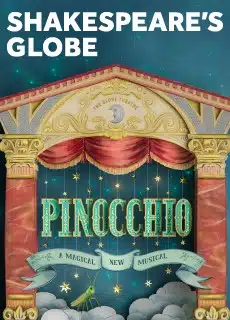
What happens in Pinocchio?
The production centres on Geppetto — reimagined here as a restless maverick rather than the gentle old craftsman of the Disney film. Geppetto is a man of great imagination who longs for connection and purpose. One night he carves a puppet from a block of wood. Much to his own surprise, the puppet comes to life.
Setting out
Pinocchio — curious, impulsive, and entirely ignorant of how the world works — immediately gets into trouble. He is easily deceived by the Fox and the Cat (two wonderfully villainous characters in Collodi's original), who divert him from his education and his responsibilities. He lies, and his nose grows. He makes promises he cannot keep. He is credulous in the face of obviously untrustworthy strangers. He is, in other words, exactly like a child.
The adventures
The show follows Collodi's episodic structure, with Pinocchio encountering a succession of colourful and often threatening characters: Stromboli, the puppet-master who exploits him; Jiminy Cricket, who serves as his conscience; the Blue Fairy, who intervenes at key moments; and the sinister Coachman, who offers children a trip to Toyland — a nightmarish theme park where boys who play instead of study are transformed into donkeys. The show's second-act sequence involving the Coachman is one of its most celebrated moments, combining dark comedy with genuine unease in a way that takes Collodi's surreal original seriously.
The sea
The production culminates with one of Collodi's most famous episodes: the swallowing of Pinocchio and Geppetto by a great fish, and their rescue and reunion within its belly. This sequence, in the Globe's staging, becomes the emotional climax of the show — the moment where everything Pinocchio has been through is redeemed by the love between the puppet and his maker.
What makes Pinocchio human
The show's central question — what does it mean to be human, and is being human something Pinocchio actually wants? — gives the production its emotional weight beyond the adventure. Charlie Josephine's adaptation is honest about the cost of the transformation Pinocchio eventually undergoes, and the ending earns its feeling rather than simply assuming it.
Collodi's original and this adaptation
Carlo Collodi's novel
The Adventures of Pinocchio was written by Carlo Collodi (the pen name of Carlo Lorenzini) and published in installments in an Italian newspaper from 1881, with the complete novel appearing in 1883. Collodi was a Florentine journalist with a gift for satire and a talent for dark comedy — his Pinocchio is a considerably more morally complex figure than subsequent adaptations have suggested. The original novel includes episodes of real violence, death (Pinocchio is hanged by the Fox and Cat at one point, though he is revived), and a sustained meditation on the relationship between childhood irresponsibility and adult consequence that has made the book a staple of literary criticism as well as children's literature.
The Disney distance
Walt Disney's 1940 film adaptation — widely considered one of the finest animated films ever made — significantly softened Collodi's original. Disney's Geppetto is a gentle old man rather than a frustrated inventor; Disney's Pinocchio is straightforwardly loveable rather than genuinely troubling; Disney's ending is unambiguously happy in a way Collodi's is more complicated about. Most people's Pinocchio is Disney's Pinocchio, not Collodi's — which is what makes Charlie Josephine and Sean Holmes's decision to return to the source material genuinely interesting. This Pinocchio remembers what the original was about.
Charlie Josephine
Charlie Josephine is a playwright whose previous Globe work includes I, Joan — the Globe's retelling of Joan of Arc's story — and whose wider credits include Cowbois at the RSC and Royal Court. Their writing is characterised by energy, verbal wit, and a willingness to take familiar stories seriously rather than simply entertainingly. Their Pinocchio has been praised for exactly these qualities: it is funny, fast-moving, and emotionally honest in a way that earns rather than assumes its moments of genuine feeling.
Jim Fortune
Jim Fortune is a composer whose previous credits include Mr Gum and the Dancing Bear at the National Theatre — another successful musical adaptation of a beloved children's story — and Hex. His score for Pinocchio has been praised for integrating well with the storytelling, with the songs driving the narrative forward rather than pausing it for set-pieces. The standout numbers from the 2025 production include a characteristically dark second-act sequence and a blues number performed by Lucy McCormick's Blue Fairy.
Shakespeare's Globe
Shakespeare's Globe is a faithful reconstruction of the original Globe Theatre, in which Shakespeare's plays were first performed. Built on Bankside in Southwark and opened in 1997, it is a working theatre as well as an educational charity. The circular, open-air design — with a central yard for standing audiences and covered galleries around the sides — is as close as it is possible to get to the experience of Elizabethan outdoor theatre. The Globe's decision to stage a festive family musical in this space, rather than confining the winter season to the indoor Sam Wanamaker Playhouse, signals a confidence in the show's theatrical robustness — and the 2025 run vindicated that confidence entirely.
Performance schedule
- Opens: 28 November 2026
- Final performance: 3 January 2027
- Running time: Approximately 2 hours including one interval (based on 2025 run — confirm when booking)
The full performance schedule — including specific days and times — will be published by Shakespeare's Globe closer to opening. Check the official website for the latest information.
Booking tickets
Tickets for Pinocchio at Shakespeare's Globe are available exclusively through the Globe's official website. They are not currently available through third-party booking agents. There are no booking fees when purchasing directly through the Globe. Prices start at £5 for standing yard tickets (groundlings) and go up to £78 for the best covered gallery seats.
Booking link: shakespearesglobe.com/whats-on/pinocchio
What to wear — outdoor theatre in winter
The Globe's yard (standing area) is open to the sky and will be cold in November and December. If you are booking yard tickets, dress warmly — layers, a hat, and waterproof outer layers are strongly recommended. The covered gallery seating is sheltered from rain and wind, though the theatre is not heated. Seat cushions can be hired on the day and make a significant difference to comfort in the galleries. Hot drinks are available at the Globe's bar.
Age guidance
Recommended for ages 5 and above. Children under 16 must be accompanied by an adult. The production is a family musical that works genuinely well for children aged 5 to 12. Younger children will enjoy the puppetry, music, and colour; older children and adults will respond to the story's emotional and thematic depth. The darker elements — the Coachman sequence, the consequences of Pinocchio's lies — are present and treated seriously, but not in a way that is inappropriate for the recommended age group.
Cast (2025 production — 2026 cast TBC)
The 2026 cast has not yet been announced. The 2025 production starred:
- Lee Braithwaite as Pinocchio (voice and primary puppeteer)
- Nick Holder as Geppetto
- Lucy McCormick as Blue Fairy / Cat
- Steven Webb as Jiminy Cricket / Coachman
- Ed Gaughan as Stromboli
- Kerry Frampton as Fox
- Michael Elcock as Carpenter / Rabbit Prince Charming
- With Jennifer Caldwell, Jamal Franklin, Lizzy Ives, Kody Mortimer as ensemble
- Puppeteers: Stan Middleton, Aya Nakamura, Andrea Sadler
Check the Globe website for 2026 casting announcements.
Creative team
- Book & lyrics: Charlie Josephine
- Music & lyrics: Jim Fortune
- Director: Sean Holmes
- Set & costume design: Grace Smart
- Puppetry direction & design: Peter O'Rourke
- Choreography: Vicki Igbokwe-Ozoagu
- Sound design: Tony Gayle
- Orchestrations: Zac Gvi
- Musical director: Benjamin Holder
Getting there
- Walking: 10 minutes along the riverside from London Bridge station (Northern and Jubilee lines) — cross to the South Bank and walk west along the river; the Globe is visible from the path
- Tube: Mansion House (District, Circle lines) — 10 min walk across Southwark Bridge; Southwark (Jubilee line) — 15 min walk
- Bus: Routes 40, 63, N63, N89 stop at Blackfriars Station South Entrance — 8 min walk from the Globe
- Boat: Uber Boat by Thames Clippers stops at Bankside Pier, directly outside the Globe
- Cycling: Santander Cycles docking points directly behind the theatre on New Globe Walk
About Shakespeare's Globe
Shakespeare's Globe is a faithful reconstruction of the original Globe Theatre, opened on Bankside in 1997. It operates as both a working theatre and an educational charity, staging productions year-round in its outdoor amphitheatre and the indoor Sam Wanamaker Playhouse. The Globe's winter season — typically running from late November to early January — is a relatively recent development that has allowed the venue to expand its programming beyond the traditional spring and summer outdoor season.
Accessibility
Shakespeare's Globe provides wheelchair-accessible seating in the covered galleries and accessible toilet facilities. The standing yard is not accessible for wheelchair users. Contact the Globe box office in advance to discuss specific access requirements and book appropriate gallery seating. Audio description, captioning, and relaxed performances are available — check the Globe website for specific dates for the 2026 run.