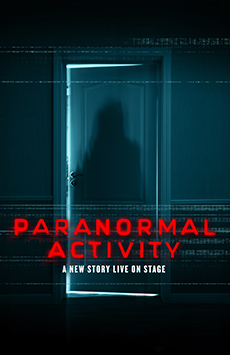
What happens in Paranormal Activity?
James and Lou are a married American couple who have moved from Chicago to a new home in London, hoping a fresh start will let them escape whatever happened in their old life. The play opens in their new flat, and within minutes the audience learns that the move was not just geographic — they are running from something that has followed them across the Atlantic.
The haunting
The first act sets up the conventions: small inexplicable events, doors that close on their own, sounds the couple try to rationalise, electrical interference. Carolanne, an oddly informed neighbour, appears with knowledge of the building's past. Etheline, a less obviously placed figure, drifts in and out of the narrative with motives that take time to clarify. Levi Holloway's script keeps the supernatural deliberately ambiguous early on — most of what is happening could, just about, be explained by stress, by marital tension, by the strangeness of an unfamiliar city.
The marriage
The play's real subject sits underneath the haunting: a marriage built on a shared secret that is consuming both partners differently. Lou is being more directly tormented than James. James is harder to read, and his attempts to comfort her sit oddly. The horror works because the central relationship is plausibly fragile — when something genuinely supernatural arrives, it has a fault line to exploit.
The revelation
The second act is a sustained sequence of escalating events, technical effects, and revelations that the marketing is deliberately careful not to spoil. The phrase the production team uses — "places aren't haunted, people are" — is doing a lot of work. By the closing minutes, the play has reframed what the audience thought they were watching. Multiple critics noted that the ending allows for several interpretations, all of them disquieting.
How Paranormal Activity got to the stage
The film franchise
The original Paranormal Activity, released in 2007 and written and directed by Oren Peli, was a defining moment in modern horror. Made for around $15,000 and grossing nearly $200 million worldwide, it relaunched the found-footage horror genre and established Blumhouse Productions as a leading horror studio. Six further films followed between 2010 and 2021. The franchise's reputation rests on its disciplined use of stillness, slow build, and audience expectation — exactly the qualities that translate unusually well to live theatre.
Levi Holloway and the stage adaptation
The stage version was commissioned several years ago and developed in partnership with Paramount Pictures, who own the film franchise rights. Holloway, whose Broadway play Grey House (2023) established him as a rising voice in stage horror, was brought in to write an original story set in the Paranormal Activity universe rather than adapt any one film. The result is a new narrative that uses the franchise's mythology and atmosphere as scaffolding for a tighter character study.
Punchdrunk and Felix Barrett
Director Felix Barrett founded Punchdrunk in 2000 and has spent two decades reshaping how audiences think about live performance. Productions like The Drowned Man, The Burnt City, and especially Sleep No More — running in New York since 2011 — have made Punchdrunk the most influential immersive theatre company of its generation. Paranormal Activity marks Barrett's first major proscenium-arch production. The discipline of working within a fixed audience perspective, rather than letting audiences roam, has been described by Barrett himself as a deliberate creative constraint that focused the design choices.
The Leeds Playhouse premiere
Paranormal Activity had its world premiere at Leeds Playhouse in summer 2024, where it played a sold-out run with a Leeds-and-New York creative team that has remained largely intact. The success of the Leeds production prompted the West End transfer announcement in early 2025 and confirmed casting in November of that year.
The West End run and return
The West End production opened at the Ambassadors Theatre on 5 December 2025 with previews from late November. It ran initially to 28 February 2026, extending in January to 25 April 2026 and again — for a strictly limited summer/autumn return — from 11 August to 3 October 2026. A US tour began at Chicago Shakespeare Theatre in autumn 2025 and continues through 2026, with a Broadway transfer rumoured but not yet announced.
Performance schedule (Aug–Oct 2026 return)
- Season dates: Tuesday 11 August – Saturday 3 October 2026 (strictly limited 8-week return)
- Evenings: Monday to Saturday, 7:30pm
- Matinees: Friday and Saturday, 2:30pm
- Running time: Approximately 2 hours, including one interval
No late admission. No readmittance if you leave the auditorium after the show has started. Latecomers will be asked to wait until a suitable break — there may not be one.
Content warnings (strictly 15+)
Paranormal Activity is recommended strictly for ages 15 and over. The production contains:
- Moments of high tension and strong language
- Haze, flashing lights, sudden darkness, and strobe effects
- Loud sustained sound at the upper edge of West End volume limits
- Theatrical gore
- Themes including death, premeditated murder, grief, childhood trauma, arson, and road accidents
- Brief references to alcohol misuse
Audience members with heart conditions, sensory processing differences, or sensitivity to horror imagery should consider carefully before booking.
Tickets and pricing
Tickets for the autumn 2026 return range from £28 to £120 depending on seat and performance. Friday and Saturday evening performances are the most expensive and sell first. Group rates are available for groups of 8 or more on selected weekday and Friday matinee performances — contact ATG Tickets for details.
Cast (Aug 2026 return)
Casting for the autumn 2026 return is to be announced. The West End opening run cast included Patrick Heusinger as James, Melissa James as Lou, Pippa Winslow as Carolanne, and Jackie Morrison as Etheline Cotgrave, with Cheyenne Dasri and Jake Solari as understudies. The original West End cast reprised their roles from the Leeds Playhouse premiere.
Creative team
- Writer: Levi Holloway
- Director: Felix Barrett (Punchdrunk founder)
- Set and costume design: Fly Davis
- Illusion design: Chris Fisher
- Lighting design: Anna Watson
- Sound design: Gareth Fry
- Video design: Luke Halls
- Casting: Stuart Burt CDG and Ginny Schiller CDG
Producers
Produced by Simon Friend and Hanna Osmolska for Melting Pot (Life of Pi), in association with Gavin Kalin, Ken Davenport, Patrick Gracey, Jonathan & Rae Corr, and Leeds Playhouse. In association with Paramount Pictures.
Getting there
- Tube: Leicester Square (Northern, Piccadilly lines) — 2 minute walk
- Mainline rail: Charing Cross — 8 minute walk
- Bus: Routes 14, 19, 22, 24, 29, 38, 40, and 176 all stop nearby
- Parking: Q-Park Chinatown, Newport Place — 4 minute walk
About the Ambassadors Theatre
The Ambassadors Theatre opened on 5 June 1913 and is one of the West End's most historic mid-sized houses, with 444 seats across stalls, dress circle, and upper circle. It famously hosted Agatha Christie's The Mousetrap from its premiere on 25 November 1952 until November 1974, when the production transferred next door to the larger St Martin's Theatre. The Ambassadors has also hosted Ivor Novello's stage debut (Deburau, 1921), Paul Robeson in The Emperor Jones, and Vivien Leigh's West End debut (The Mask of Virtue, 1935).
Accessibility
The Ambassadors is a 1913 building with some access limitations. Wheelchair-accessible seating is available in the stalls but spaces are limited. The dress circle and upper levels are accessed by stairs only. Hearing assistance systems are available. For specific access requirements, ATG's dedicated Access line on 0333 009 5399 can confirm seating and book directly. Given the production's reliance on sound and sudden darkness, audience members with sensory sensitivities should contact the access team to discuss whether the production is suitable before booking.