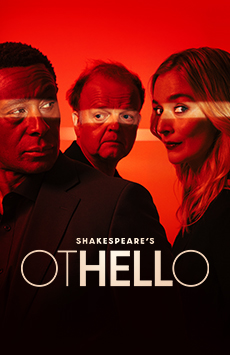
What happens in Othello?
Shakespeare's Othello — first performed around 1604 — follows a Black general in the Venetian military whose marriage to the senator's daughter Desdemona is destroyed by his white ensign Iago. Iago, passed over for promotion in favour of the more junior Cassio, sets out to ruin Othello by convincing him Desdemona is unfaithful. The tragedy is one of the most psychologically intense and racially loaded plays in Shakespeare's canon.
Act I — Venice
The play opens at night in Venice. Iago and Roderigo wake Brabantio, a senator, with the news that his daughter Desdemona has eloped with Othello. Brabantio confronts Othello in the senate; Desdemona testifies to the marriage's legitimacy; the Venetian state, which needs Othello to lead the defence against the Turks at Cyprus, sets the marriage aside as a matter for personal grievance and dispatches the general.
Act II — Cyprus
The action moves to Cyprus, where Othello arrives in triumph. The Turkish fleet has been destroyed by storms; the campaign is over before it begins; Iago's destructive work has space and time to operate. Through the second act, Iago manipulates Cassio into a drunken brawl that costs him his lieutenancy, plants the suggestion in Othello's mind that Desdemona has favoured Cassio, and constructs the famous handkerchief plot.
Acts III–V — destruction
The remaining three acts trace Othello's psychological collapse. Iago's suggestion takes root; Othello's interrogations of Desdemona grow more violent; the second-act handkerchief becomes the false proof Iago needs. The play closes with Othello's murder of Desdemona, Emilia's revelation that her husband Iago has engineered everything, Othello's recognition of what he has done, and his suicide. Iago's final silence — "From this time forth I never will speak word" — closes the play.
Why this play, now
Othello has been continuously performed in English since the early seventeenth century and remains one of Shakespeare's most-revived tragedies in Britain. Major recent London productions before Dyer's included Sam Mendes's 1997 National Theatre staging (with David Harewood — the first Black actor to play Othello at the NT), Trevor Nunn's RSC production (Willard White, with Ian McKellen as Iago), and Nicholas Hytner's 2013 NT staging with Adrian Lester and Rory Kinnear.
How Clint Dyer's Othello came to the National Theatre
Dyer at the National
Clint Dyer joined the National Theatre as Deputy Artistic Director under Rufus Norris in 2020. His credits at the National before Othello included co-writing and directing the Death of England trilogy with Roy Williams (Death of England, Death of England: Delroy, Death of England: Closing Time). The Othello commission was understood within the building as one of Dyer's signature large-scale National Theatre productions.
The casting
Giles Terera had recently completed the original London run of Hamilton, winning the 2018 Olivier Award for Best Actor in a Musical for his Aaron Burr. Othello was Terera's first major National Theatre lead. Rosy McEwen had received strong notices for The Alienist on television and was making her National Theatre debut. Paul Hilton — already a regular at the National — had played central roles in The Inheritance, A View from the Bridge and Mosquitoes. Tanya Franks, an EastEnders regular for her Mum role, was a known face whose stage work was less familiar to most National audiences.
The design
Chloe Lamford's set was a sequence of grey stepped platforms — austere, institutional, and entirely abstracted from period. Michael Vale's costumes mixed contemporary military uniforms with subtle Renaissance silhouettes for the Venetian court. Jai Morjaria's lighting design — for which he had won the Association of Lighting Designer's ETC Award in 2016 — was cold, often overhead, and refused warm colour even in domestic scenes. Lucie Pankhurst's movement direction shaped the ensemble into a near-balletic chorus of complicit white onlookers.
The Lyttelton run and the filming
The strictly limited Lyttelton season ran from 23 November 2022 to 21 January 2023. As is standard for National Theatre productions, the show closed on schedule with no commercial transfer. The production was filmed by NT Live for permanent inclusion in the National Theatre at Home streaming archive, where it remains available — one of the few major Shakespeare productions of the 2020s to be permanently preserved.
The 2025-26 Theatre Royal Haymarket production
A second major West End Othello followed in 2025-26: Tom Morris's commercial production at the Theatre Royal Haymarket, with David Harewood OBE returning to the title role he first played at the National Theatre in 1997, and Toby Jones OBE as Iago. The Morris production was a separate staging — different director, different design, different conceptual framing — and ran from 23 October 2025 to 17 January 2026. It too has now closed.