What happens in Twelfth Night?
Twelfth Night, or What You Will is one of Shakespeare's most-loved comedies, written around 1601–02 and set in the fictional country of Illyria. The play opens with the Duke Orsino lovesick for the Countess Olivia, who is in deep mourning for her recently dead brother and will not see him.
The shipwreck
Elsewhere on the Illyrian coast, Viola — a young woman who has just survived a shipwreck — washes ashore. Her twin brother Sebastian is missing, presumed drowned. Alone and frightened, she decides to disguise herself as a young man named Cesario and seek work in Duke Orsino's court. The play's central engine — its great machinery of mistaken identity — begins here.
The love triangle
Orsino, charmed by his new servant Cesario, sends him to plead his suit to Olivia. Olivia, instead of falling for Orsino, falls in love with Cesario — that is, with Viola in disguise. Viola, meanwhile, has fallen in love with Orsino. A triangle no one can resolve: the woman both men want is in love with one of them and is loved back by the other, and only she knows the truth.
The Malvolio subplot
Parallel to the main plot runs the gulling of Malvolio — Olivia's stiff, self-important steward. Sir Toby Belch (Olivia's drunken uncle), Sir Andrew Aguecheek (a foolish suitor), Maria (Olivia's lady-in-waiting), and Feste (the household fool) conspire to forge a letter from Olivia, leading Malvolio to believe she is in love with him. Malvolio appears before her in yellow cross-gartered stockings, smiling absurdly. Olivia, understandably, concludes he has gone mad. He is locked in a dark room. The comedy of this subplot turns increasingly cruel; Samuel West's Malvolio carried the full weight of its darker register.
The resolution
Sebastian, Viola's twin, has not in fact drowned. He arrives in Illyria, is mistaken for Cesario by Olivia, and (improbably to a modern reader, conventionally to a Shakespeare audience) marries her on the spot. Viola is revealed as a woman. Orsino, freed from his fantasy of Olivia, transfers his affection to her. The play ends with two weddings — Orsino/Viola and Sebastian/Olivia — and Feste alone on stage singing the famous closing song, "When that I was and a little tiny boy / With hey, ho, the wind and the rain..."
Malvolio's exit
Before that song, Malvolio is released from his dark-room imprisonment. He has not gone mad; he has been the victim of a cruel joke. His parting words — "I'll be revenged on the whole pack of you" — are the line on which Puwanarajah's production hinged its tonal complexity. The wedding chorus continues; Malvolio's revenge will never come; but the comedy ends on that hanging note, with Feste's song confirming that the rain rains every day after the show ends.
The 2024 Stratford production and the 2025/26 Barbican transfer
The Stratford original
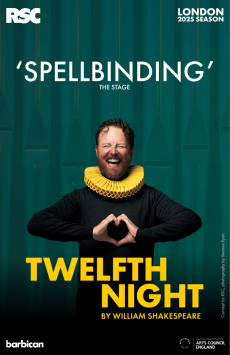
Prasanna Puwanarajah's Twelfth Night first opened at the Royal Shakespeare Theatre in Stratford-upon-Avon in winter 2024. The production was received with consistent four-star reviews: the Guardian called it "a superb, tinsel-inflected take on Shakespeare's melancholy comedy" and singled out Samuel West's Malvolio as achieving "greatness"; The Telegraph called it "bubblingly ingenious"; The Stage said "inspired and spellbinding"; and What's On Stage declared "the RSC has a proper festive winner on its hands." Tickets sold out across the run.
Why Twelfth Night for the Barbican Christmas slot
The choice to put Twelfth Night in the Barbican's December–January Christmas slot, while programming the more conventionally family-friendly Wendy and Peter Pan for the half-term October–November autumn slot, was widely commented on at the time. Co-Artistic Director Tamara Harvey framed it as a deliberate scheduling: Twelfth Night is, after all, the play that names the Christmas season, and Feste's "the wind and the rain" plus Malvolio's "I'll be revenged" together make for a Shakespeare with both festive and reflective notes — a Christmas Shakespeare with a steel core, in our reading. Most critics agreed in retrospect that the scheduling worked.
The London cast changes
The Barbican transfer carried over the Stratford core ensemble — Samuel West as Malvolio, Freema Agyeman as Olivia, Michael Grady-Hall as Feste, Gwyneth Keyworth as Viola — and added Daniel Monks as Orsino, making his RSC debut. Monks had previously been known for stage work at the Donmar Warehouse (Teenage Dick) and television work in Pulse. The supporting ensemble was substantially re-cast for the London transfer: Joplin Sibtain as Sir Toby, Demetri Goritsas as Sir Andrew, Danielle Henry as Maria, and Daniel Millar as Fabian.
The creative team
Prasanna Puwanarajah is one of British theatre's most-watched directors of the 2020s. His credits include the National Theatre, the Bridge, the Royal Court, and prior RSC productions; he also works as an actor and has appeared in television series including Ted Lasso. Set and costume designer James Cotterill, lighting designers Bethany Gupwell and Zoe Spurr, sound designer George Dennis, and movement director Polly Bennett completed the creative team. The original music and songs were composed by Matt Maltese, the British-Canadian singer-songwriter known for the 2018 single 'As the World Caves In' and his subsequent albums; the RSC commission was Maltese's first major theatre score.
The run and the legacy
The London Barbican season ran for six weeks, from 8 December 2025 to 17 January 2026, with a Saturday and Thursday matinee schedule. The RSC's Twelfth Night: Unwrapped — a companion event programmed alongside the production — explored the play's themes and design in more detail. The production closed on schedule and is not currently planned to tour or transfer. Twelfth Night remains one of Shakespeare's most regularly revived comedies; this RSC production will join the list of significant 21st-century stagings alongside Tim Carroll's all-male 2002 production at Shakespeare's Globe with Mark Rylance, and Simon Godwin's 2017 National Theatre version with Tamsin Greig as Malvolia.