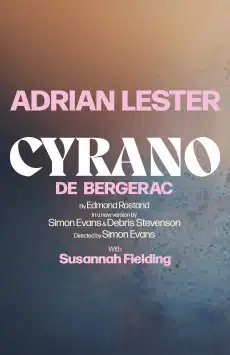
What happens in Cyrano de Bergerac?
Cyrano de Bergerac is a poet, soldier, philosopher, and duellist — one of the most brilliant men in Paris, and one of the most insecure. His nose, which is large enough to have become the defining fact of his public identity, has convinced him that he cannot be loved romantically. He maintains the performance of bravado — slashing wit, magnificent swordsmanship, outrageously extravagant self-mockery — and conceals, beneath it, a profound tenderness he believes he has no right to express.
The woman he loves
Roxane is Cyrano's cousin and childhood friend. She is bold, intelligent, and passionate about words — she falls in love with the man she believes to be expressing himself in the letters she receives, and it is language, not looks, that captures her. What she doesn't know is that the beautiful letters are Cyrano's. She thinks she loves Christian.
The arrangement
Christian de Neuvillette is a young soldier, handsome and kind but hopelessly inarticulate. He can feel everything Roxane deserves to hear and express none of it. Cyrano, who cannot bear to watch Roxane fall for a man who cannot honour her, makes a proposition: he will provide the words, Christian will provide the face. Together, they will give Roxane the man she deserves — or a reasonable facsimile. The balcony scene, in which Cyrano speaks from the darkness while Christian stands visible above, is the play's most celebrated sequence and one of the most beautiful scenes in dramatic literature.
War and consequence
The regiment is sent to war. Cyrano continues writing letters in Christian's name — daily letters, letters of such quality that Roxane travels to the front to find the man who writes them. When Christian, beginning to understand the situation's cruelty, tries to force Cyrano's hand, the action of the play accelerates toward its irreversible conclusion.
The final act
Years later. Roxane lives in a convent. Cyrano visits each week. The ending, which Rostand handles with an economy that makes the final revelation almost unbearable, brings the play's central question — whether love expressed too late is still love — to the only answer it can offer. It is one of the most emotionally devastating conclusions in the classical repertoire, and it arrives after three hours of comedy, swordplay, and poetry that make you entirely unprepared for it.
Edmond Rostand and the play
The historical Cyrano
Savinien de Cyrano de Bergerac (1619–1655) was a real person: a French writer, soldier, and freethinker known for his verbal wit and his duelling. His actual nose may or may not have been unusually large — the evidence is ambiguous — but his reputation for brilliance and outsider status was well established. Rostand took the historical figure as a jumping-off point for something more personal and more myth-like: a story about the unbridgeable gap between who you feel yourself to be and who the world sees when it looks at you.
The 1897 play
Rostand wrote Cyrano de Bergerac in verse — five acts, around 1,600 lines — and it premiered at the Théâtre de la Porte Saint-Martin in Paris on 28 December 1897. The opening night was one of the most celebrated in French theatrical history: a twenty-minute ovation at the end of the first act, the audience reportedly throwing gloves, hats, and capes onto the stage. Rostand was 29 years old. The play made him the most celebrated playwright in France and has never left the international repertoire in the 128 years since.
Previous London productions
London has seen many versions of the play. Anthony Burgess's translation was used in numerous productions over several decades. The most recent major West End production before this RSC version was Jamie Lloyd's 2019 staging at the Playhouse Theatre, starring James McAvoy in a radical deconstruction that used Martin Crimp's adaptation and positioned the play as a meditation on performance and identity. That production won the Olivier Award for Best Revival. Evans and Stevenson's version takes a different approach — rooted in character and emotional directness rather than formal experiment — and has earned its own place in the play's London history.
Simon Evans and Debris Stevenson
Simon Evans is a director and writer best known in theatre for The Dazzle and for directing Inside No. 9: Stage/Fright at Wyndham's Theatre. Debris Stevenson is a spoken-word poet and playwright whose Poet in Da Corner premiered at the Royal Court. Their collaboration on this version began several years before the RSC run, and the result — as critics consistently noted — is an adaptation that doesn't feel like a compromise between two distinct sensibilities but like a genuinely unified new text, where Cyrano's verbal genius is rendered in language that sounds contemporary without being costumey about it.
Performance schedule
- Opens: 13 June 2026
- Final performance: 5 September 2026
- Evenings: Monday to Saturday, 7:30pm
- Matinees: Wednesday and Saturday, 2pm
- Additional matinee: Thursday 23 July at 2pm (in lieu of no matinee on Wednesday 22 July)
- Running time: Approximately 3 hours, including one interval
The schedule may vary — confirm your specific date when booking.
Content warnings
This production contains haze, loud noises including gunfire and explosions, flashing lights and strobe, strong language, and smoking. Children under 16 must be accompanied by and seated next to a ticketholder aged 18 or over. Children under 3 are not admitted.
Cast
- Adrian Lester as Cyrano de Bergerac (Olivier Award winner; Henry V, Othello, The Lehman Trilogy, Hustle, Riviera, The Sandman)
- Susannah Fielding as Roxane (Ian Charleson Award winner; Wolf Hall, Here We Go, A Midsummer Night's Dream)
- Levi Brown as Christian (This Town, Macbeth)
- Scott Handy as Comte de Guiche
- Philip Cumbus as Le Bret
- Christian Patterson as Ragueneau
- David Mildon as Jodolet / Carbon
- Matt Mordak as Valvert / Pierre
- Joseph Christain as Edmond
- Sunny Chung as Sister Claire / Madame Jodolet
- Greer Dale-Foulkes as Abigail
- Rachel Dawson as Ann-Sofie
- Oliver Grant as Jean
- Daniel Norford as Louis
- Chris Nayak as Monfleury / Bernard
- Josh Sneesby as Raphael / Music Director
- Robert Jackson as Arnauld
- Taiva Hove, Joshua Maduike and Elim Mapira share the role of Small Boy
Cast information correct at time of publication and subject to change.
Creative team
- Original play: Edmond Rostand (1897)
- New version by: Simon Evans and Debris Stevenson
- Director: Simon Evans
- Set & costume design: Grace Smart
- Lighting design: Joshie Harriette
- Composer: Alex Baranowski
- Sound design: Donato Wharton
- Movement direction: Sarita Piotrowski
- Fight & intimacy direction: Bethan Clark
- Voice & text: Barbara Houseman
- RSC dramaturg: Rebecca Latham
Tickets and pricing
Tickets start from £18, with a range up to £150. Monday to Wednesday evening seats up to £80 are available at £59.50 (standard offer). Stalls and Royal Circle seats up to £80 are available from £39.50 for Monday to Friday evenings between 15 June and 3 July. Schools can book Grand Circle seats at £25 plus one free teacher place per 10 students for Monday to Wednesday performances.
Getting there
- Tube: Leicester Square (Northern, Piccadilly lines) — 2 minute walk west on Cranbourn Street then south on St Martin's Lane
- Alternative: Charing Cross (Northern, Bakerloo lines) — 2 minute walk north on St Martin's Lane
- Bus: Routes 6, 9, 13, 15, 23, 87 serve the Strand/Trafalgar Square area; routes 24, 29, 176 serve Charing Cross Road
- Cycling: Santander Cycles docking stations on William IV Street and Adelaide Street
About the Noël Coward Theatre
The Noël Coward Theatre (formerly the Albery and the New Theatre) opened in 1903 and is one of the West End's most distinguished venues. Operated by Delfont Mackintosh Theatres, it seats 972 across the stalls, dress circle, and upper circle. Previous productions include Prima Facie with Jodie Comer, The Inheritance, Into the Woods, and Dracula starring Cynthia Erivo. Its elegant Edwardian interior and central St Martin's Lane location make it one of the most desirable mid-scale houses in London.
Accessibility
The Noël Coward Theatre offers wheelchair-accessible seating, hearing assistance systems, and accessible toilet facilities. Contact the theatre in advance to discuss specific requirements and book appropriate seating. Access performances will be announced — check the official website for dates.
Producers
The West End transfer is presented by Wessex Grove and Gavin Kalin Productions in association with the Royal Shakespeare Company.