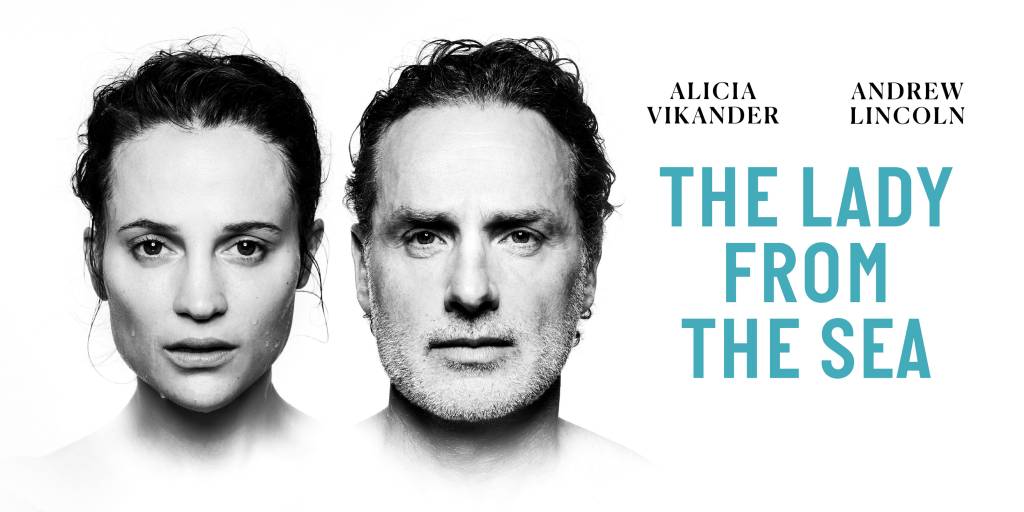
What happens in The Lady from the Sea
The play takes place at a Lake District country house owned by Edward (Andrew Lincoln), a successful neurosurgeon and widower remarried to Ellida (Alicia Vikander), a Swedish writer with a restless inner life. The household includes Edward's two teenage daughters from his first marriage, Asa and Hilda, both grieving their mother's suicide and feeling out of place as the only mixed-race young women in the area. Ellida has recently miscarried.
Into this fragile domestic world come two visitors. Heath (Joe Alwyn) is Edward's distant cousin from Cornwall, a sculptor who has just received a terminal ALS diagnosis. Lyle (John Macmillan) is Edward's old medical-school friend, now a Manchester-based doctor. As the visit unfolds, Ellida reveals a secret from her teenage years: she had a sexual relationship with an older climate-activist named Finn, with whom she once tried to disrupt an oil rig — a confrontation in which a security guard was killed. Finn took the blame and went to prison.
Now Finn (Brendan Cowell) has been released from prison and arrives at the country house to claim Ellida — who once pledged eternal loyalty to him. Across the play's second half, Ellida must decide between the freedom she promised her younger self and the comfortable domestic life she has built with Edward. Stone's ending diverges sharply from Ibsen: in his version, Ellida leaves the household with her suitcase, the outcome left open. Edward jumps into the swimming pool and stays under for so long the audience is forced to wonder whether he will resurface.
Ibsen's original
Henrik Ibsen wrote Fruen fra havet (The Lady from the Sea) in 1888, between his most famous social-realist plays (A Doll's House, Ghosts, Hedda Gabler) and his late symbolist work (The Master Builder, John Gabriel Borkman). The original play is set in a small Norwegian fjord village and concerns Ellida Wangel — a lighthouse keeper's daughter married to the much older Dr Wangel — who is reclaimed by a mysterious sailor from her past. Ibsen explored ideas of marriage, free will, and the strange pull of the irrational and elemental. The play anticipates psychoanalysis by several decades.
Simon Stone's adaptation method
Australian writer-director Simon Stone has built his career on radical rewrites of classical and modern classics. Earlier work in London includes his Olivier Award-winning Yerma (Young Vic, 2016, with Billie Piper) and Phaedra (National Theatre, 2023). His method — described by Time Out as "take a classic play, rewrite it into aggressively modern English that revolves around long, light-hearted stretches of posh people swearing amusingly, season with stage trickery, and finally change tack and wallop us with the tragedy" — has won admirers and detractors in roughly equal measure.
The Lady from the Sea retained the essential plot beats (married woman reclaimed by mysterious lover; husband must choose to let her go) but transposed everything else. Stone also borrowed elements from other Ibsen plays — Heath's terminal illness echoes Dr Rank in A Doll's House and Rubek in When We Dead Awaken — creating what Stone himself has described as an "expanded Ibsen universe."
The Bridge Theatre
The 900-seat Bridge Theatre, opened in 2017 by Nicholas Hytner and Nick Starr's London Theatre Company, has been the venue for several of London's most-discussed productions of the past decade — including Hytner's Julius Caesar, A Midsummer Night's Dream and Guys and Dolls (all promenade), and Ivanov (also a Simon Stone adaptation). The Lady from the Sea was produced by London Theatre Company in association with the Dutch producer Wouter van Ransbeek and was the venue's marquee autumn 2025 production.