What happens in Into the Woods?
Into the Woods is a two-act musical built deliberately around what the audience assumes a fairy tale is. The first act follows the conventional shape and resolves to happy endings. The second act tells you what happened afterwards, and asks what those stories were actually teaching.
Four wishes
A village on the edge of a great forest. Cinderella wishes to attend the King's festival. Jack has been told to sell the family cow because they are starving. Little Red Riding Hood is heading to her grandmother's. And the Baker and his Wife, childless, learn from their neighbour the Witch that they were cursed because the Baker's father once stole from her. The curse lifts only if they bring her four things: a cow as white as milk, a cape as red as blood, hair as yellow as corn, and a slipper as pure as gold.
The first-act quest
Every storyline collides in the woods. The Baker and his Wife pursue the cow, the slipper, the hair and the cape. Jack climbs the beanstalk and finds a Giant. Cinderella runs from her Prince. Little Red meets the Wolf. Rapunzel is shut in a tower by the Witch, who is also her adoptive mother. The act builds to a first-act finale in which every wish is granted, the curse lifts, and everyone lives happily ever after.
The interval
The interval does structural work. Sondheim and Lapine wrote the first act so that it could stand alone — the licensed school version, Into the Woods Jr., is essentially just that act. Audiences return believing they know what kind of evening this is.
The second act
The Giant's widow comes down the beanstalk looking for whoever killed her husband, and starts destroying the village. Cinderella's Prince has already wandered. The Baker is overwhelmed. Characters blame each other, abandon each other, and die. The Witch gets "Last Midnight", a furious indictment of everyone still trying to look blameless. What began as a comedy about wishes becomes a play about consequences and who carries them.
How it ends
The final two numbers are among Sondheim's most loved. "No One Is Alone" is a survivor's song about the responsibility of being one of the ones left. "Children Will Listen" closes the show quietly, on the moral weight of the stories adults choose to tell. The show earns its emotion by refusing the easy version of it.
How Into the Woods got here
Sondheim and Lapine
Stephen Sondheim (1930–2021) wrote lyrics for West Side Story and Gypsy before writing his own music and lyrics from A Funny Thing Happened on the Way to the Forum onwards. The 1970s produced Company, Follies, A Little Night Music and Sweeney Todd; he won the Pulitzer Prize for Sunday in the Park with George in 1985. James Lapine wrote the book for three of Sondheim's most ambitious shows — Sunday in the Park with George, Into the Woods and Passion — and directed each. His approach is unusually literary: Into the Woods is structured around the audience's expectations of a form rather than around a plot.
Premiere and Broadway
The show premiered at the Old Globe Theatre in San Diego in December 1986 and opened on Broadway on 5 November 1987, directed by Lapine, with Bernadette Peters as the Witch and Joanna Gleason as the Baker's Wife. It ran 765 performances and won three Tony Awards, including Best Score and Best Book. Its critical standing has risen steadily since; it is now generally counted among Sondheim's finest.
London before this
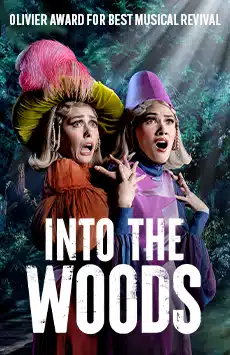
The first West End production opened at the Phoenix Theatre in 1990 with Julia McKenzie as the Witch and a young Imelda Staunton as the Baker's Wife. The Donmar Warehouse revived it in 1998. Regent's Park Open Air Theatre's 2010 staging won the 2011 Olivier Award for Best Musical Revival, with Hannah Waddingham as the Witch. Terry Gilliam directed a version at Theatre Royal Bath in 2022. This Noël Coward run is the first time the show has played the West End in thirty-five years.
The 2014 Disney film
Rob Marshall's film starred Meryl Streep, James Corden, Emily Blunt and Chris Pine, took over $213 million worldwide and drew three Academy Award nominations. It is widely regarded as a softening — the second act's deaths and abandonments are handled far more gently than on stage. For many audiences it was the introduction to the show, which is worth knowing if you are bringing someone who expects it.
Jordan Fein's production
Jordan Fein won the 2025 Olivier Award for Best Musical Revival for Fiddler on the Roof at Regent's Park, and has also directed Oklahoma! at the Young Vic. This was his first Sondheim. Tom Scutt designs set and costumes, following the Kit Kat Club's Cabaret and The Lehman Trilogy. The production opened at the Bridge Theatre in December 2025, extended more than once, and closed there on 30 May 2026 having won two Olivier Awards. The West End transfer is the Bridge Theatre's first in its history.
Performance schedule
- Previews begin: 22 September 2026
- Opening night: 7 October 2026
- Final performance: 9 January 2027
- Running time: Approximately 2 hours 40 minutes, including one interval
Performance times vary across the run, particularly over the Christmas and New Year period. Check the booking calendar for your chosen date rather than assuming a standard pattern.
Tickets and offers
Tickets start from £15 on selected performances. The producers have also run a reduced Stalls and Royal Circle rate on Monday to Thursday performances, a groups rate for parties of ten or more, and a schools rate on Grand Circle and Balcony seats including one free teacher place per ten students booked. All of these carry booking deadlines and date exclusions — check the current terms at the point of booking rather than assuming they still stand. A strictly limited run of this profile tends to lose weekend availability first.
Age guidance and content
Recommended for ages 12 and above. Under-5s will not be admitted, and under-16s must be accompanied by and seated next to a ticketholder aged 18 or over.
- Themes of grief, death and violence — this is the full second act, not the Disney version
- Haze and strobe effects
- Loud noises
- Periods of complete darkness in the auditorium, during which the audience is asked to remain seated
Cast
- Kate Fleetwood as the Witch — returning from the Bridge Theatre run
- John Dagleish as the Baker
- Laura Pitt-Pulford as the Baker's Wife
- Simbi Akande as Cinderella
- Keith Ramsay as Jack
- Gracie McGonigal as Little Red Riding Hood — returning
- Fiona Finsbury as Rapunzel
- Lucas Koch as Rapunzel's Prince
- Matthew Seadon-Young as Cinderella's Prince / the Wolf
- Michael S Siegel as the Narrator
- Jack Quarton as the Steward
Also returning from the Bridge company: Valda Aviks as Grandmother and the Giant, Geoffrey Aymer as Cinderella's Father, Jennifer Hepburn as Cinderella's Stepmother and Alternate Witch, Hana Ichijo as Lucinda, Julie Jupp as Jack's Mother, and Gabrielle Lewis-Dodson as Florinda. Casting for the West End run is by Stuart Burt CDG CSA.
Creative team
- Music & lyrics: Stephen Sondheim
- Book: James Lapine
- Director: Jordan Fein
- Set & costume design: Tom Scutt
- Lighting design: Aideen Malone — 2026 Olivier winner
- Video design: Roland Horvath — 2026 Olivier winner
- Sound design: Adam Fisher
- Musical supervision & direction: Mark Aspinall
Presented by London Theatre Company in association with Jamie Wilson Productions.
Getting there
- Tube: Leicester Square (Northern, Piccadilly) — 2 min walk
- Alternative: Charing Cross (5 min), Covent Garden (5 min)
- Rail: Charing Cross mainline station, 5 min walk
- Bus: Routes stopping on Charing Cross Road and the Strand
- Parking: Q-Park Chinatown, Newport Place
About the Noël Coward Theatre
The Noël Coward opened in 1903 as the New Theatre, designed by W. G. R. Sprague — the same architect responsible for Wyndham's, a few minutes away. It was renamed the Albery in 1973 and became the Noël Coward in 2006. Grade II listed, part of the Delfont Mackintosh group, it seats around 870 across four levels and has long been one of the West End's better rooms for work that needs both scale and detail.
Accessibility
The Noël Coward Theatre has step-free access to the main foyer, an adapted toilet, and a wheelchair space in the Royal Circle, with staff available to assist with entry. As a Grade II listed building from 1903, some areas are not fully accessible and the upper levels involve stairs. Contact the box office in advance to confirm the best seating for your requirements and to ask about assisted performance dates for this run.