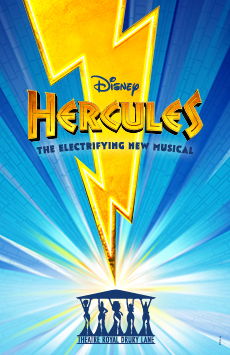
What happens in Hercules?
The musical follows the broad shape of the 1997 Disney animated film, with some restructuring of the songs and several new numbers added for the stage. It's a coming-of-age story dressed up as Greek myth: a boy raised in obscurity discovers he is in fact the son of Zeus, sets out to prove himself a hero, and learns that real heroism is something different from what he thought.
The opening: Olympus and the kidnapping
The show opens on Mount Olympus with the birth of the infant Hercules to Zeus and Hera. The Muses — five (here six) gospel-singing narrators — set up the show's tone with a sassy, knowing prologue ("The Gospel Truth"). Hades, ruler of the Underworld and Zeus's brother, learns from the Fates that if Hercules grows up he will prevent Hades' planned overthrow of Olympus. Hades dispatches his henchmen Pain and Panic — here renamed Bob and Charles — to kidnap the baby and make him drink a potion that will strip his immortality. They succeed, mostly: Hercules is rendered mortal but retains his godlike strength because the boy refuses to finish the bottle.
Growing up in Thebes
Hercules is found and raised by mortal foster parents. As a young man (we cut forward fifteen years), he is enormous, awkward, much too strong for his own good, and considered a freak by his peers ("Today's Gonna Be My Day", a new song for the stage). After accidentally destroying half the village marketplace, he is told the truth of his origins by his foster parents: he was found in the wilderness with a medallion bearing the symbol of Zeus.
Phil and "Go the Distance"
Hercules journeys to the temple of Zeus, where his immortal father appears to him in a famous show-stopping number ("Go the Distance") and reveals that he can only return to Olympus by proving himself a true hero on earth. He must find Philoctetes — "Phil" — a grizzled satyr who has trained dozens of would-be heroes, all of whom have failed. Phil, played in the original London cast by Trevor Dion Nicholas and from 29 June 2026 by Emile Ruddock, has retired and wants nothing to do with another hero. Hercules eventually persuades him.
Meg and the rise to fame
Hercules and Phil set out to make a name. Their first encounter is with Meg — a wisecracking, deeply cynical young woman who has, unknown to Hercules, sold her soul to Hades in exchange for the life of a former lover, and is now Hades' indentured agent. Hercules saves her from a centaur. He falls instantly in love. She is professionally obliged to manipulate him. The Muses narrate his rapid rise to celebrity via the show's biggest production number, "Zero to Hero" — Hercules becomes a Greek tabloid superstar, signing endorsement deals for sandals, action figures and statues. Meg's reluctant love song "I Won't Say (I'm in Love)" is one of the show's emotional highlights.
Hades' gambit and the second act
The second act opens with Hades discovering that Hercules and Meg have genuinely fallen in love — a development that Hades exploits. He offers Hercules a deal: give up his strength for 24 hours in exchange for Meg's safety. Hercules agrees. Hades immediately releases the Titans — long-imprisoned monstrous gods — to attack Olympus, then reveals Meg has been working for him all along.
The finale
The climactic battle sequence — Hercules powerless, the Titans destroying Olympus, Meg risking herself to save Hercules — is the show's most ambitious staging sequence. Hercules' strength returns at the cost of Meg's life. He descends into the Underworld and pulls Meg's soul from the River Styx — proving, by the willingness to die for love, that he is a true hero. He earns the right to return to Olympus. He declines it. Real heroism, he realises, is staying with the woman he loves, on earth, as a mortal. The Muses bring the show home with a final reprise.
How Hercules the Musical got here
The 1997 animated film
Disney's Hercules was released in June 1997, directed by John Musker and Ron Clements (the team behind The Little Mermaid and Aladdin) and featuring the voice of Tate Donovan as Hercules, James Woods as Hades, Susan Egan as Meg, and Danny DeVito as Phil. Released during the tail end of the Disney Renaissance era — the period that gave us The Little Mermaid, Beauty and the Beast, Aladdin, The Lion King, Pocahontas, The Hunchback of Notre Dame, Mulan and Tarzan — it was a moderate commercial success rather than a blockbuster, but acquired a devoted cult following. The Alan Menken / David Zippel score was praised at the time and has aged well; "Go the Distance" was nominated for the Academy Award for Best Original Song.
The road to the stage (2017–2019)
Disney first announced a stage adaptation of Hercules in 2017, with Alan Menken returning to score new songs alongside the film numbers. The road to the stage was unusually long for a Disney property — partly because the development team wanted to develop the book extensively rather than simply restage the film. The first version, conceived as an open-air production, premiered at the Delacorte Theater in Central Park, New York as part of the Public Works initiative in summer 2019. The Public Works version was a community-oriented production with a large amateur ensemble alongside professionals; it was not intended as a commercial transfer but as a developmental staging.
The Paper Mill Playhouse premiere (2019)
The first fully professional production opened at the Paper Mill Playhouse in Millburn, New Jersey, in February 2019, with Bradley Gibson as Hercules. The production was directed by Lear deBessonet (the Public Works founder). Reviews were mixed-positive. Plans for a Broadway transfer were complicated by the COVID-19 pandemic and by Disney's decision to substantially reshape the production before bringing it to a major commercial venue.
The Hamburg production (2024)
Disney's strategic decision was to launch the next major iteration in Hamburg, Germany, at the Stage Theater Neue Flora — a Disney-anchored 2,000-seat venue. The German-language production opened in March 2024 and was the version that established the show's current creative team: Casey Nicholaw replaced Lear deBessonet as director and choreographer, the book was substantially rewritten by Robert Horn and Kwame Kwei-Armah, and Mae Ann Jorolan originated the role of Meg in Hamburg. The Hamburg production ran through May 2025 and confirmed the commercial viability of the rewritten show.
The Theatre Royal Drury Lane London opening (June 2025)
The London production opened at the Theatre Royal Drury Lane on 6 June 2025, taking over from the long-running Frozen. Luke Brady — best known for originating the role of Moses in The Prince of Egypt — led the original London cast as Hercules, with Mae Ann Jorolan transferring from Hamburg as Meg. Trevor Dion Nicholas played Phil and Stephen Carlile took on Hades. Press night was 24 June 2025. The critical reception was politely mixed (see Critical Reception section above), but family audience reception was sufficient for two extensions: first to 18 July 2026, then to the final extension of 5 September 2026 announced in February 2026.
The Casey Nicholaw / Alan Menken team
Casey Nicholaw is one of the most in-demand musical theatre directors and choreographers of his generation. His credits include The Book of Mormon (Tony for Best Direction), Aladdin (Broadway and West End), Something Rotten!, Mean Girls, The Drowsy Chaperone, and most recently The Greatest Showman — currently in workshop / try-out at Bristol Hippodrome ahead of a widely anticipated West End opening.
Alan Menken is the most decorated film composer in Academy Award history alongside Walt Disney himself — eight Oscars, eleven Golden Globes, eleven Grammys. His Disney credits include The Little Mermaid, Beauty and the Beast, Aladdin, Pocahontas, The Hunchback of Notre Dame, Hercules, Tangled, and Enchanted. He has been the composer of choice for Disney's stage musicals for over thirty years.
David Zippel is the Tony-winning lyricist (City of Angels) who has collaborated with Menken on Hercules, Captain Marvel and other projects. The Hercules film songs are among his most loved lyrical work.
Kwame Kwei-Armah is the British playwright, actor and director, former Artistic Director of the Young Vic (2018–2023) and the recipient of an OBE for services to drama. Hercules is his first major commercial musical credit and one of the few mainstream West End / Broadway musicals with a Black British co-writer.
The 2026 cast change
In April 2026, Disney announced that Bradley Gibson — who originated the role of Hercules at the 2019 Paper Mill Playhouse premiere before going to Broadway to play Simba in The Lion King — would take over the role in London from 29 June 2026 for the final run through to 5 September 2026. Emile Ruddock (ensemble in The Greatest Showman at Bristol Hippodrome) takes over from Trevor Dion Nicholas as Phil. Several of the Muses also changed — Leslie Beehann moves from Calliope to Terpsichore, Kimmy Edwards joins as Clio, Malinda Parris returns as Calliope, and Paige Peddie joins as Melpomene. Mae Ann Jorolan remains as Meg throughout, Stephen Carlile remains as Hades.
Performance schedule
- Dates: 6 June 2025 – 5 September 2026 (final London run, no further extensions confirmed)
- Press night: 24 June 2025
- Running time: Approximately 2 hours 10 minutes, including one interval
- Schedule: Monday to Saturday at 7.30pm; Thursday and Saturday matinees at 2.30pm; no Sunday performances. The Monday performances are unusual for a Drury Lane musical — confirm exact times when booking.
- Cast change: Bradley Gibson takes over as Hercules from 29 June 2026; new principal company from that date
Access performances
- Audio Described: 15 May 2026
- Captioned: 20 April 2026, 7.30pm
- Signed (BSL): 6 May 2026
- Additional access performances: Contact LW Theatres Access Scheme for further dates through September 2026
Age guidance and content
Recommended for ages 6+. Children under 4 (including babies in arms) will not be admitted to the theatre. All persons aged 16 or under must be accompanied by an adult aged 18 or over and seated next to them. Every audience member regardless of age must have their own ticket.
- Battle sequences with monsters and the Hydra
- Hades and the Underworld setting include some dark visual elements
- Strobe and pyrotechnic effects
- Loud music throughout
- Themes of identity, belonging, and self-sacrifice (broadly Disney-film level intensity)
- No content that diverges significantly from the 1997 film's rating
Tickets and pricing
Disney's Hercules tickets at the Theatre Royal Drury Lane range from £29.50 to £90 depending on seat and performance. Saturday evenings and prime Friday slots sit at the higher end; Tuesday and Wednesday evening performances and Thursday matinees offer the best value. The Lightning Performances scheme offers best-available seats at £62 for selected Tuesday evening performances from September 2025. Group rates (10+) and school packages are available — contact LW Theatres directly.
Principal Cast (from 29 June 2026 — final London run)
- Bradley Gibson as Hercules (originated role at 2019 Paper Mill Playhouse world premiere)
- Mae Ann Jorolan as Meg (continues from original London cast)
- Emile Ruddock as Phil
- Stephen Carlile as Hades (continues from original London cast)
- Craig Gallivan as Bob
- Lee Zarrett as Charles
- Felipe Bejarano as Standby Hercules / Swing
The Muses (from 29 June 2026)
- Leslie Beehann as Terpsichore
- Kimmy Edwards as Clio
- Candace Furbert as Thalia
- Malinda Parris as Calliope
- Paige Peddie as Melpomene
- Psalms-Nissi Myers-Reid as Standby Muse
- Francessca Daniella-Baker as Standby Muse
Original London cast (June 2025 – 28 June 2026)
Luke Brady (Hercules), Trevor Dion Nicholas (Phil), Mae Ann Jorolan (Meg), Stephen Carlile (Hades), Craig Gallivan (Bob), Lee Zarrett (Charles), Brianna Ogunbawo and Sharlene Hector among the original Muses.
Creative team
- Music: Alan Menken
- Lyrics: David Zippel
- Book: Robert Horn & Kwame Kwei-Armah
- Director & choreographer: Casey Nicholaw
- Co-choreographer: Tanisha Scott
- Set design: Dane Laffrey
- Costume design: Sky Switser
- Lighting design: Jeff Croiter
- Sound design: Brian Ronan
- Video design: George Reeve
- Original orchestrations: Danny Troob (film), Doug Besterman (stage)
- Producer: Disney Theatrical Productions
Getting there
- Tube: Covent Garden (Piccadilly) — 5 minute walk; Holborn (Central, Piccadilly) — 7 minute walk; Temple (District, Circle) — 8 minute walk; Charing Cross (Bakerloo, Northern) — 10 minute walk
- Mainline rail: Charing Cross — 10 minute walk; Waterloo East — 15 minute walk via Waterloo Bridge
- Bus: Aldwych stop served by routes 6, 11, 13, 23, 59, 68, 87, 171, 172, 188, RV1, X68; night buses include N11, N13, N26, N47, N68, N87, N89, N155, N171, N551
- Parking: Drury Lane car park (5 min walk); Parker Street car park; on-street parking heavily restricted
About the Theatre Royal Drury Lane
The Theatre Royal Drury Lane is the oldest continuously functioning theatre site in the world, with the current building (the fourth on the site) opened in 1812. It has hosted productions since 1663, when the original was built under royal charter from King Charles II. Across its history it has been associated with figures including David Garrick, Edmund Kean, Henry Irving, and Andrew Lloyd Webber. The 2,196-seat auditorium across four levels (Stalls, Royal Circle, Grand Circle, Balcony) makes it one of the largest West End theatres. It was extensively refurbished by Andrew Lloyd Webber's LW Theatres group between 2019 and 2021, restoring much of the original Edwardian and Georgian decoration while modernising backstage facilities. Recent productions include Frozen (2021–2024), the long-running 42nd Street, and Charlie and the Chocolate Factory. It is Grade I-listed.
Accessibility
The Theatre Royal Drury Lane was extensively refurbished in 2021 with full accessibility prioritised: step-free access from the Russell Street entrance, a passenger lift to all four auditorium levels, dedicated wheelchair spaces available on every level except the Balcony, accessible toilets on multiple levels, and hearing assistance via infrared. The theatre is part of the LW Theatres Access Scheme — register in advance via the LW Theatres website to discuss specific requirements and book accessible seating. Audio-described, captioned and BSL-interpreted performances run periodically during the production.
Producers
The production is produced by Disney Theatrical Productions, the Disney subsidiary responsible for the company's stage musical output — current and recent shows include The Lion King (Lyceum), Aladdin (Prince Edward, closed 2025), Frozen (Drury Lane, closed 2024), and the developing Greatest Showman musical currently in workshop at Bristol Hippodrome. The Theatre Royal Drury Lane is owned and operated by LW Theatres, the theatre-owning arm of Andrew Lloyd Webber's Really Useful Group, which also operates the Adelphi, Cambridge, Drury Lane, Gillian Lynne, Her Majesty's (His Majesty's), London Palladium and Sondheim theatres.