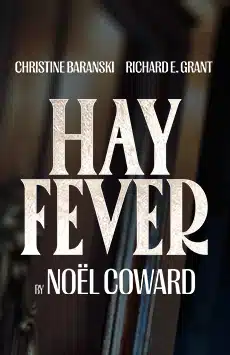
What happens in Hay Fever?
The Bliss family live in a country house in Cookham and have no discernible interest in anyone outside it, including each other. Judith retired from the stage a year ago and has discovered that domestic life provides no applause. David is upstairs writing a novel. Sorel and Simon, both adults, are conspicuously failing to launch. It is a household where everyone is the lead in a production nobody else is watching.
Four guests, one weekend
Each of the four Blisses invites someone to stay for the weekend, and none of them mentions it to the others. Judith has asked a young admirer, Sandy Tyrell. Simon has invited the worldly Myra Arundel. Sorel has asked the respectable diplomat Richard Greatham. David has invited the very young, very nervous Jackie Coryton. Four strangers arrive at the same house on the same afternoon expecting a pleasant country weekend.
Hospitality as blood sport
The Blisses are not cruel so much as entirely uninterested in the concept of a guest. Rooms are unallocated, dinner is unplanned, and Clara — the family's former dresser, now their housekeeper — is left to manage a situation nobody has thought about. What the visitors receive instead of hospitality is a running performance: parlour games with rules that seem to be invented on the spot, and a family that treats sincerity as the one unforgivable social error.
The realignment
By the second act, every guest has been paired off with the wrong Bliss, each pairing announced with enormous theatrical conviction and abandoned about ten minutes later. Judith in particular treats every romantic development as a scene from a play she once starred in, delivering renunciations and forgivenesses that no one has asked for and that mean nothing by the following morning.
Escape
The visitors reach the same conclusion at roughly the same time. The final act is one of the great comic exits in English theatre: four people creeping out of a house at breakfast while the family, absorbed in an argument about the geography of a novel, fails to notice them leaving. Nothing has been learned. Nothing has changed. That is precisely the joke.
Why Hay Fever?
Written in three days
Coward wrote Hay Fever in 1924, reportedly over a single weekend, and it opened in London in 1925 when he was twenty-five. It arrived in the same period as The Vortex, the play that made his reputation as a serious dramatist. Hay Fever is the opposite proposition: no scandal, no substance, no moral. Coward himself noted that the play had no plot and very little action, and considered that a feature rather than a defect.
Where the Blisses came from
The family is generally understood to have been inspired by the American actress Laurette Taylor and her household, where Coward spent time in New York and where guests were routinely conscripted into elaborate, aggressively competitive parlour games. The play's central comic engine — theatrical people who cannot stop performing even at home — was drawn from life.
A comedy of bad manners
The English comic tradition of manners usually turns on characters straining to observe social rules. Coward inverts it. The Blisses know the rules perfectly well and simply decline to apply them, while their guests, who observe every convention, are left with no defence at all. The comedy comes from watching politeness lose, repeatedly, to sheer force of personality.
Why it survives
Hay Fever has been revived continuously for a century, including a famous 1964 National Theatre production that Coward directed himself with Edith Evans as Judith — the first time the National staged a play by a living English playwright. It endures because the central observation has not dated: the funniest thing about self-absorbed people is that they are entirely sincere about it. Judith is not pretending to feel everything enormously. She really does.
Emily Burns's production
Burns directs, with set and costume design by Frankie Bradshaw, lighting by Oliver Fenwick and sound by Tingying Dong. The production is presented by Wessex Grove and Gavin Kalin Productions. Burns's previous work, including Jack Absolute Flies Again at the National Theatre, suggests a director more interested in the mechanics of comic timing than in period reverence, which is the right instinct for a play whose reputation has occasionally suffered from being staged too politely.
Performance schedule
- Previews begin: 22 September 2026
- Press night: 1 October 2026
- Final performance: 12 December 2026
- Evenings: Monday to Saturday, 7:30pm
- Matinees: Wednesday and Saturday, 2:30pm
- Running time: Approximately 2 hours 20 minutes, including one interval
A strictly limited season
Hay Fever plays a 12-week engagement only. Wyndham's seats around 750 people across four levels, which means the total ticket inventory for the entire run is modest by West End standards. With casting of this profile, weekend performances and the weeks immediately following press night are likely to go first. Additional tickets were released in August 2026.
Age guidance and content
Our editorial guidance is 12 and above.
There is no formal age rating for this production. Wyndham's Theatre requires everyone, regardless of age, to hold their own ticket; under-16s must be accompanied by and seated next to a ticketholder aged 18 or over; and children under 3 are not admitted. The production contains flashing lights and the smoking of cigarettes on stage. The humour is verbal, social and adult in register rather than in content — there is nothing unsuitable here, but younger children will simply be bored.
Cast
- Christine Baranski as Judith Bliss (The Good Wife, The Good Fight, The Gilded Age)
- Richard E. Grant as David Bliss (Withnail and I, Can You Ever Forgive Me?, Saltburn)
- Ophelia Lovibond as Sorel Bliss (The Hills of California, Minx)
- Will Close as Simon Bliss (Dear England, National Theatre and West End)
- Nancy Carroll as Myra Arundel (After the Dance, National Theatre)
- Charles Edwards as Richard Greatham (Best of Enemies, The Line of Beauty)
- Ash Hunter as Sandy Tyrell (Hamilton, West End)
- Lucy Karczewski as Jackie Coryton (Stereophonic, West End)
- Jo McInnes as Clara (4.48 Psychosis, Royal Court and RSC)
The company is completed by Helena Antoniou, Charlotte Avery and Shaun Mendum.
Creative team
- Writer: Noël Coward
- Director: Emily Burns
- Set and Costume Design: Frankie Bradshaw
- Lighting: Oliver Fenwick
- Sound: Tingying Dong
- Fight and Intimacy Director: Bethan Clark
- Dialect Coach: Danièle Lydon
- Associate Director: Blythe Stewart
- Casting: Jim Carnahan CSA and Liz Fraser CSA
Getting there
- Tube: Leicester Square (Northern, Piccadilly) — 2 min walk
- Alternative: Covent Garden (5 min), Charing Cross (7 min), Tottenham Court Road (8 min)
- Bus: Routes 24, 29 and 176 stop on Charing Cross Road
- Parking: Q-Park Chinatown, Newport Place
About Wyndham's Theatre
Wyndham's opened on 16 November 1899, designed by W. G. R. Sprague for the actor-manager Sir Charles Wyndham, and is Grade II* listed. It seats around 750 across four levels — Stalls, Royal Circle, Grand Circle and Balcony — and has been operated by Delfont Mackintosh Theatres since 2005. It has always been a house for spoken drama rather than musicals, which is why plays of this scale keep returning to it.
Accessibility
Wyndham's Theatre provides wheelchair spaces in the Stalls with step-free access, a hearing assistance system and accessible toilet facilities. As a listed Edwardian building, other levels involve stairs. A captioned performance is scheduled for 2.30pm on Saturday 31 October 2026, and an audio-described performance for 7.30pm on Tuesday 3 November 2026. Contact the box office in advance to confirm the best seating for specific access requirements.
Producers
Hay Fever is produced by Wessex Grove and Gavin Kalin Productions at Wyndham's Theatre, a Delfont Mackintosh Theatre.