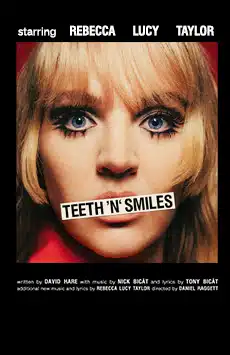
What happens in Teeth 'n' Smiles?
It is summer 1969. The Skins, a minor rock band whose moment was three years ago, have been booked to play a Cambridge University May Ball. The student who booked them, Anson, is a medical undergraduate who thinks he's just secured the gig of the year. He hasn't. The band is at war with itself; their lead singer, Maggie Frisby, is at war with everyone.
The set-up
The first scenes establish the band: Saraffian, the band's manager, who knows exactly how disposable they all are; Inch, the roadie; Smegs, Peyote, Wilson, and Nash, the musicians; and at the centre, Maggie — once the band's reason for existing, now the reason it can't function. She arrives onstage carried in unconscious by her bandmates. The play is structured around the three sets the band will play during the night and the increasingly catastrophic backstage scenes between them.
The first set
The band play. Maggie performs. She is, the play makes clear, very good — her voice is the only reason any of these people have a career. Between sets, the band fight. Arthur — a former member of the band turned songwriter, now Maggie's ex — is trying to talk her into something she doesn't want to discuss. The class lines between the band and the students are immediately visible.
The second set
Things deteriorate. Anson, the medical student, has provided Maggie with drugs and has started to realise what kind of mistake that was. Saraffian launches into a long monologue about something that happened to him in the war — one of the script's most divisive sections — that is, depending on your reading, profound or interminable. The second set ends with Maggie incoherent.
The third set and the aftermath
The third set never properly happens. Maggie's behaviour at the gig has catastrophic consequences — for the band, for Anson, and for her own future. The play's ending is bleak but not nihilistic: Maggie chooses what she chooses, with full knowledge of the cost, and Hare gives her the dignity of meaning it. Taylor's Maggie's Song — Taylor's new contribution to the score — lands in this section.
Why the play matters
Hare was 28 when he wrote Teeth 'n' Smiles in 1975, inspired by watching Manfred Mann play a university ball at his own Cambridge. The play arrived as one of the first serious British dramas to take rock music seriously, six years before The Wall, two years before punk broke. Its reputation rests on its prescience — the figure of the burned-out, drug-damaged front-woman is now familiar; in 1975 it was new. The 50th anniversary revival foregrounds that lineage, with Self Esteem's Maggie standing in for everyone from Janis Joplin to Amy Winehouse.
How Teeth 'n' Smiles got here
The 1975 premiere
Teeth 'n' Smiles premiered at the Royal Court Theatre on 2 September 1975, directed by David Hare himself. The original cast was led by a 30-year-old Helen Mirren as Maggie Frisby, with Dave King as Saraffian, Jack Shepherd as Arthur, Karl Howman as Inch, and the live band performing original songs by Nick and Tony Bicât. The production was an immediate critical and commercial success and transferred to Wyndham's Theatre in 1976 for a West End run. It established Mirren — already a rising classical actress — as a contemporary stage star, and confirmed Hare, a year after Knuckle, as one of the most important young playwrights of his generation.
The David Hare arc
Sir David Hare (born 1947) is one of the defining British playwrights of the last fifty years. Teeth 'n' Smiles sits in the early phase of his career, alongside Slag (1970), Knuckle (1974), and the National Theatre's Plenty (1978). The major works that followed — The Secret Rapture, Racing Demon, Skylight, Amy's View, The Vertical Hour, The Absence of War, The Power of Yes, and recently Grace Pervades at the Theatre Royal Haymarket — established him as the chief chronicler of post-war British public life. He has also written extensively for film and television, including the screenplays for The Hours, The Reader, Page Eight, and Collateral. He was knighted in 1998.
Helen Mirren and the role's legacy
Helen Mirren's original Maggie Frisby is widely regarded as one of the great early performances of her career, predating her film stardom and her later National Theatre and RSC seasons. The role established what the play asks of its lead — singing ability, comic timing, the capacity to play a character who is awful to be around without losing the audience's sympathy — and set a bar that has discouraged regular revivals. Until this year, the play had not had a major London production since the 1970s.
Rebecca Lucy Taylor / Self Esteem
Rebecca Lucy Taylor (born 1986) was previously one half of indie duo Slow Club, releasing five albums between 2009 and 2014. She launched her solo project, Self Esteem, in 2017. The 2021 single I Do This All The Time and the 2021 album Prioritise Pleasure made her one of the most acclaimed British pop artists of the decade; her 2024 album A Complicated Woman was Mercury-nominated. She made her stage acting debut in Cabaret at the Kit Kat Club in 2025, opposite Jake Shears, and brought her own concert show A Complicated Woman Live to the Duke of York's Theatre in spring 2025 — a fact that gives this engagement a curious symmetry. Teeth 'n' Smiles is her first straight play.
Daniel Raggett and the creative team
Daniel Raggett directs. His recent credits include the acclaimed Accidental Death of an Anarchist (Lyric Hammersmith / Theatre Royal Haymarket / Olivier nomination), Richard II (Bridge Theatre), and Anna X (Harold Pinter Theatre). The creative team includes Chloe Lamford (set), Alex Mullins (costume), Matt Daw (lighting), Ben & Max Ringham (sound), Liam Godwin (music supervisor), and Polly Bennett (movement choreographer, who also choreographed Taylor's Self Esteem live shows).
The 50th anniversary revival
The revival was announced in September 2025, with full casting confirmed in January 2026. It opened at the Duke of York's Theatre on 13 March 2026 for a 12-week strictly limited season, with press night on 25 March. The choice of venue is pointed: the Duke of York's also hosted Stereophonic in 2025, the Pulitzer Prize-winning play about a fictional 70s rock band, and the producers have leaned into the connection. The production is produced by Wessex Grove and Gavin Kalin Productions.
Performance schedule
- Dates: 13 March – 6 June 2026 (12-week limited season)
- Press night: 25 March 2026
- Running time: Approximately 2 hours 20 minutes, including one interval
- Schedule: Confirm specific performance times when booking
NT Live filming
Both performances on Wednesday 27 May 2026 will be filmed for NT Live. Cameras will be positioned in the Stalls, and some seats will have restricted views as a result. If you want to be part of the recorded audience, this is the date; if you'd prefer unobstructed sightlines, choose another performance. The NT Live cinema release date will be confirmed separately.
Age guidance and content
Recommended for ages 14 and above. The production contains:
- Simulated drug use, drug references, and use of needles
- Smoking on stage
- Strong language throughout
- Adult themes including addiction, sexual references, and a depiction of mental collapse
- A live dog onstage in close proximity to the audience
- Loud live music
Tickets and pricing
Teeth 'n' Smiles tickets range from £24.40 to £137 depending on seat and performance. Saturday evenings sit at the higher end; Monday–Thursday performances offer the best value. The production has limited £25-£30 discount tickets for under-30s on selected performances — check the box office for availability.
Cast
- Rebecca Lucy Taylor as Maggie Frisby
- Phil Daniels as Saraffian (band manager)
- Michael Fox as Arthur
- Michael Abubakar as Wilson
- Roman Asde as Anson
- Bill Caple as Nash
- Joseph Evans as Randolph
- Samuel Jordan as Smegs
- Aysha Kala as Laura
- Jojo Macari as Peyote
- Christopher Patrick Nolan as Snead
- Noah Weatherby as Inch
- Damien James, Gregor Milne — Ensemble
- Guy Amos, Daniel Crespin, Levi Heaton — Understudies
Creative team
- Writer: David Hare
- Music: Nick Bicât
- Lyrics: Tony Bicât
- Additional new music and lyrics: Rebecca Lucy Taylor
- Director: Daniel Raggett
- Set design: Chloe Lamford
- Costume design: Alex Mullins
- Lighting design: Matt Daw
- Sound design: Ben & Max Ringham
- Music supervisor: Liam Godwin
- Movement choreographer: Polly Bennett
- Fight director: Alex Payne
- Associate director: George Jibson
- Casting director: Bryony Jarvis-Taylor CDG
- Producers: Wessex Grove and Gavin Kalin Productions
Getting there
- Tube: Leicester Square (Piccadilly, Northern) — 2 minute walk; Charing Cross (Bakerloo, Northern) — 5 minute walk; Covent Garden (Piccadilly) — 5 minute walk; Embankment (District, Circle, Bakerloo, Northern) — 7 minute walk
- Mainline rail: Charing Cross — 5 minute walk
- Bus: Routes 24, 29, 176 along Charing Cross Road; 6, 9, 11, 15, 87, 91 along Trafalgar Square
- Parking: Q-Park Chinatown (5 min walk); on-street parking is heavily restricted
About the Duke of York's Theatre
The Duke of York's Theatre opened in 1892 as the Trafalgar Square Theatre, designed by Walter Emden and built by the impresario Frank Wyatt and his wife Violet Melnotte. It was renamed in 1895 to honour the future King George V. The 640-seat Grade II-listed Victorian auditorium has hosted some of the West End's most celebrated productions and performers — Sir Ian McKellen, Orlando Bloom, Michael Gambon, Jeremy Irons, and most recently the Pulitzer-winning Stereophonic. The theatre is owned and operated by ATG Entertainment.
Accessibility
The Duke of York's Theatre offers wheelchair-accessible seating in the Stalls, hearing assistance via infrared system, accessible toilets, and trained staff. The theatre is a Grade II-listed Victorian building with some access limitations — including stairs to certain seating levels. Contact the ATG access line in advance to discuss specific requirements and book accessible seating.
Producers
The production is produced by Wessex Grove — the major British commercial producer behind Plaza Suite, Vanya with Andrew Scott, and The Hills of California — and Gavin Kalin Productions, the prolific London/Broadway commercial producer with credits including Operation Mincemeat, Stranger Things: The First Shadow, and The Lehman Trilogy.