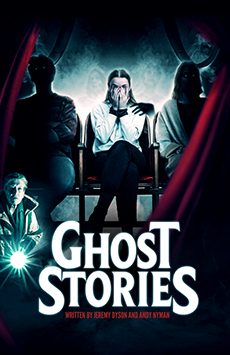
What happens in Ghost Stories?
Professor Philip Goodman is a Professor of Parapsychology and a long-standing arch-sceptic. His public life is devoted to debunking the paranormal — exposing fraudulent mediums, dismantling apparent hauntings, attacking what he sees as the dangerous ground supernatural belief gives to delusion and grief. The play opens with Goodman addressing the audience directly as if delivering one of his university lectures.
The three case files
Goodman walks the audience through three case files he has been unable to explain, each dramatised in turn as the lights shift on Jon Bausor's set.
Case one. Tony Matthews, a night watchman, is alone in a disused converted asylum on a routine overnight shift. The lights start to behave strangely. He hears a child. The play's first sustained sequence of stage-managed dread.
Case two. Simon Rifkind, a teenage boy, has been driving alone through woodland when he hits something. Or someone. The car will not start. He is convinced he is being watched.
Case three. Mike Priddle, a businessman, is at home awaiting the imminent birth of his first child when a presence begins to make itself known in the nursery.
The final act
Goodman returns to the lectern. The three case files appear to be over. They are not. The play's final twenty minutes — kept deliberately unspoiled by reviewers, audiences and producers since 2010 — recontextualise everything the audience has watched in a way that the production has insisted, successfully for fifteen years, must remain secret. It is the reason the show carries an age guidance of 15+, the reason the production specifies "moments of extreme shock and tension", and the reason audience members leave the theatre still talking about it days later.
How Ghost Stories became a 15-year theatrical fixture
The Lyric Hammersmith commission
Ghost Stories began as a conversation between Andy Nyman and Sean Holmes, the newly appointed artistic director of the Lyric Hammersmith. Nyman had walked past the Fortune Theatre — long-time home of The Woman in Black — and noticed there had been no serious horror play produced in London since. He approached his childhood friend Jeremy Dyson, co-creator of The League of Gentlemen and a long-standing horror enthusiast, with the idea of a multi-strand ghost story play. Holmes commissioned them.
The 2010 premiere and the original Olivier nomination
Ghost Stories had its world premiere at the Liverpool Playhouse on 4 February 2010 in a co-production with the Lyric Hammersmith, transferring to the Lyric on 1 March 2010. The original cast included Andy Nyman himself as Professor Goodman. The production received an Olivier Award nomination and transferred to the Duke of York's Theatre in the West End from 25 June 2010 to 19 June 2011.
Further West End runs
The show returned to the West End in 2014 at the Arts Theatre and again in 2019 at the Ambassadors Theatre, following a renewed run at the Lyric. Between West End engagements the production ran internationally — Toronto, Moscow, Sydney, Shanghai, productions in Finland, Holland and Peru — making it one of the most-travelled British original horror plays of the century.
The 2017 film adaptation
In 2017 Dyson and Nyman directed a film adaptation of Ghost Stories with Lionsgate UK. Nyman reprised the role of Goodman opposite Paul Whitehouse, Alex Lawther and Martin Freeman in the three case-file roles. The film received positive reviews and won the Fangoria Chainsaw Award for Best Debut Feature in 2019.
The 2025 UK tour and Peacock Theatre return
Ghost Stories embarked on its first ever full UK tour in January 2025, opening at the Churchill Theatre Bromley on 17 January and visiting 27 venues across the year. The tour cast was led by Dan Tetsell as Goodman, alongside David Cardy, Clive Mantle, Eddie Loodmer-Elliott and Lloyd McDonagh. Following the tour, the production returned to London for a limited six-week season at the Peacock Theatre — Sadler's Wells's West End venue — from 30 September to 8 November 2025, with a gala performance on 8 October. The Peacock run featured a partially refreshed cast including Jonathan Guy Lewis as Goodman, Preston Nyman as Simon Rifkind, and David Cardy and Clive Mantle reprising their tour roles. Simon Friend Entertainment produced.
What's next from Dyson and Nyman
Jeremy Dyson and Andy Nyman's second play together, The Psychic, has its world premiere at York Theatre Royal in March 2026 — the writers' first full theatrical collaboration since Ghost Stories itself. The new piece is described as an "edge-of-your-seat" suspense thriller; full casting and creatives have not yet been announced. Ghost Stories, meanwhile, has no further dates currently announced, but given the production has now returned to the West End four times since 2010, a fifth engagement at some future point should not be ruled out.