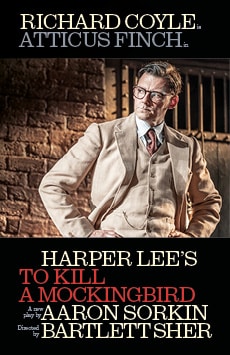
What happens in To Kill a Mockingbird?
The play is set in Maycomb, Alabama, 1934, during the Great Depression. Jean Louise "Scout" Finch, eight years old, lives with her brother Jem and their widowed father Atticus, a lawyer widely respected in the community for his fairness and quiet moral authority. The children spend their summers with a boy called Dill, who is obsessed with the mystery of Boo Radley — their reclusive neighbour who has not been seen outside in years.
The accusation
Tom Robinson, a Black man who works nearby, is accused by Bob Ewell — the town's most disreputable white resident — of having raped his daughter Mayella. The accusation is almost certainly false. Atticus agrees to defend Tom, an act that scandalises parts of the community and exposes his children to hostility they have never faced before. Atticus's faith is that if he can present the evidence clearly enough, reason and decency will prevail.
The courtroom
The trial is the play's centrepiece. Sorkin's adaptation expands the courtroom sequences significantly, turning what is a section of the novel into the dominant dramatic mode of the play. Atticus dismantles the prosecution's case with methodical precision, demonstrating that Tom Robinson could not have committed the assault and that the accusation is built on malice and shame. The jury deliberates. The verdict is not what reason would dictate.
Aftermath
The verdict forces Atticus to confront the limits of his own philosophy. His belief in the essential goodness of people — including Bob Ewell — is tested by the reality of what a community can do when prejudice serves its interests. The play asks whether maintaining that belief is wisdom or naivety, and does not resolve the question cleanly. The final scenes, involving Boo Radley, bring the children's story and the moral drama into a single image that is both the novel's most famous moment and the play's most devastating.
Harper Lee's novel
To Kill a Mockingbird was published in July 1960 and won the Pulitzer Prize for Fiction the following year. Harper Lee drew on her own childhood in Monroeville, Alabama — Atticus Finch is partly based on her father, a lawyer who once defended two Black men accused of murder — and on the trial of the Scottsboro Boys, a 1931 case in which nine Black teenagers were falsely accused of raping two white women. The novel has sold more than 45 million copies worldwide and for decades topped lists of the most influential books in American education. It was also, for much of its history, among the most frequently challenged and banned books in the United States.
Aaron Sorkin's adaptation
Sorkin — best known for The West Wing, The Social Network, and A Few Good Men — spent several years adapting the novel, with the estate of Harper Lee initially threatening legal action over his changes to Atticus's character. The dispute was settled, and the play premiered on Broadway at the Shubert Theatre on 13 December 2018. It broke the record for the highest-grossing American play in Broadway history, running for over 600 performances before the pandemic shutdown. Jeff Daniels played Atticus Finch in the original Broadway production.
The London productions
The play transferred to London's Gielgud Theatre in 2022, where it ran to five-star reviews with Rafe Spall as Atticus. Richard Coyle took over the role for subsequent performances at the Gielgud and for the first-ever UK and Ireland tour, which ran from September 2025 through May 2026, visiting nineteen venues. The current Wyndham's Theatre engagement is the third time the production has played in London's West End, and the same touring company makes the transfer.
Sorkin's changes to the novel
Sorkin's most significant change is to Atticus Finch's character. Where the novel presents Atticus largely through Scout's admiring eyes as a near-perfect moral exemplar, Sorkin's Atticus is a man whose belief in the fundamental goodness of all people — including Bob Ewell — is interrogated throughout the play and found inadequate in the face of structural racism. This has divided audiences who came to the play with deep attachment to the novel's Atticus, but has also been credited with giving the adaptation genuine dramatic tension and contemporary relevance.
Performance schedule
- Opens: 25 June 2026
- Final performance: 12 September 2026
- Evenings: Tuesday to Saturday, 7pm
- Matinees: Wednesday and Saturday, 2pm
- Running time: Approximately 2 hours 50 minutes, including one 15-minute interval
No Monday or Sunday performances. The schedule may vary around bank holidays — confirm your specific date when booking.
Important casting note
Richard Coyle is not scheduled to perform between Monday 7 and Saturday 12 September 2026. If you are booking specifically to see Coyle as Atticus Finch, avoid performances in this window. An alternative cast member will cover those performances.
Age guidance and content
Recommended for ages 12 and above. Children under 16 must be accompanied by and seated next to a ticketholder aged 18 or over. Children under 3 are not admitted. Everyone, regardless of age, must have their own ticket.
This production contains racially explicit language, themes and content, references to sexual abuse and violence, and brief gunfire audio. The production does not shy away from its difficult material. It is an important work — but parents should consider the content thoughtfully for younger teenagers.
Cast
- Richard Coyle as Atticus Finch (Player Kings, Macbeth, Fantastic Beasts: The Secrets of Dumbledore)
- Anna Munden as Scout Finch
- Gabriel Scott as Jem Finch
- Dylan Malyn as Dill Harris
- Andrea Davy as Calpurnia
- Stephen Boxer as Judge Taylor
- Aaron Shosanya as Tom Robinson
- Oscar Pearce as Bob Ewell
- Evie Hargreaves as Mayella Ewell
- Harry Attwell as Mr Cunningham / Arthur "Boo" Radley
- Richard Dempsey as Horace Gilmer
- Sarah Finigan as Mrs Dubose
- Colin R Campbell as Sheriff Heck Tate
- Phillipa Flynn as Miss Stephanie / Dill's Mother
- Plus David Kennedy, Charlotte Luxford, Tiwai Muza, John J O'Hagan, Jonathan Rubin, Carole Stennett, Paul Albertson, Tom Brace-Jenkins, Cheryl Burniston, and Simon Hepworth
Cast information correct at time of publication and subject to change.
Creative team
- Adapted by: Aaron Sorkin (from the novel by Harper Lee)
- Director: Bartlett Sher
- Associate Director: Louisa Muller
- Set design: Miriam Buether
- Costume design: Ann Roth
- Lighting design: Jennifer Tipton
- Sound design: Scott Lehrer
- Original score: Adam Guettel
- Musical supervisor: Kimberley Grigsby
- Hair & wigs: Campbell Young Associates
Tickets and pricing
Tickets start from £36, with a range up to £180. Stalls and Royal Circle seats are available from £57 for Monday to Friday performances including Wednesday matinees (group rate 10+). School groups of 10 or more can access Grand Circle seats at £25 plus one free teacher place, valid for Tuesday to Thursday evenings and Wednesday matinees.
Getting there
- Tube: Leicester Square (Northern, Piccadilly lines) — 2 minute walk south on Charing Cross Road
- Alternative: Covent Garden (Piccadilly line) — 5 min walk; Charing Cross (Northern, Bakerloo) — 5 min walk
- Bus: Routes 24, 29, 176, N5, N20, N29, N279 stop nearby on Charing Cross Road
- Cycling: Santander Cycles docking stations on William IV Street, Craven Street, and St Martin's Street
About Wyndham's Theatre
Wyndham's Theatre opened in 1899 and is one of the West End's most celebrated Edwardian venues. Named after actor-manager Charles Wyndham, it seats 759 across the stalls, dress circle, and upper circle. Its ornate interior and intimate proportions have made it home to some of the most significant productions of the last century — from Noël Coward to Maggie Smith to Rafe Spall. Now operated by Delfont Mackintosh Theatres, it remains one of the most desirable houses in London for mid-scale drama.
Accessibility
Wyndham's Theatre provides wheelchair-accessible seating, an infrared hearing assistance system, accessible toilets, and companion seating. Some areas of the historic building involve stairs. Contact the access department on 0344 482 5137 to discuss specific requirements and book appropriate seating in advance. Captioned performance: 2pm Saturday 11 July 2026. Audio described performance: 2pm Saturday 1 August 2026.
Producers
The 2026 West End season is presented by Jonathan Church Theatre Productions in association with Karl Sydow and Tulchin Bartner Productions.