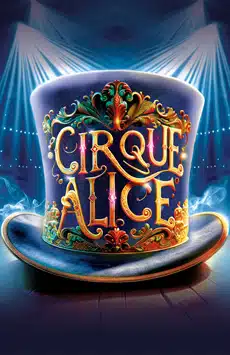
What is Cirque Alice?
Cirque Alice takes the structural shape of Lewis Carroll's Alice's Adventures in Wonderland — the fall down the rabbit hole, the encounters with the Caterpillar, the Cheshire Cat, the March Hare, the Queen of Hearts — and uses each as the platform for a major circus set-piece. The show is not a literal adaptation of the book. There is no spoken dialogue carrying the narrative. Instead, the audience moves through the world of Wonderland the way a dream moves: one transformation into the next, held together by music, costume, and the visual logic of the source material.
The performance vocabulary
The cast combines several distinct circus disciplines. Aerialists work on silks, trapeze and aerial hoops, with the Royal Festival Hall's stage height giving the production unusual vertical room. Contortion sequences anchor several of Carroll's strangest set-pieces. Acrobatic ensembles handle the larger group numbers. Puppetry — credited as one of the show's distinctive elements — handles the moments where transformation needs to feel surreal rather than purely physical. A live ensemble plays an arrangement of newly reworked classical favourites, integrating the music into the action rather than running it as accompaniment.
The Royal Festival Hall version
The London engagement is a specific staging of the show built for the Royal Festival Hall — a venue capable of holding 2,700 across its main auditorium and known for its excellent sight-lines. For this London engagement, the production is offering on-stage seating as an option: a small number of seats placed inside the staging area, giving those audience members a unique close-up perspective. The on-stage seats are typically priced in the higher bands and tend to sell out earliest.
What to expect
For older children and adults, Cirque Alice works as both a circus and a piece of theatrical design — moments of genuine technical "how is that possible" combined with the visual pleasure of seeing Carroll's Wonderland staged at scale. For younger children, the show is paced and lit to keep attention without overwhelming. A 2-hour running time with one interval is well-judged for the audience: long enough to feel like a real event, short enough to stay engaged.
The Painter & Lawson production house
Simon Painter and Tim Lawson have spent over a decade building one of the most successful family circus and variety production houses in international entertainment. Their work — typically large-scale, theatrically presented, technically rigorous — has played on every continent except Antarctica.
Circus 1903
Their best-known production. A circus show framed as a 1903-era travelling tent show, complete with a master of ceremonies and full-size elephant puppetry from the team behind the National Theatre's War Horse. The show has toured globally since 2016 and is a regular returner to London's Royal Festival Hall during the festive season.
The Illusionists
A magic and illusion variety production bringing together a rotating cast of internationally renowned magicians. Multiple Broadway, West End and international engagements. The Illusionists franchise has been one of the most commercially successful magic productions of the past decade.
Le Noir
A darker, more adult-orientated circus piece with a stylised noir aesthetic. Played long engagements in Las Vegas and on tour.
Why this matters for Cirque Alice
Family circus and variety productions vary enormously in quality. Painter and Lawson's track record — sold-out runs across multiple continents, repeat business, technical standards on par with the best Cirque du Soleil productions — is the strongest available indicator of what Cirque Alice will deliver. Record-breaking runs in Australia and Singapore add a further data point. The European premiere arrives with substantial expectation, and the producers have a strong track record of meeting it.
The London creative team
The London engagement is presented by Roast Productions and Senbla, in association with Lawson and Painter. Direction is by Ash Jacks McCready and Kirsty Painter, with choreography by Dane Bates, costume design by Angela Aaron, lighting by Hugo Mercier, and musical arrangements by Martin Raabe-Olsen and Marius Christiansen.
Performance schedule
- First performance: 12 December 2026
- Final performance: 3 March 2027
- Evening and matinee performances Tuesday to Sunday, varying by week — full schedule on the booking page
- Running time: Approximately 2 hours, including one interval
- Peak periods: Christmas Eve through New Year, and February half-term — earliest booking advised
Age guidance and content
Recommended for ages 5 and above. Under-12s must be accompanied by an adult.
Cirque Alice is designed as a family experience and contains no content unsuitable for older children. Some moments involve aerial work, dramatic lighting and louder musical sequences that very young children may find intense. There is no spoken narrative, so language is not a factor in age suitability.
On-stage seating
For this London engagement only, the production is offering on-stage seating — a small number of seats placed inside the staging area, giving those audience members a unique close-up "through the looking glass" perspective of the action. These seats are priced in the higher bands and typically sell out earliest. Standard auditorium seating is available across all price bands.
Creative team
- Created and produced by: Simon Painter and Tim Lawson
- Directors: Ash Jacks McCready and Kirsty Painter
- Choreographer: Dane Bates
- Costume designer: Angela Aaron
- Lighting designer: Hugo Mercier
- Musical arrangements: Martin Raabe-Olsen and Marius Christiansen
- London engagement presented by: Roast Productions and Senbla, in association with Lawson and Painter
Getting there
- Tube/rail: Waterloo (Bakerloo, Jubilee, Northern, Waterloo & City, National Rail) — 5 min walk
- Alternative: Embankment (across Hungerford Bridge, 5 min), Charing Cross (10 min via bridge)
- Bus: Multiple routes serve Waterloo Bridge and the Southbank
- Parking: Q-Park Westminster (Park Plaza Westminster Bridge), Southbank Centre car park
About the Royal Festival Hall
The Royal Festival Hall is the centrepiece of the Southbank Centre and one of London's most significant 20th-century buildings. Opened for the 1951 Festival of Britain and Grade I listed, it seats 2,700 across its main auditorium. The wide stage, generous height and excellent acoustics make it well-suited to circus-scale productions, and the Painter and Lawson team has used the venue for their Christmas Circus 1903 engagements for several years running.
Accessibility
The Royal Festival Hall is one of London's most accessible venues. It offers level access throughout, wheelchair-accessible seating across multiple levels, accessible toilets on every floor, lift access, and induction loops. The Southbank Centre runs an Access Membership Scheme that simplifies booking and provides additional support. Contact the Southbank Centre box office in advance to discuss specific access requirements.
Eating and drinking nearby
The Southbank Centre site has multiple cafés, bars and restaurants in the Royal Festival Hall building itself, including Skylon, the Riverside Terrace Café, and several pre-show bars. The wider Southbank has dozens of options within a short walk. Pre-theatre menus are widely available.