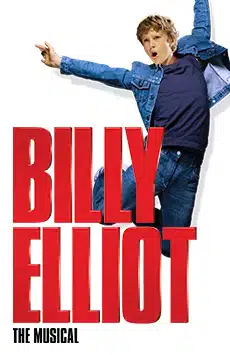
What happens in Billy Elliot?
County Durham, 1984. Billy Elliot is eleven. His mother has died. His father and older brother work down the pit, and the pit — along with most of the pits in the North East — has been on strike for months. The miners' strike of 1984-85 is the longest and most bitter industrial dispute in modern British history, and Billy's family is at the centre of it. Money is gone. Communities are fracturing. Police vans are on the village streets. This is the world he is growing up inside.
Boxing to ballet
Billy is sent to weekly boxing lessons at the local hall. The hall double-books, and Mrs Wilkinson's girls' ballet class takes over the second half of the session. Billy stays. Almost in spite of himself, he discovers that what he wants — what he is genuinely, unmistakably good at — is to dance. The discovery is private at first, then increasingly impossible to hide. Mrs Wilkinson, herself a frustrated woman in a frustrated town, recognises the talent and begins coaching him for the Royal Ballet School.
The conflict at home
Billy's father and older brother are appalled. Ballet is, in their world, not what boys do. The disapproval is not random cruelty — it's the protective reflex of a community whose entire sense of itself is under attack by a government determined to break it. The conflict in the household is partly about ballet, but underneath it is the question every working-class family in Britain was asking in 1984: what kind of life can our children actually have? Where can they go? Who decides?
The audition
Mrs Wilkinson arranges for Billy to audition for the Royal Ballet School. He nearly doesn't go. The money for the train fare doesn't exist, and the family is breaking down around the strike. The argument that follows — between Billy's father and the rest of the village — is one of the most extraordinary scenes in modern British musical theatre. It is about what fathers owe their children, what communities owe their futures, and what individuals are allowed to want in a system designed to tell them they aren't allowed to want anything.
The cost
Billy Elliot resists the tidy ending. It is a story about a boy who escapes — and about everything he leaves behind. The miners' strike is lost. The pits close. Billy gets out. The community that produced him does not. The show treats both halves of that story with the same seriousness, and the second half is the part that earns the tears the first half draws. By the time Billy dances out of County Durham, the audience knows exactly what his leaving means.
The 1984-85 miners' strike
The strike began in March 1984 and lasted nearly a year. At its heart was the National Coal Board's plan to close twenty pits — a decision the National Union of Mineworkers, led by Arthur Scargill, believed was the first step in dismantling the British coal industry, and which Margaret Thatcher's Conservative government was determined to push through. The strike ended in March 1985 with the NUM defeated. By the early 1990s, the British deep-coal industry was effectively gone, and the mining communities of South Yorkshire, South Wales, Nottinghamshire and the North East had been hollowed out economically, socially, and psychologically.
Billy Elliot is one of the very few mainstream British musicals to engage seriously with this history. The show does not treat the strike as a backdrop — it treats it as the story's emotional engine. The musical numbers carry political weight: Solidarity uses the structure of a ballet class to weave together protest, riot police, and children's lessons; The Stars Look Down opens the show with a working-class anthem; Once We Were Kings closes it with a mining community looking back at what it used to be.
From film to stage
The 2000 film
Stephen Daldry's debut feature, written by Lee Hall, was released in autumn 2000 to broad critical acclaim. Jamie Bell, then thirteen, played Billy. The film was nominated for three Oscars (Best Director, Best Original Screenplay, Best Supporting Actress for Julie Walters) and remains one of the most successful British films of the 2000s.
The musical
Daldry, Hall and Elton John began developing the stage version almost immediately after the film's release. Billy Elliot The Musical opened at the Victoria Palace Theatre on 11 May 2005 and ran continuously until April 2016 — nearly eleven years. It transferred to Broadway in 2008, where it won ten Tony Awards including Best Musical. International productions have run in Australia, the Netherlands, Korea, Brazil and across Europe.
The 2027 revival
This is the first time Billy Elliot has been produced in London since the Victoria Palace run closed. The revival reunites Stephen Daldry, Lee Hall, Elton John and Peter Darling — the original creative core. Producers Working Title and Universal Stage Productions are the same companies that produced the original. The decision to revive with the original team rather than reimagine the production is deliberate: the show is not being remounted as a curiosity, it's being restored.
The cast search
Casting for Billy and the other children's roles is, by tradition, an open national search. Producers conducted a UK-wide search through 2025 for new performers to play Billy, Michael and Debbie. The role of Billy is rotated between multiple young performers across the week — the part is physically and emotionally demanding enough that no single child can play it continuously. The original production was famous for launching the careers of several of its young Billys, including Tom Holland and Liam Mower.
Performance schedule
- Previews begin: 12 February 2027
- Final performance: 31 July 2027
- Evenings: Monday to Saturday, 7:00pm
- Matinees: Wednesday and Saturday, 2:00pm
- Running time: Approximately 2 hours 45 minutes, including one interval
A strictly limited season
The Adelphi season is approximately five and a half months — substantially longer than most West End limited runs, but a fraction of the original Victoria Palace engagement. The London run is bookended by a UK and Ireland tour that begins at the Sunderland Empire on 4 November 2026 and resumes for a further nine months after the London engagement ends in July 2027. Given the show's status, the original-team revival framing, and the strict end date, advance booking is strongly recommended for prime dates.
Age guidance and content
Recommended for ages 8 and above.
Billy Elliot contains strong language throughout — characteristic of the working-class Durham community the show depicts — and depicts the political violence and police confrontations of the 1984-85 miners' strike. The emotional weight of the show is significant. Producers have always been clear that softening the language would compromise the truthfulness of the world the show depicts. Families bringing younger children should consider this carefully. The show is widely loved by families with children aged 10 and above.
Creative team
- Music: Elton John
- Book and lyrics: Lee Hall
- Director: Stephen Daldry
- Choreographer: Peter Darling
- Producers: Working Title and Universal Stage Productions
Cast
Casting for the 2027 production is to be announced. By design, the role of Billy is rotated between multiple young performers across the week. The full company will be announced in the months before the run begins.
Tour dates
- Sunderland Empire: 4 – 28 November 2026
- Palace Theatre Manchester: 2 December 2026 – 9 January 2027
- Edinburgh Playhouse: 19 January – 6 February 2027
- Adelphi Theatre, London: 12 February – 31 July 2027
- Onward tour: Further dates to be announced after the London run
Getting there
- Tube: Charing Cross (Bakerloo, Northern) — 3 min walk
- Alternative: Covent Garden (5 min), Embankment (5 min), Temple (8 min)
- Bus: Strand routes 6, 9, 11, 13, 15, 23, 77A, 91, 139, 176
- Parking: St Martin's Lane Hotel car park (4 min walk)
About the Adelphi Theatre
The Adelphi is one of the West End's larger and most commercially significant venues, seating approximately 1,500 across the Stalls, Dress Circle, Upper Circle and Balcony. Its current building dates from 1930, with a striking Art Deco interior. The theatre has housed many of the West End's biggest hits, most recently Back to the Future: The Musical. Front-of-house and foyer renovations were carried out during 2026.
Accessibility
The Adelphi Theatre offers wheelchair-accessible seating in the Stalls and accessible toilet facilities. Hearing assistance systems are available, and signed and audio-described performances are scheduled on selected dates. Some areas of the building involve steps. The box office can advise on the best access routes and seating positions — contact in advance to plan the visit.