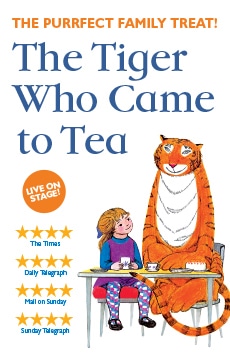
The Tiger Who Came to Tea at a glance

Show
The Tiger Who Came to Tea
Venue
Theatre Royal Haymarket, West End
Address
18 Suffolk Street, London SW1Y 4HT
Nearest station
Piccadilly Circus (3 min walk)
Genre
Family musical play
Running time
55 minutes, no interval
Age guidance
3 and above
Dates
22 June – 5 September 2026
West End season
12th season (6th consecutive at Haymarket)
Price range
From £12 (typically £12–£40)
Adaptor and Director
David Wood OBE
Based on
The picture book by Judith Kerr OBE (1968)
Producer
Nicoll Entertainment Ltd

Expert Review: The Tiger Who Came to Tea at Theatre Royal Haymarket

4.6
★★★★★

LTH Expert Rating

The Verdict

The Tiger Who Came to Tea has been returning to the West End every summer for twelve years now, and the reason is straightforward: it does exactly what it sets out to do, and it does it exceptionally well. David Wood's adaptation takes Judith Kerr's perfectly constructed picture book — a story so elegant in its simplicity that it is almost impossible to improve — and turns it into exactly the right piece of live theatre for small children. The songs are catchy, the magic is genuine, the tiger is enormous and friendly, and the whole thing is over in 55 minutes before anyone loses patience or concentration.

What distinguishes this production from lesser family shows is the intelligence behind it. Wood understands that the audience is as much the adults as the children, and that the best family theatre works on both levels simultaneously. The interactive moments are well-judged — enough to make children feel involved without tipping into chaos. The live magic designed by Scott Penrose, former President of the Magic Circle, consistently provokes the right kind of delighted disbelief. And the Theatre Royal Haymarket — one of London's most beautiful theatres — gives the whole experience a grandeur that makes it feel special, which for a child's first trip to the theatre is exactly what you want.

What Makes It Special

  • The book it's based on. Judith Kerr's original story, first published in 1968, is a picture book masterclass — a simple domestic scene invaded by an extraordinary visitor, told with absolute economy and a warmth that has never aged. The stage adaptation starts with the best possible source material.
  • David Wood's adaptation. Wood is widely regarded as Britain's leading children's theatre dramatist, and this is among his finest work. The adaptation extends the story with songs and interactive moments without losing what makes the book so good — the gentleness, the humour, the sense of a world where magic is entirely possible.
  • Scott Penrose's live magic. Penrose is a former President of the Magic Circle. His illusions are integrated into the storytelling rather than bolted on, and they regularly produce the kind of wide-eyed astonishment in young audiences that only live theatre can generate. This is not conjuring as a sideshow — it is conjuring as drama.
  • The perfect duration. Fifty-five minutes with no interval is the gold standard for theatre aimed at very young children. Long enough to be a proper event and a memorable experience; short enough that no three-year-old is being tested beyond their natural tolerance for sitting still.
  • Twelve seasons of trust. The show has been coming back to the same venue every summer for six consecutive years because parents and grandparents know what they are getting. That accumulated goodwill is its own recommendation — when a show becomes a family tradition, it means the show is doing something genuinely right.

You'll love it if you...

  • Are bringing a child aged 3–7 to the theatre, especially for the first time
  • Love Judith Kerr's book and want to see it brought to life on stage
  • Want a short, sweet, professionally produced family show in a magnificent West End venue
  • Are looking for a guaranteed crowd-pleaser for a mixed-age group including grandparents
  • Want value for money — £12 tickets for a West End show at a historic theatre is genuinely good

It might not be for you if you...

  • Are bringing older children aged 9 and above who have outgrown picture books — there are more age-appropriate choices
  • Want a full evening's theatre — at 55 minutes this is a daytime or early-afternoon experience
  • Are coming without children and hoping for adult-oriented content — this is genuinely a show for families with young children

Best for

  • Ages 3–8
  • First theatre experience
  • Summer half-term
  • Grandparents and grandchildren
  • Family visitors to London
  • Judith Kerr fans

Best suited to children aged 3–8. Older children may prefer longer, more age-appropriate shows.

Critical Reception

The Tiger Who Came to Tea has received consistently strong critical notices across its twelve West End seasons, with reviewers and audiences alike returning year after year. The production was nominated for the Olivier Award for Best Family Entertainment in 2012. Verified ratings from major publications across the show's West End run:

  • The Times ★★★★ "The cat's meow"
  • Daily Telegraph ★★★★ "Perfectly pitched"
  • Mail on Sunday ★★★★ "A rare and grrreat achievement"
  • Sunday Telegraph ★★★★ "Roar talent"
  • Daily Express ★★★★ "All the fun of the fur"
  • WhatsOnStage ★★★★★ "Delightful"

Source: published reviews of previous West End seasons at Theatre Royal Haymarket.

Everything You Need to Know

What happens in The Tiger Who Came to Tea?

Sophie and her mummy are sitting down for afternoon tea when the doorbell rings. They are not expecting anyone. But when they open the door, they find a large, friendly, extremely hungry tiger standing on the doorstep, asking to come in for tea. Being a polite and generous family, Sophie and her mummy invite him in.

The tiger arrives

The tiger is enormous and warm and cheerful and absolutely ravenous. He sits down at the kitchen table and begins to eat. He eats all the sandwiches. He eats all the biscuits. He eats all the buns and the cake and everything else on the table. Then he starts on the cupboards — eating everything in them too. He drinks all the milk and all the orange juice and all of Daddy's beer, and then he drinks all the water from the tap until there is none left.

The tiger says goodbye

Having eaten and drunk absolutely everything, the tiger thanks Sophie and her mummy very politely, says goodbye, and walks off down the street. He does not come back. When Daddy comes home from work there is no food and no water left, and the family goes out for a special supper instead — which turns out to be a very good thing. The next morning, Mummy buys a big tin of tiger food, just in case. The tiger never comes again, but the tin stays on the shelf.

What the stage show adds

David Wood's stage adaptation expands the story with original songs that children can join in with, interactive moments where the audience can take part in the action, and the spectacular arrival of the tiger himself in full theatrical form. The live magic woven through the show — including some of the tiger's more spectacular feats of consumption — consistently produces the kind of gasps and laughter that only live theatre can generate. The bones of Kerr's story remain completely intact; the stage show simply gives them room to breathe and perform.