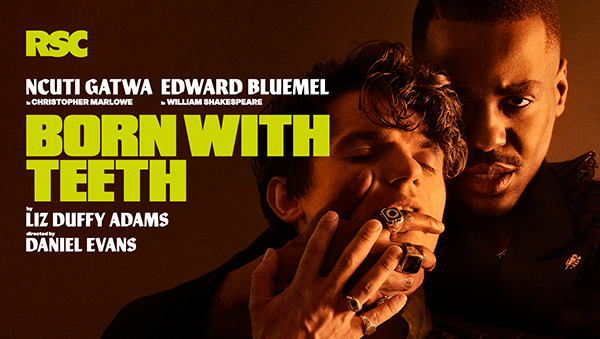
What happens in Born With Teeth
The play unfolds across three secret meetings between Christopher Marlowe and William Shakespeare in 1591, in the back room of a London pub. Marlowe — already a literary rock star, openly homosexual, and a part-time spy for the Crown — is the more powerful figure. Shakespeare — younger, ambitious, careful, married, just beginning to make his name — is the supplicant.
Across the three meetings, the two writers attempt to collaborate on a dangerous new history play cycle (a nod to the real scholarly theory that Marlowe and Shakespeare collaborated on Henry VI). They flirt, fight, drink, plot, betray and outwit each other. Meanwhile, the political pressure mounts around them: spies are watching, the Queen is dying, and the wrong words spoken in the wrong room could destroy them both. Marlowe's historical fate — stabbed to death at a Deptford inn in 1593 — hovers over the play's third meeting.
The 100-minute production runs without interval and was staged in a tight chamber set by Joanna Scotcher, with lighting design by Neil Austin, sound by George Dennis and video by Andrzej Goulding.
Marlowe, Shakespeare and the historical record
Christopher Marlowe and William Shakespeare were born within two months of each other in 1564, and both rose to prominence as London playwrights in the late 1580s and early 1590s. Marlowe was the more established figure by 1591 — Doctor Faustus and Tamburlaine had made him the dominant voice in English drama — while Shakespeare's writing career was just beginning. Marlowe was killed under disputed circumstances in Deptford in May 1593; Shakespeare's major career began effectively at the moment of Marlowe's death.
Recent scholarship — notably the work of the New Oxford Shakespeare editorial team in the late 2010s — has produced computational evidence supporting the long-standing theory that Marlowe contributed to the writing of Shakespeare's Henry VI plays. Liz Duffy Adams's play takes this scholarly possibility as its springboard and asks: if these two men sat in a room together to write, what might that have looked like, and what might it have cost them?
The RSC and West End
Born With Teeth was the seventh production presented in London in 2025 by the Royal Shakespeare Company under the joint artistic leadership of Daniel Evans and Tamara Harvey. The Evans/Harvey strategy of bringing more RSC work to West End audiences — rather than relying solely on Stratford-upon-Avon and touring — has produced a notable expansion of the company's London footprint. Born With Teeth was co-produced with Playful Productions and Elizabeth Williams for Grain of Sand Productions, with 2,000 tickets reserved at £10 for 16–25 year-olds, sponsored by TikTok.
Liz Duffy Adams and the play's pre-history
Born With Teeth premiered at the Alley Theatre, Houston, in 2022, with subsequent US productions before the 2025 West End premiere. Liz Duffy Adams's prior work includes Or, and Dog Act. The London production was the play's UK premiere and its first major commercial run.