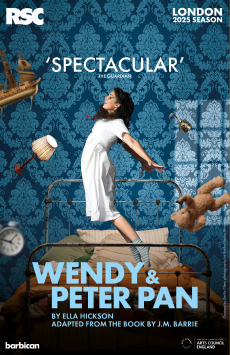
What happens in Wendy and Peter Pan?
Hickson's adaptation opens in the Darling family nursery, but with a crucial difference from Barrie. There are four Darling siblings — Wendy, John, Michael, and Tom — and Tom has recently died. The grief Tom left behind hangs over Mr and Mrs Darling and over the surviving children. Wendy in particular keeps insisting on talking about Tom; her parents would prefer not to. The play frames its journey to Neverland against this loss.
Peter at the window
Peter Pan (Daniel Krikler) appears at the nursery window with Tink (Charlotte Mills), searching for his lost shadow. He speaks of "Lost Boys" on his island who never grow up and have no mothers. Wendy hears this and reads it differently from how Peter intends it: she hears a description of a place where her brother Tom might still exist. The decision to fly to Neverland becomes Wendy's, motivated by her search for Tom, not Peter's invitation as in Barrie. This single change rewires the play's gender politics.
Neverland with the Lost Boys
In Neverland, the Darling children meet the Lost Boys (Slightly, Curly and others) and the indigenous Lost Boys community led by Tiger Lily. Hickson's Tiger Lily is significantly more agential than Barrie's: a warrior and political leader, not a love interest. Mermaids, the crocodile, and Captain Hook's pirate ship all appear. Tink is jealous of Wendy not because of romantic rivalry over Peter but because Wendy threatens her position as Peter's closest companion — a recasting that Charlotte Mills played with sharp wit.
Hook and Mr Darling
As in many traditional Peter Pan productions, the same actor plays Captain Hook and Mr Darling — here Toby Stephens. The doubling is given thematic weight in Hickson's version: both men are figures of paternal authority who have, in different ways, failed their children. Stephens leant into the parallel without making it heavy-handed.
The ending
Hickson's ending preserves Barrie's broad shape — Wendy returns to the nursery, Peter remains in Neverland — but loads it with the play's added emotional weight. The question of growing up is given to Wendy directly rather than implied through Peter's refusal. The resolution involves a confrontation between Wendy and her parents about Tom that the original Peter Pan would never have permitted. The production's final image, on which most critics agreed, was genuinely affecting.
The history of Wendy and Peter Pan and the 2025 RSC revival
J.M. Barrie's original
J.M. Barrie's Peter Pan, or The Boy Who Wouldn't Grow Up was first performed in 1904 at the Duke of York's Theatre, London. The novelisation, Peter and Wendy, followed in 1911. Royalties from Peter Pan have, since Barrie's 1929 gift, supported Great Ormond Street Hospital in perpetuity under a unique extension of UK copyright law. The play's central figures — Peter, Wendy, Hook, Tink, Tiger Lily — have remained continuously in cultural circulation across stage, film, and animated adaptation for more than a century.
Ella Hickson's 2013 RSC commission
In 2013 the RSC commissioned Ella Hickson, then in her early thirties and best known for Eight (2008) and Boys (2012), to write a Peter Pan adaptation for the Stratford-upon-Avon Christmas slot. Hickson's brief, as she has described it in subsequent interviews, was to address the felt mismatch between Barrie's beloved central figures and his more uncomfortable structural choices — particularly the gendered logic that lets the Lost Boys remain lost forever while expecting Wendy to mother them. Her solution, the addition of the dead older brother Tom, gave the play a new dramatic engine. The 2013 Stratford production was directed by Jonathan Munby (who returned to direct the 2025 revival) and received broadly positive reviews including four-star coverage from the Times, Telegraph, and Sunday Times.
The decade in between
Between 2013 and the 2025 revival, Hickson's Wendy and Peter Pan became one of the most-licensed contemporary RSC commissions. Amateur and youth-theatre productions ran throughout the UK; notable professional stagings included the Hertfordshire Players at the Minack Theatre in summer 2024 and the Watermill Theatre Youth Ensemble in March 2024. The Christmas-slot demand for family-friendly classical adaptations made the play a popular regional choice. Hickson herself moved on to a string of further commissions — Oil at the Almeida, The Writer at the Almeida, Anna at the National Theatre, and the recent Oedipus.
The 2025 RSC London season
The RSC's London season at the Barbican was the second under co-Artistic Directors Tamara Harvey and Daniel Evans, who succeeded Gregory Doran in 2023. Wendy and Peter Pan opened the autumn 2025 Barbican season on 21 October, running for five weeks to 22 November. The choice to programme Wendy and Peter Pan for the Barbican's autumn rather than its Christmas slot (which went to Twelfth Night) was widely noted; the Stage in particular questioned whether the half-term/family Wendy and Peter Pan would not have been a better Christmas fit. Press night was 28 October 2025.
The 2025 production
Director Jonathan Munby returned from the 2013 original. The new ensemble was led by Toby Stephens (Hook / Mr Darling), Lolita Chakrabarti (Mrs Darling), Daniel Krikler (Peter Pan), Charlotte Mills (Tink) and Hannah Saxby (Wendy). The wider Neverland company included Joe Hewetson as Martin the Cabin Boy, Scott Karim as Smee, Max Lauder as Slightly, and a Shadow ensemble of Joe Anthony, James Berkery, Kazmin Borrer, Lili-Evangeline Bryden, Harrison Claxton, Christopher Jeffers, and Alexander Kranz. The production used substantial aerial flying, video projection, and a live-music score by Shuhei Kamimura. Assisted performances included a captioned matinee (8 November), a relaxed matinee (15 November), and an audio-described matinee (22 November) with a pre-show touch tour.