What happens in Trainspotting?
Edinburgh, late 1980s. Mark Renton is in his early twenties, intermittently employed, fully addicted to heroin, and surrounded by a group of friends who are themselves addicted to versions of self-destruction that look slightly different on the surface. The city — specifically the housing schemes of Leith — is in the long shadow of de-industrialisation, mass unemployment, and an HIV epidemic that, for a period in the late 1980s, made Edinburgh the AIDS capital of Europe. This is the world the show inhabits.
Renton and his friends
Renton is the show's centre. Around him circulate Sick Boy — handsome, manipulative, intermittently funny — who is using addiction as a kind of intellectual project. Begbie, who does not take drugs but is the most genuinely dangerous person in the group. Spud, the gentlest of them, the one whose damage is hardest to watch. Tommy, who is clean, until he isn't. Kelly, the woman in the group, who sees more clearly than any of the men and has the fewest options for doing anything about it. The musical follows them across a period of years.
The cycle
The novel is structured as a series of overlapping voices rather than a single linear plot, and the musical follows the same general shape. Renton attempts to get clean. He fails. He succeeds. He fails again. Around him, the other characters move through their own versions of the same struggle. The show is not interested in a redemption arc, or a cautionary tale, or the structures we expect from drama about addiction. It is interested in showing what addiction is actually like, and what it does to friendships, and what the long-term consequences look like when the people involved are still in their twenties.
The decision
The show builds towards Renton's decision, near the end, to betray his friends for a large amount of money that none of them have earned legitimately. The act is unforgivable. It is also possibly the only thing that gets him out alive. Welsh has always refused to moralise about the choice. The musical follows the same principle — it shows what happens, and it lets the audience hold the contradiction.
Welsh's stage version
The novel and the film
Irvine Welsh's debut novel was published in 1993. It became one of the defining British novels of the decade. Danny Boyle's 1996 film adaptation — with Ewan McGregor as Renton, Robert Carlyle as Begbie, Jonny Lee Miller as Sick Boy, Ewen Bremner as Spud, and Kelly Macdonald as Diane — turned the story into a generational reference point. T2 Trainspotting, the 2017 sequel, reunited the cast twenty years on.
The 'anti-musical'
This is the first time Welsh himself has adapted Trainspotting for the stage. (Harry Gibson's stage version, which has been performed widely in pub theatres and on tour since the mid-1990s, is a separate adaptation and is not connected to this production.) Welsh has described the new musical as an "anti-musical" — meaning, in his framing, a show that uses the form to do something the form does not usually do. The Scots vernacular of the novel is preserved. The bleakness is not softened. The score is rock and electronic rather than orchestral. The intention is to use the musical theatre platform without surrendering to its conventions.
The creative team
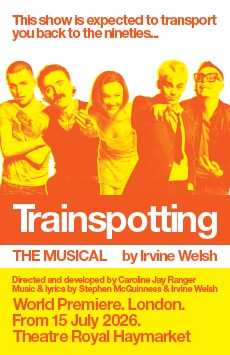
Caroline Jay Ranger directs, with music and lyrics by Stephen McGuinness and Irvine Welsh. The production design includes Colin Richmond (set and costumes — credits include extensive RSC and National Theatre work). Robbie Scott leads the cast as Renton; further casting was being finalised at time of writing.
The pricing
Tickets from £15 is an unusually accessible entry point for a major West End opening. The decision is deliberate: producers have publicly framed the show as one that should be available to audiences who don't typically book West End tickets, and the price band structure has been calibrated accordingly. Premium seats remain priced in line with comparable productions.
Performance schedule
- World premiere: 15 July 2026
- Final London performance: 5 September 2026
- Evenings: Monday to Saturday, 7:30pm
- Matinees: Thursday and Saturday, 2:30pm
- Running time: Approximately 2 hours, including one interval
Age guidance and content
Recommended for ages 15 and above. The guidance is firm.
The musical contains explicit depictions of drug taking and death, references to overdose and HIV, scenes of sexual content, scenes of violence, and strong language throughout. The material is handled honestly rather than softened — that approach is the show's point. Anyone under 15 should not see this production.
Creative team
- Book: Irvine Welsh
- Music and lyrics: Stephen McGuinness and Irvine Welsh
- Director: Caroline Jay Ranger
- Set and costume designer: Colin Richmond
- Live band on stage
Cast
- Robbie Scott as Renton (West End debut)
- Further Scottish ensemble cast playing Sick Boy, Begbie, Spud, Tommy and Kelly — full casting being announced ahead of premiere
UK tour
Following the London world premiere, the production tours the UK from October 2026:
- Edinburgh Playhouse — from 19 October 2026
- Subsequent dates: Sheffield, Manchester, York, Hull, Ipswich, Birmingham, Leeds, Blackpool, Stoke, Aberdeen, Nottingham, Cardiff, Southend, Bradford, Oxford, Sunderland, Dunfermline, Brighton, Glasgow, returning to Edinburgh in March 2027
Getting there
- Tube: Piccadilly Circus (Bakerloo, Piccadilly) — 3 min walk
- Alternative: Charing Cross (5 min), Leicester Square (8 min)
- Bus: Haymarket routes 3, 6, 9, 12, 13, 15, 19, 23, 38, 53, 88, 139, 159
- Parking: Whitcomb Street car park (2 min walk)
About the Theatre Royal Haymarket
The Theatre Royal Haymarket is one of the oldest working theatres in London. The current building dates from 1820, but a theatre has stood on the site since 1720, making this one of only three London theatres with a royal patent dating from the eighteenth century. Grade I listed, with a striking John Nash portico. The interior seats 888 across four levels. The booking of Trainspotting The Musical for this venue is one of the more interesting recent juxtapositions in West End programming.
Accessibility
The Theatre Royal Haymarket offers wheelchair-accessible seating in the Stalls and accessible toilet facilities. Hearing assistance systems are available. As a historic building, some areas involve stairs. Contact the box office in advance to discuss specific access requirements and seating positions.