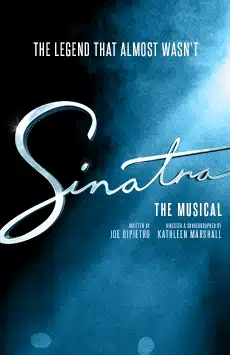
What happens in Sinatra The Musical?
The show opens on New Year's Eve, 1942. A 27-year-old Italian-American singer walks onto the stage of New York's Paramount Theatre and causes a reaction nobody anticipated — screaming, fainting, chaos. Frank Sinatra has arrived. What follows is the story of how he became the defining popular entertainer of the 20th century, and nearly lost everything in the process.
The rise
Sinatra's voice captures a nation almost overnight. The bobby-soxers — teenage girls who screamed at the sight of him — made him a phenomenon before the word existed in its modern sense. But the pressures of sudden fame arrive fast: a wife, Nancy, and children at home; a career that demands constant performance; and the growing, impossible pull of Hollywood star Ava Gardner.
The fall
His affair with Gardner becomes public. The press, which had built him up, turns on him with the same energy. His voice fails him at a crucial moment. His recording contract is dropped. His film career stalls. By the early 1950s, Frank Sinatra — the biggest star in America — is finished. Or so everyone believes.
The comeback
What Sinatra does next is the part of the story that has defined his legend. He fights his way back — through a career-changing film role, a new record deal, and a reinvention as a different kind of singer. The comeback is not just one of the great showbusiness stories. It is genuinely one of the most remarkable second acts in American cultural life.
Frank Sinatra: the man and the music
Why Sinatra still matters
Frank Sinatra (1915–1998) is not simply a beloved entertainer from a previous era. He is the artist who defined what it meant to sing a popular song as a piece of emotional communication rather than technical performance. His approach to phrasing — the way he treated rhythm as something to bend and delay rather than simply follow — influenced every serious popular singer who came after him. When musicians talk about interpretation, Sinatra is the standard they are measuring against.
The Paramount Theatre moment
The New Year's Eve 1942 performance at New York's Paramount Theatre is genuinely one of the hinge moments of American popular culture. The audience reaction — 30,000 fans outside, chaos inside — was something nobody had seen before. It preceded Beatlemania by two decades and established the template for every subsequent pop phenomenon. Sinatra didn't just become famous that night; he invented a new kind of fame.
The creative team
Joe DiPietro's writing credits include Memphis, which won four Tony Awards including Best Musical. His approach to biographical musical theatre is to find the human story inside the legend — the fear, ambition, and contradiction behind the performance persona. Kathleen Marshall's direction brings the same quality she brought to her Tony-winning revivals: precise, elegant, and built around the performers rather than overwhelming them with spectacle.
Performance schedule
- Previews begin: 3 June 2026
- Press night: 24 June 2026
- Booking until: 10 April 2027
- Evenings: Tuesday to Saturday, 7:30pm
- Matinees: Thursday and Saturday, 2:30pm
- Running time: Approximately 2 hours 20 minutes, including one interval
Extended West End run
Sinatra The Musical is booking through to April 2027, making this an extended engagement rather than a limited run. There is no immediate pressure to book early — though opening weeks typically offer the best availability and atmosphere.
Age guidance and content
Recommended for ages 10 and above.
Sinatra The Musical contains themes of romantic infidelity and the pressures of fame. The content is handled in a way accessible to family audiences. The Sinatra songbook makes it an appealing choice across different generations.
Cast
- Joel Harper-Jackson as Frank Sinatra (Standing at the Sky's Edge, COCK, Kinky Boots tour)
- Ana Villafañe as Ava Gardner (On Your Feet!)
- Phoebe Panaretos as Nancy Sinatra (Strictly Ballroom)
- Jenna Russell as Dolly Sinatra
Creative team
- Writer: Joe DiPietro
- Director and Choreographer: Kathleen Marshall
- Set Designer: Peter McKintosh
- Costume Designer: Jon Morrell
- Lighting Designer: Bruno Poet
- Sound Designer: Jonathan Deans
- Musical Supervisor: Gareth Valentine
- Orchestrations: Larry Blank
Getting there
- Tube: Covent Garden (Piccadilly) — 5 min walk
- Alternative: Temple (District, Circle) — 7 min walk; Charing Cross (8 min)
- Bus: Routes 1, 59, 68, 91, 168, 171, 188 on Aldwych
- Address: 49 Aldwych, London WC2B 4DF
About the Aldwych Theatre
The Aldwych Theatre on Aldwych, in the heart of the West End, dates from 1905 and seats 1,122. One of London's grandest theatrical spaces, it has housed productions ranging from RSC seasons in the 1960s and 70s through to major commercial musicals and straight plays. The scale and acoustics make it well suited to a show built around live orchestral arrangements of a classic popular music catalogue.
Accessibility
The Aldwych Theatre offers wheelchair-accessible seating, hearing enhancement systems, and accessible toilet facilities. Contact the box office in advance to discuss specific access requirements and arrange the best seating options for your visit.