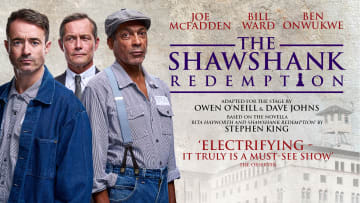
What happens in The Shawshank Redemption?
The story opens with Andy Dufresne, a Portland banker, on trial for the murder of his wife and her lover. Despite maintaining his innocence, the evidence against him is damning and the jury returns a guilty verdict. He is sentenced to two consecutive life terms and sent to Shawshank State Penitentiary in Maine — one of the harshest maximum-security facilities in the state.
Life inside Shawshank
Andy's first years at Shawshank are brutal. The prison is run by the pious and corrupt Warden Stammas, and violence — from guards and inmates alike — is a constant presence. Andy survives through a combination of intelligence, self-containment, and a deliberate refusal to be defined by where he is. He gradually earns the respect of fellow inmates, most importantly Ellis "Red" Redding, the prison's resourceful fixer, who can obtain almost anything for the right price.
The friendship
At the heart of the story is the friendship between Andy and Red — two men from entirely different backgrounds who find in each other something the prison cannot extinguish. Andy gives Red a sense of possibility; Red gives Andy an anchor to the human world. Their bond deepens over years and decades, tested by the institution's attempts to grind both men down.
Andy's quiet resistance
Andy uses his accounting skills to benefit both the prison guards and Warden Stammas, gaining privileges in return. He also works quietly for years to improve conditions for the other inmates — lobbying for a library, obtaining books and records. Beneath this visible compliance, he has been pursuing something else entirely, a plan so patient and private that no one around him suspects it until it is already complete.
Hope and what it costs
The story's central argument is that hope is simultaneously the most sustaining and most dangerous force a person can carry inside a prison. Red, institutionalised after decades, has learned to distrust it. Andy's refusal to surrender it becomes the decisive difference between them — and the source of the story's extraordinary final act.
From novella to stage
Stephen King's original novella
Rita Hayworth and Shawshank Redemption was published in 1982 as part of King's collection Different Seasons — a set of four novellas, each associated with a different season, that marked a deliberate departure from King's usual horror territory. The novella is narrated entirely by Red, and its quiet, reflective tone differs markedly from King's other work of the period. It became the basis for one of the most widely seen films ever made.
The 1994 film
Frank Darabont's film adaptation, starring Tim Robbins as Andy and Morgan Freeman as Red, was released in September 1994. It performed modestly at the box office on first release but found an extraordinary second life on home video and cable television, building a following that made it one of the most watched and beloved films of its era. It was nominated for seven Academy Awards. The film's dialogue and imagery are so deeply embedded in popular culture that any stage adaptation must work in their shadow — and find reasons to exist independently of them.
The stage adaptation
Owen O'Neill and Dave Johns' stage adaptation has been produced by Bill Kenwright Limited, one of the UK's most prolific theatrical producers, whose credits span West End dramas and major touring productions over several decades. The current production, directed by David Esbjornson, has toured extensively across the UK since 2022, reaching audiences in venues across England, Scotland, and Ireland before arriving at Richmond Theatre for its final London dates in June 2026.
Themes and lasting relevance
The Shawshank Redemption endures because its central themes — wrongful imprisonment, institutional power, the corrupting effect of authority, and the sustaining force of human connection — are not period concerns. King set the story in the 1940s through 1960s, but the questions it asks about justice, dignity, and what systems do to people are as contemporary as they have always been. The stage adaptation, by necessity, strips away the film's visual grandeur and makes those human questions even more immediate.
Performance schedule
- Run: Tuesday 2 June – Saturday 6 June 2026
- Evenings: Tuesday to Saturday, 7:30pm
- Matinees: Thursday and Saturday, 2:30pm
- Running time: Approximately 2 hours 20 minutes including one interval
This is a strictly limited five-night London engagement. No additional performances will be added. Advance booking is strongly recommended.
Age guidance and content
Recommended for ages 14 and above. The production contains strong language, scenes of prison violence, and adult themes including false imprisonment, institutional abuse, and coercion. It is not suitable for young children.
Tickets and pricing
Tickets are available through ATG Tickets and range from £21.95 to £83 depending on seat location and performance. This is a limited run — availability is expected to be tight across all performances.
Cast
- Joe McFadden as Andy Dufresne
- Ben Onwukwe as Red
- Bill Ward as Warden Stammas
- Graham Elwell as Bryan Hadley
- Ashley D Gayle as Rooster
- Jeffrey Harmer as Entwistle
- Kyle Harrison-Pope as Tommy Williams
- Kenneth Jay as Brooksie
- Sean Kingsley as Bogs Diamond
- Fernando Mariano as Rico
- Aein Nasseri as Nelson
- Owen Oldroyd as Dawkins
Cast information correct at time of publication and subject to change.
Creative team
- Adapted by: Owen O'Neill and Dave Johns
- Based on: Rita Hayworth and Shawshank Redemption by Stephen King (1982)
- Director: David Esbjornson
- Producer: Bill Kenwright Limited
Getting there
- Richmond station: London Overground, National Rail (South Western Railway), and District line — all terminate at Richmond. The theatre is a short walk from the station across Richmond Green.
- By bus: Numerous bus routes serve Richmond town centre
- By car: Parking is available in Richmond town centre — check local car parks in advance as they fill quickly on performance evenings
- From central London: Approximately 25–30 minutes by District line or Overground from central London
About Richmond Theatre
Richmond Theatre is one of the finest surviving examples of theatre architect Frank Matcham's work, opening in 1899 and Grade II-listed for its architectural importance. It sits at the edge of Richmond Green, one of London's most attractive town squares, and has operated continuously as a receiving house for touring productions and pre/post-West End runs for over 125 years. Its beautiful auditorium holds around 850 seats across stalls, dress circle, and upper circle.
Accessibility
Richmond Theatre offers wheelchair-accessible seating, hearing assistance systems, and accessible toilet facilities. Contact the box office in advance to discuss specific access requirements and to book accessible spaces.