What happens in The Snowman?
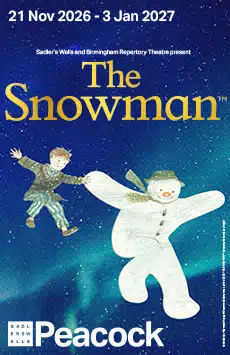
On a winter's day, a young boy builds a snowman in his garden. At midnight the snowman comes to life, and the boy shows his new friend around the sleeping house.
Walking in the air
The snowman takes the boy on a flight through the night sky to a snowy world far from home — the moment set to Walking in the Air, the best-known piece in Howard Blake's score.
Morning
The friendship lasts one night. The ending, which many people remember from the book and the film, is gentle and bittersweet, and it is part of why the story has endured.
Told without words
Like Raymond Briggs' original picture book, the stage show has no dialogue. Dance, music, puppetry and design carry the story, which makes it easy for very young children to follow.
A new Snowman for 2026
Retiring a London tradition
Birmingham Rep first staged The Snowman in 1993. The production went on to tour the UK and to play the Peacock Theatre every Christmas for nearly three decades, becoming the West End's longest-running festive show. In February 2026 Sadler's Wells and Birmingham Rep announced that it would be replaced by a completely new production.
The creative team
Will Tuckett directs and choreographs. Anna Fleischle is the production designer, with Keziah Ferguson as associate production designer. Tahra Zafar designs the Snowman costume and Daisy Beattie the puppets, with Emma Brunton as associate puppetry director. Video design is by Nina Dunn, illusions by Chris Fisher, lighting by Matt Daw and sound by Kelsh Buckman-Drage.
Birmingham first
The new production premieres on Birmingham Rep's main stage, The House, from 20 October to 1 November 2026, before transferring to the Peacock Theatre for the Christmas season.
Performance schedule
- First London performance: 21 November 2026
- Final performance: 3 January 2027
- Performances: Tuesday to Sunday, evenings and matinees; times vary across the festive season
- Running time: Around 1 hour 30 minutes, including an interval — confirm when booking
Accessible performances
- Relaxed performance: Wednesday 2 December, 2.30pm
- Audio described: Saturday 12 December, 2.30pm, with a touch tour beforehand
Tickets
Tickets range from around £22 to £90 depending on seat and performance.
Age guidance
Suitable for all ages. Babies are admitted; children aged two and over need their own ticket. The production uses some flashing lights and strobe effects.
Cast
The role of the Boy is shared by Felix Anderson, Jake Durant, Tristan Marwa and Tate Masuku, with an ensemble of twelve dancers. Cast may vary between performances.
Creative team
- Based on the book by: Raymond Briggs
- Music and libretto: Howard Blake
- Director and choreographer: Will Tuckett
- Production design: Anna Fleischle
- Snowman costume design: Tahra Zafar
- Puppet design: Daisy Beattie
- Lighting design: Matt Daw
- Sound design: Kelsh Buckman-Drage
- Video design: Nina Dunn
- Illusions: Chris Fisher
Getting there
- Tube: Holborn (Central, Piccadilly) is the nearest station; Temple and Covent Garden are also within walking distance
- Location: Portugal Street, off Kingsway, close to Lincoln's Inn Fields
Producers
Presented by Sadler's Wells and Birmingham Repertory Theatre, by arrangement with Snowman Enterprises Ltd and Chester Music Limited.