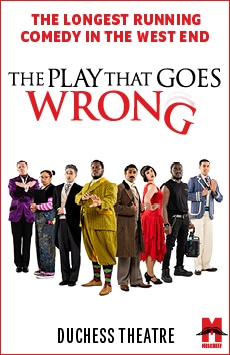
What happens in The Play That Goes Wrong?
The structural conceit is the joke: the audience is watching the fictional Cornley Polytechnic Drama Society perform a 1920s murder mystery called The Murder at Haversham Manor, and as the title of the framing show suggests, everything that can go wrong, does.
The Cornley Polytechnic Drama Society
The Cornley Drama Society, the audience is told via the pre-show announcement, has just had a substantial bequest and is using the funds to stage a serious 1920s murder mystery. Their previous productions have included Two Sisters, The Lion and The Wardrobe, Cat, and James and the Peach — a running joke about their commitment to staging plays for which they don't quite have a full cast. The director, lead actor, set designer and box office manager is one Chris Bean, who also plays Inspector Carter in the show itself.
The pre-show
Part of the show's brilliance is that the comedy starts before the lights go down. From the moment the audience enters the auditorium, members of the Cornley Drama Society are visibly trying (and failing) to fix problems with the set — a mantelpiece that keeps falling off, a door that won't shut, a missing dog. The pre-show interaction with confused audience members is part of the show, and resets the audience's expectations: nothing about this evening is going to go to plan.
The Murder at Haversham Manor
The show-within-a-show begins with the discovery of a body in the country house — Charles Haversham. An Inspector is sent for. There are suspects: Cecil Haversham, the dead man's brother; Florence Colleymoore, his fiancée; Thomas Colleymoore, her brother; Perkins, the butler; and Arthur the gardener. As the murder mystery's plot proper begins, the small failures of the Cornley production start to escalate: lines forgotten, props mishandled, characters knocked unconscious, actresses replaced mid-scene by stage managers who don't know the lines.
The collapsing set
The genuinely extraordinary element of the production is the way the set physically deteriorates across the show. Doors malfunction. The mantelpiece falls. Pictures drop. Eventually the entire upper level of the manor house — the study where the body is — begins to detach from the wall. By the final act, characters are running across a set that is, by any reasonable interpretation, actively collapsing around them. The audience watches the actors keep going as the show literally falls apart. The Tony Award for Best Scenic Design recognises exactly this engineering achievement.
The second act and the chaos finale
The second act is where the show's premise is pushed to its outer limits. By this point everything that could collapse has collapsed; characters are repeating their entrances because they cannot remember whether they entered before; a key prop has been smashed; an actress has been physically removed from the scene. The murder mystery does get solved — in the sense that someone announces who did it — but the conclusion is largely incidental to the slapstick fireworks of the finale.
Winston the dog
A running joke through every iteration of the production is the role of Winston, the dog, who is missing from the cast list and whose absence (or unexpected presence) becomes a recurring gag. Winston the dog returns to play Winston the dog in the 13th cast, as in every previous cast.
How The Play That Goes Wrong got here
Mischief Theatre's origins (2008-2012)
Mischief Theatre was founded in 2008 by Henry Lewis, Jonathan Sayer and Henry Shields, three friends and recent graduates of the London Academy of Music and Dramatic Art (LAMDA). The company's early work was improvised comedy with a heavy emphasis on physical performance — clear influences from British sketch comedy traditions, music hall, and the early-twentieth-century slapstick of Buster Keaton and Charlie Chaplin. The trio developed their idea for a piece about a hapless amateur drama company over several years of small-scale work.
The Old Red Lion debut (2012)
The Play That Goes Wrong premiered at the Old Red Lion Theatre, a 60-seat pub theatre in Islington, in early 2012. The first performances reportedly played to four paying customers. The production was directed by Mark Bell, who has remained the show's director through every subsequent iteration. The original cast included the three writer-creators in major roles: Henry Lewis as Robert, Jonathan Sayer as Dennis, and Henry Shields as Chris, alongside Charlie Russell (Sandra), Dave Hearn (Max), Nancy Zamit (Annie), Greg Tannahill (Jonathan), and Rob Falconer (Trevor).
The Trafalgar Studios run (2013)
Word of mouth was rapid. The show transferred to the smaller of the two auditoriums at Trafalgar Studios in 2013 for a limited season; it sold out. The reviews from this run established the show's critical reputation and led to discussion of a full West End transfer.
The Duchess Theatre opening (September 2014)
The Play That Goes Wrong opened at the Duchess Theatre on 14 September 2014. The Duchess — a 494-seat Nimax Theatres venue on Catherine Street, opened in 1929 — was an inspired venue choice. Smaller and more intimate than most West End houses, the Duchess allows the show's physical comedy to read clearly even from the back of the auditorium. The 2015 Olivier Award for Best New Comedy followed within months of opening, confirming the production's place in the West End comedy canon.
The franchise (2014-2025)
The Play That Goes Wrong's success enabled Mischief Theatre to develop the company's "Goes Wrong" universe. Peter Pan Goes Wrong (2013) — initially developed in parallel with the main show — transferred to the West End, then to Broadway, and was televised by the BBC as a Christmas special in 2016. The Comedy About a Bank Robbery (2016) ran for three years at the Criterion Theatre. Magic Goes Wrong (2019) was co-created with Penn & Teller. A Christmas Carol Goes Wrong has become a London festive fixture. The Comedy About Spies opened in 2025. Mischief have a BBC One sitcom (The Goes Wrong Show) and their first musical, Thespians, tours the UK from May 2026.
International success
The Play That Goes Wrong opened on Broadway at the Lyceum Theatre on 2 April 2017 with the original London cast, with J.J. Abrams making his debut as a theatrical producer. The Broadway run played 745 regular performances plus 27 previews before closing on 6 January 2019. Nigel Hook won the 2017 Tony Award for Best Scenic Design. The production toured Australia from February 2017 (Comedy Theatre Melbourne, Adelaide, Sydney, Canberra, QPAC Brisbane, His Majesty's Theatre Perth). A North American tour began in Pittsburgh in September 2018. The play has been translated and licensed into multiple languages worldwide and is one of the most-licensed contemporary British comedies in the global amateur theatre repertoire.
The Duchess Theatre milestone
The production passed its 2 millionth London visitor in February 2026, alongside its 4,000+ performance at the Duchess. It is the longest-running comedy currently in the West End, the longest-running play at the Duchess Theatre since the venue opened in 1929, and the 9th longest-running West End show of any kind currently in performance. The current booking period extends through 3 October 2027.
Henry Lewis, Jonathan Sayer and Henry Shields
The three Mischief co-founders have built one of the most successful UK comedy careers of their generation. Beyond Mischief Theatre, the trio have written for BBC television, appeared in their own shows on stage and screen, and acted as creative consultants on the international productions. They remain involved in Mischief's creative leadership but have stepped back from performing in the original London production.
Performance schedule
- Current booking period: Until 3 October 2027
- Running time: Approximately 2 hours, including one 20-minute interval
- Schedule: Tuesday – Saturday evenings at 7.30pm; Sunday evenings at 7pm; Saturday matinees at 2.30pm; Sunday matinees at 3pm. Times may vary by week — confirm exact times when booking.
- 13th cast begins: Tuesday 2 June 2026
Access performances
- Audio Described: Friday 25 September 2026, 7.30pm
- BSL Interpreted: Friday 13 November 2026, 7.30pm
- Captioned: Periodic dates throughout the run — contact the Nimax access team for the latest schedule
- Up to two access tickets per booking available online at 50% off per person
Age guidance and content
Recommended for ages 8+. Children aged 14 and under must be accompanied by, and seated next to, an adult aged 18 or over. The show contains:
- Slapstick violence, including characters falling from height (always safely choreographed)
- Prop weapons including a stage gun used in the murder-mystery framing
- Collapsing scenery and set elements (this is part of the show's design)
- Loud bangs and crashes
- Theatrical alcohol consumption (the wrong drinks are drunk for comic effect)
- Mild peril throughout — no real adult content or strong language
- Broadly accessible to confident 8-year-olds; many 7-year-olds with parental support also enjoy the show
Tickets and pricing
The Play That Goes Wrong tickets range from £30 to £105 depending on seat, day of the week and performance. Most performances offer Stalls and Dress Circle seats at £55-£82.50 standard pricing, with Upper Circle seats from £30. Weekday evenings (Tuesday-Thursday) and Sunday performances typically offer the best value. The production runs a strong group rates programme (10+ guests) with substantial discounts, and a schools programme at £23 per ticket (Tuesday-Thursday performances, one free teacher per 10 students, with various exclusion dates around school holidays). STEREO dining + show packages from £67.50. Day seats are typically released by the box office on the day.
13th West End Cast (from 2 June 2026)
- Ruby Ablett as Annie (previously The Ocean at the End of the Lane)
- Matthew Spencer as Chris (previously The Woman in Black)
- Raphael Bushay as Robert (previously The Crucible)
- Luke Wilson as Jonathan (previously Rockets & Blue Lights)
- Lucinda Turner as Sandra (previously Peaky Blinders: The Rise)
- Alex Bird as Dennis (previously A Christmas Carol Goes Wrong — internal Mischief promotion)
- Joshua Lendon as Max (previously Treasure Island)
- Kieron Michael as Trevor
- Winston as the dog (returning role)
Understudies and swings
- Paige Round
- Harry Al-Adwani
- Tom Quinn
- Will Bishop
- Phoenix Edwards
Creative team
- Written by: Henry Lewis, Jonathan Sayer & Henry Shields
- Director: Mark Bell
- Set design: Nigel Hook (2017 Tony Award winner, built by Splinter Scenery)
- Costume design: Roberto Surace
- Lighting design: Ric Mountjoy
- Sound design: Andy Johnson
- Original music: Rob Falconer
- Associate director: Sean Turner
- Resident director: Amy Marchant
- Producers: Mischief Theatre, Kenny Wax Ltd, Stage Presence Ltd
- Venue operator: Nimax Theatres
Getting there
- Tube: Covent Garden (Piccadilly) — 5 minute walk; Charing Cross (Bakerloo, Northern) — 8 minute walk; Temple (District, Circle) — 10 minute walk; Holborn (Central, Piccadilly) — 10 minute walk
- Mainline rail: Charing Cross — 8 minute walk; Waterloo East — 12 minute walk via Waterloo Bridge
- Bus: Aldwych stop served by routes 1, 59, 68, 76, 172, 188, 243, 341 and others
- Cycle: Santander Cycles docking station nearby on Drury Lane
- Parking: Drury Lane car park (5 min walk); Parker Street car park; on-street parking heavily restricted
About the Duchess Theatre
The Duchess Theatre opened on 25 November 1929, designed by architect Ewen Barr. With approximately 494 seats across two levels (Stalls and Dress Circle), it is one of the smaller and more intimate West End theatres. The Duchess has hosted significant productions across its history — including the long-running run of The Mousetrap from 1952 to 1974 before that play moved to the St Martin's. The venue passed into the hands of Nimax Theatres in 2005 (alongside the Apollo, Garrick, Lyric, Palace and Vaudeville theatres). The Duchess is Grade II listed. The Play That Goes Wrong has, since 14 September 2014, become the longest-running play in the theatre's nearly century-long history.
Accessibility
The Duchess Theatre offers step-free access to the Stalls via a Domino Zonzini stair climber. Dedicated wheelchair spaces are available — choose wheelchair spaces if you'll remain in your wheelchair. Hearing assistance via infrared headsets is available; accessible toilet facilities are on site. The Dress Circle is accessed via stairs and is not step-free accessible. Up to two access-rate tickets can be booked online per booking, at 50% off per person, for any performance. Audio Described, BSL-interpreted and Captioned performances are scheduled periodically — see Access performances above. Contact the Nimax access team in advance to discuss specific requirements.
Producers
The production is produced by Mischief Theatre (the company founded by the show's writer-creators), with West End producers Kenny Wax Ltd (one of the UK's most successful family-theatre and musical producers, also responsible for Six and Operation Mincemeat) and Stage Presence Ltd. The Duchess Theatre is owned and operated by Nimax Theatres, the privately-held theatre group owned by Nica Burns and Max Weitzenhoffer, which also operates the Apollo, Garrick, Lyric, Palace and Vaudeville theatres in the West End.