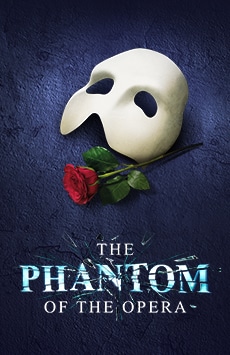
What happens in The Phantom of the Opera?
The musical opens in 1905, with an aged Raoul attending an auction at the now-derelict Paris Opera House. As a chandelier is unveiled, the action flashes back to the same building in 1881, when a mysterious figure known as the Phantom of the Opera was rumoured to haunt the theatre's underground levels.
A young soprano is chosen
When the Opera's temperamental star Carlotta walks out before opening night, the chorus girl Christine Daaé is given her first leading role. Her unexpected vocal brilliance astonishes the company. Christine confides in her childhood friend Raoul that her gift comes from a hidden teacher she calls the Angel of Music — a voice she believes was sent to her by her late father.
The Phantom revealed
The Angel of Music is in fact the Phantom — a disfigured musical genius who lives in the catacombs beneath the Opera House. He has been coaching Christine in secret and has fallen obsessively in love with her. The first act builds to the famous title sequence as the Phantom takes Christine through the looking-glass and down to his lair beneath the building, where he serenades her with The Music of the Night.
Raoul, jealousy and disaster
As Christine grows closer to Raoul, the Phantom's love turns to rage. He begins terrorising the Opera company — sending threatening notes, sabotaging performances, and ultimately bringing about the most famous moment in musical theatre: the chandelier crashing to the stage at the end of Act One.
The final confrontation
Act Two follows the Opera's increasingly desperate attempts to mount a new production while the Phantom's grip tightens. Christine is forced to choose between the safety Raoul offers and the strange, magnetic pull of her teacher. The famous final sequence — in the Phantom's lair, with all three characters in the same room — is one of the most emotionally devastating endings in popular musical theatre. The curtain falls on a single mask, left behind.
How Phantom got here
Gaston Leroux's novel
The Phantom of the Opera began as a 1910 novel by French journalist Gaston Leroux, written as a quasi-investigative gothic romance set inside the real Palais Garnier in Paris. The novel inspired multiple film adaptations from the 1925 silent classic onwards, but it was Andrew Lloyd Webber who turned it into the musical phenomenon that has defined the property ever since.
Lloyd Webber's musical
Lloyd Webber developed the musical with director Hal Prince and producer Cameron Mackintosh in the mid-1980s, with lyrics by Charles Hart and additional lyrics and book by Richard Stilgoe. The score deliberately fused classical operatic conventions with the contemporary musical-theatre vocabulary Lloyd Webber had developed across Cats, Evita, and Jesus Christ Superstar. Sarah Brightman, then Lloyd Webber's wife, originated the role of Christine.
The 1986 opening
The Phantom of the Opera opened at Her Majesty's Theatre on 9 October 1986, with Michael Crawford as the Phantom, Sarah Brightman as Christine, and Steve Barton as Raoul. It won the 1986 Olivier Award for Best New Musical. The Broadway production followed in January 1988, winning seven Tony Awards including Best Musical and Best Actor in a Musical for Crawford.
Forty years at His Majesty's
The London production has played continuously at the same theatre since opening, surviving every cultural shift and economic downturn of the past four decades. The theatre itself was renamed from Her Majesty's to His Majesty's on 11 January 2023 following the accession of King Charles III — the building reverts each time the monarch's gender changes, a tradition dating back centuries. Phantom is now the West End's second longest-running musical of all time after Les Misérables.
The 40th anniversary year
2026 marks the production's 40th anniversary. The year was opened by a special performance at the Olivier Awards 50th anniversary ceremony, with Andrew Lloyd Webber making a surprise organ cameo. The production continues at His Majesty's Theatre, currently booking into 2027.
Performance schedule
- Currently booking until: 13 March 2027
- Evenings: Monday to Saturday, 7:30pm
- Matinees: Wednesday and Saturday, 2:30pm
- Running time: Approximately 2 hours 30 minutes, including one interval
Schedule may vary around bank holidays. Confirm specific dates when booking.
Age guidance and content
Recommended for ages 10 and above. Children under 4 (including babes in arms) are not admitted. Children under 16 must be accompanied by and seated next to a ticketholder aged 18 or over.
The show contains scenes of psychological menace, dramatic special effects including a stage fire moment, and the famous chandelier sequence which can startle younger viewers. The themes of obsession and unrequited love are handled seriously. Most children aged 11+ engage with the show without difficulty.
Tickets and pricing
Phantom of the Opera tickets typically range from £29 to £259 depending on the seat and performance date. Premium seats and weekend performances sit at the higher end. The cheapest seats start at £29. London Theatre Hub recommends booking through LOVEtheatre, our official partner.
Cast (2026)
- Dean Chisnall as The Phantom
- Beatrice Penny-Touré as Christine Daaé (until 9 May 2026)
- Colleen Rose Curran as Christine Daaé (certain performances)
- Ashley Gilmour as Raoul, Vicomte de Chagny
- Joanna Ampil as Carlotta Giudicelli
- Adam Linstead as Monsieur André
- Martin Ball as Monsieur Firmin
- Helen Hobson as Madame Giry
- Bradyn Debysingh as Ubaldo Piangi
- Millie Lyon as Meg Giry
Cast information correct at time of publication and subject to change. Confirm current cast on the official Phantom London website.
Creative team
- Music: Andrew Lloyd Webber
- Lyrics: Charles Hart, with additional lyrics by Richard Stilgoe
- Book: Richard Stilgoe and Andrew Lloyd Webber (based on the novel by Gaston Leroux)
- Director (current): Seth Sklar-Heyn
- Original director: Harold Prince
- Production design: Maria Björnson
- Set design (adapted): Matt Kinley
- Lighting design: Andrew Bridge
- Sound design: Mick Potter
- Musical staging and choreography: Gillian Lynne (recreated by Chrissie Cartwright)
- Music supervision: Simon Lee
Getting there
- Tube: Piccadilly Circus (Piccadilly, Bakerloo lines) — 3 minute walk
- Alternative: Charing Cross (5 min), Leicester Square (7 min)
- Bus: Routes 6, 13, 15, 23, 139, 159, 453 stop nearby
- Parking: Q-Park Whitcomb Street — 5 minute walk
About His Majesty's Theatre
His Majesty's Theatre on Haymarket is one of the West End's most beautiful and historically significant venues, with a capacity of around 1,216 across stalls, dress circle, upper circle, and balcony. The current building, designed by Charles J. Phipps, opened in 1897 — though the site has hosted theatres since 1705. The theatre is renamed each time the monarch's gender changes: it was Her Majesty's throughout Queen Elizabeth II's reign, and was renamed His Majesty's on 11 January 2023 following the accession of King Charles III. The building has hosted the Phantom of the Opera continuously since 1986, making it one of the most theatrically iconic venues in the world.
Accessibility
His Majesty's Theatre offers wheelchair-accessible seating in the stalls, hearing assistance systems, and accessible toilet facilities. Some areas of the historic 1897 building involve stairs. Wheelchair spaces are limited — contact the access line in advance to book and confirm specific requirements.
Producers
The London production is produced by Cameron Mackintosh and The Really Useful Group Ltd. Mackintosh is also the producer of Les Misérables, Mary Poppins, and Hamilton in London — Phantom is the longest-running show in his catalogue and one of the most commercially successful musicals in theatre history.