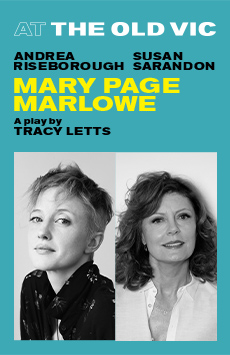
What happens in Mary Page Marlowe?
Mary Page Marlowe is an accountant from Dayton, Ohio. The play opens with Mary at 40, sitting in a restaurant with her two children, telling them she is divorcing their father and moving to Kentucky. From there, the play jumps — backwards, forwards, sideways — across 11 scenes that span 70 years of her life.
The non-chronological scenes
One scene shows Mary at 12, in conflict with her own mother. Another shows her in her late twenties, navigating a first marriage. Another shows her at 50, dealing with the legal consequences of three drink-driving convictions. Another shows her in her late sixties, with a quietness that the earlier scenes have not prepared the audience for. The order is deliberately broken; the audience puts the timeline together themselves.
Five Marys, one woman
Five actors play Mary at different ages: Alisha Weir as Mary at 12, Eleanor Worthington-Cox at 19, Rosy McEwen at 27 and 36, Andrea Riseborough at 40, 44 and 50, and Susan Sarandon at 59, 63 and 69. The casting is not gimmick. Letts wrote the play partly to test what happens when an audience sees the same character played by visibly different people across a single evening — whether the self that travels through a life is one self or several. The play's quiet conclusion turns on that question.
The ordinary as subject
Mary is not a famous person. Nothing momentous happens to her. She works as an accountant, she has children, she divorces, she remarries, she ages, she dies. The play's claim is that this constitutes a life as worth attention as any other — and that the ways we narrate ourselves to ourselves, fragmentary and out of order, are the closest most of us get to making sense of who we are.
How Mary Page Marlowe arrived at The Old Vic
Tracy Letts and the post-Osage County career
Tracy Letts won the Pulitzer Prize for Drama in 2008 for August: Osage County, and a Tony Award for the play's Broadway transfer. His earlier work (Killer Joe, Bug, Superior Donuts) had established him as a writer of confrontational, often violent domestic drama. Mary Page Marlowe, which premiered at Chicago's Steppenwolf in 2016, marked a deliberate move into quieter territory — a play with no central conflict, no act break, and a single character pulled apart across five performers.
The Steppenwolf premiere and Off-Broadway run
The 2016 Steppenwolf production, directed by Anna D. Shapiro, originally cast a series of real babies as the infant Mary in early previews. Audience unease at seeing real infants used as stage props convinced Shapiro to recast the role with a doll — a small footnote in the play's history that captures the seriousness of its commitment to seeing Mary at every stage of her life. The play transferred Off-Broadway to Second Stage Theater in 2018, where it ran for a limited engagement to strong reviews but no commercial transfer.
The Old Vic UK premiere
The Old Vic's announcement of the production in July 2025 was the headline news of Matthew Warchus's final season as artistic director. The casting of Susan Sarandon (UK stage debut) and Andrea Riseborough (returning to theatre after fifteen years working in film) gave the production a profile that would have been unusual for a Letts play of this scale. The full UK cast — Rosy McEwen, Eleanor Worthington-Cox, Alisha Weir, Hugh Quarshie, Paul Thornley, Lauren Ward, Melanie La Barrie, Ronan Raftery, Eden Epstein, Gilbert Kyem Jnr, Clare Hughes, Daniella Arthur-Kennedy, Kingsley Morton, Noah Weatherby — was confirmed in August.
In-the-round staging
For the run, The Old Vic's traditional proscenium auditorium was completely reconfigured in-the-round, with seating built up around a central acting area. Rob Howell designed the set and costumes, Hugh Vanstone lit it, Simon Baker did the sound, and Penny Dyer worked on dialect. The play closed on 1 November 2025 after a six-week run.
The play's place in Letts' career
Mary Page Marlowe sits in the quieter chamber of Tracy Letts' work — alongside Linda Vista (Steppenwolf, 2017; Broadway, 2019) and The Minutes (Broadway, 2022). It is a play about a woman, written by a man who has spent his career studying how American family lives go wrong. The Old Vic production was the first major UK staging.