
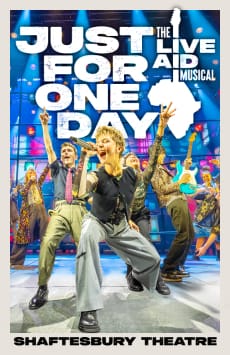
Just For One Day at a glance

Show
Just For One Day The Live Aid Musical
London status
Closed at the Shaftesbury Theatre, 7 February 2026
Current status
UK & Ireland tour from 31 March 2027
UK tour pricing
From £20 (typically £20–£95 depending on venue)
UK tour run
31 March – early August 2027
Tour venues
14 cities including Leicester, Manchester, Edinburgh, Birmingham, Glasgow, Liverpool
Genre
Musical (jukebox / historical)
Running time
Approximately 2 hours 30 minutes, including interval
Age guidance
10+ (some strong language)
Book
John O'Farrell
Director
Luke Sheppard (& Juliet, In The Heights)
Tour cast
Craige Els as Bob Geldof
Producer
Jamie Wilson Productions, in association with the Band Aid Charitable Trust
West End run
Shaftesbury Theatre, 17 January 2025 – 7 February 2026
World premiere
The Old Vic, 26 May – 30 March 2024
Charity
Over £1.6 million raised for the Band Aid Charitable Trust

UK & Ireland Tour 2027 — book now

Following its West End run at the Shaftesbury Theatre, Just For One Day embarks on a major UK & Ireland tour from 31 March 2027. The tour opens at Curve Leicester and visits fourteen cities through to early August:

  • Curve Leicester (31 Mar – 10 Apr 2027)
  • Wales Millennium Centre, Cardiff
  • Marlowe Theatre, Canterbury
  • Manchester Opera House (4 – 15 May 2027)
  • Oxford New Theatre (18 – 22 May 2027)
  • Edinburgh Playhouse (25 – 29 May 2027)
  • Theatre Royal Plymouth (1 – 5 Jun 2027)
  • Sunderland Empire (8 – 12 Jun 2027)
  • Birmingham Alexandra (22 Jun – 3 Jul 2027)
  • Hull New Theatre (6 – 10 Jul 2027)
  • Leeds Grand Theatre (13 – 17 Jul 2027)
  • Nottingham Theatre Royal (20 – 24 Jul 2027)
  • King's Theatre Glasgow (27 – 31 Jul 2027)
  • Liverpool Empire (3 – 7 Aug 2027)

Tickets from £20 · A portion of every ticket continues to support the Band Aid Charitable Trust

Book UK Tour Tickets on ATG →

Looking back: Just For One Day in the West End

4.4
★★★★½

LTH Retrospective Rating

The Verdict

Just For One Day took on one of the harder briefs in recent musical theatre. The 1985 Live Aid concerts at Wembley and JFK are not, in themselves, a story — they are a sixteen-hour broadcast of more than seventy acts, complete with technical disasters, geopolitical naïveté, financial chaos, and the moments of pure pop epiphany (Queen's twenty minutes, Bowie introducing the CBC famine footage) that have hardened into cultural shorthand. John O'Farrell's book threads through this terrain by anchoring the show in Bob Geldof's perspective — Craige Els giving a properly weighty performance as the Boomtown Rat turned reluctant moral conscience — and treating the larger event as something that happened around him, often against his expectations.

Luke Sheppard's production at the Old Vic, and then through thirteen months at the Shaftesbury, made two clever choices. First, the songs do character work; they are not simply nostalgic interludes. Second, the show is honest about Geldof's contradictions — the famous swearing, the diplomatic clumsiness, the genuine commitment, the cost to his own band — without scripting him as either saint or self-promoter. Audiences responded: the production raised over £1.6 million for the Band Aid Charitable Trust during its run, an unusually direct connection between a piece of commercial theatre and a continuing humanitarian cause. The UK tour from March 2027 should sustain that record.

What Makes It Special

  • Songs that work as character beats. Queen, Bowie, U2, the Boomtown Rats, Status Quo, Dire Straits — the catalogue is famous, but Sheppard's staging treats each number as part of the story rather than a karaoke setpiece.
  • Craige Els as Geldof. A performance that takes the swearing, the awkwardness, and the commitment seriously and earns its emotional weight in the second half.
  • John O'Farrell's book. The novelist and political satirist (An Utterly Impartial History of Britain, Things Can Only Get Better) gives the political backdrop room without lecturing the audience.
  • Real-world charitable continuity. Over £1.6 million raised for the Band Aid Charitable Trust during the run, with the tour continuing the donation arrangement. Few musicals tie their box office quite this directly to their subject.
  • The Live Aid restaging. The Wembley sequences are the show's set-piece reason for being. Sheppard and his creative team deliver them as theatre rather than tribute act — closer to The Inheritance's stage-within-stage scale than to a stadium recreation.

Everything You Need to Know

What happens in Just For One Day?

The musical opens in October 1984, with Bob Geldof — frontman of the increasingly unfashionable Boomtown Rats — sitting at home watching Michael Buerk's BBC News report from Korem in northern Ethiopia. The famine footage prompts what becomes the founding instinct of the piece: that something has to be done, immediately, and that as a famous person he might be able to do it.

Band Aid

The first act traces Geldof's collaboration with Midge Ure on the Band Aid single "Do They Know It's Christmas?" — the late-night writing session, the recruitment of every available British pop star (George Michael, Paul Young, Boy George, Sting, Bono, Phil Collins, members of Duran Duran and Spandau Ballet), the SARM West studio session on 25 November 1984, and the song's release a week later. The single went to number one in seventeen countries and raised £8 million for famine relief — at the time, an unprecedented sum from a piece of pop music.

Live Aid

The second act is about the concerts themselves: the eighteen months of planning, the political and logistical near-disasters, the eventual broadcast on 13 July 1985 from Wembley Stadium and JFK Stadium in Philadelphia, watched by an estimated 1.9 billion people across 150 countries. Onstage we see Queen's defining twenty-minute set, Bowie's surrender of his last four minutes to the CBC famine footage that played behind "Drive", U2's career-making "Bad", and Paul McCartney's piano breaking down during "Let It Be". Offstage we see Geldof's mounting exhaustion, the famous expletive on the BBC News broadcast that quadrupled donations within an hour, and the moral and political questions about the entire endeavour that the show is honest enough to leave unresolved.

Aftermath

The final scenes look at the Band Aid Charitable Trust's continuing work, the complications of celebrity humanitarianism that have followed Live Aid into the present, and the personal cost to Geldof — the end of the Boomtown Rats, the public weight of the role he never asked for. The musical does not pretend the questions are easy. It does insist, in its closing moments, that the impulse was right.