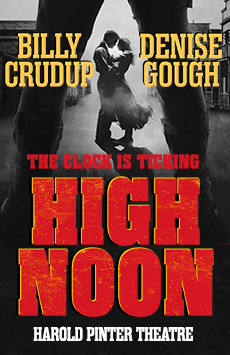
What happens in High Noon?
High Noon takes place in Hadleyville, a small town in the New Mexico Territory, in 1880. The action unfolds in real time across approximately 100 minutes, opening with a wedding and ending at twelve noon.
Kane hangs up his badge
Marshal Will Kane (Billy Crudup) marries Amy Fowler (Denise Gough), a Quaker, in a small civil ceremony. Kane has resigned as marshal to begin a new life with Amy as a storekeeper in another town. He and Amy are minutes away from leaving Hadleyville for good.
The news arrives
A telegram reaches the marshal's office: Frank Miller (James Doherty), an outlaw Kane sent to prison five years earlier, has been pardoned and is arriving in Hadleyville on the noon train. Three of Miller's old gang members are already at the train station waiting for him. Kane is told he should leave town immediately. Amy begs him to come with her.
The town refuses
Kane decides to stay. He goes door to door asking his deputies, his friends, the church congregation, and the men he once stood beside in earlier fights to help him face Miller. Each in turn refuses — out of fear, out of resentment, out of the convenient logic that Kane has already resigned and no longer holds office. By the time the noon train sounds, Kane is alone. Amy, who has come to the station to leave on the same train, must decide whether her pacifist principles or her husband's life are the deeper commitment.
The high noon confrontation
The clock strikes twelve. The film's famous final twenty minutes — Miller and his men through the empty streets, Kane waiting, Amy's choice — played out in the Pinter auditorium with the gunshots that gave the show its 12+ age guidance. The play, like the film, refuses to deliver Hollywood's usual catharsis. Kane survives, but the moral indictment of the townspeople who would not stand with him is the play's last word.
How High Noon arrived at the Harold Pinter Theatre
The 1952 film
High Noon was directed by Fred Zinnemann, produced by Stanley Kramer, and written by Carl Foreman from a story by John W. Cunningham. It starred Gary Cooper as Will Kane and Grace Kelly, in her breakthrough role, as Amy Fowler. The film won four Academy Awards (including Best Actor for Cooper and Best Original Song for "Do Not Forsake Me, Oh My Darlin'") and is routinely listed among the greatest Westerns ever made. It is also one of the most politically loaded American films of the 1950s.
The blacklist subtext
Carl Foreman wrote the screenplay during the height of the House Un-American Activities Committee's investigations into the Hollywood film industry. Foreman was himself called before HUAC; he refused to name names and was blacklisted. The image of Kane going door to door asking for help and being turned away was, for Foreman, an open commentary on what was happening to his colleagues in real life. John Wayne famously called the film "the most un-American thing I've ever seen in my whole life" and later said he was proud to have helped drive Foreman out of the country. The political reading has been part of the film's meaning ever since.
Eric Roth and the stage adaptation
Eric Roth's screenwriting career includes Forrest Gump (Academy Award, Best Adapted Screenplay), The Insider, The Curious Case of Benjamin Button, A Star Is Born, Dune, and Killers of the Flower Moon — six Oscar nominations across forty years. High Noon was his first stage play. He worked from Carl Foreman's original screenplay rather than the source short story, and developed the project over several years in workshop with producers Paula Wagner and Tom Werner before the West End premiere was announced in summer 2025.
The West End production
The Harold Pinter Theatre run was the production's world premiere. Thea Sharrock — Olivier winner for After the Dance, with credits including Equus and the West End/Broadway transfer of The Bodyguard — directed. Tim Hatley designed set and costume; Neil Austin lit it; Chris Egan composed the score, which incorporated songs by Bruce Springsteen, The Chicks and Ry Cooder. Kate Waters was fight director and Lizzi Gee was movement director — both essential to the production's real-time discipline.
What's next
No transfer has been announced as of May 2026. Given the scale of the production, the strength of the source material and the involvement of American producers (Paula Wagner, Tom Werner, Thomas Tull), a Broadway transfer is plausible but unconfirmed. The Harold Pinter Theatre run was Eric Roth's stage debut — and on this evidence, unlikely to be his last.