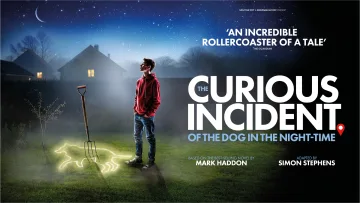
What happens in The Curious Incident of the Dog in the Night-Time?
The play opens with Christopher Boone standing over Wellington — his neighbour Mrs Shears' dog — who has been killed with a garden fork. Christopher is fifteen years old, lives with his father Ed in Swindon, and has an exceptional gift for mathematics and logic. He decides to investigate the dog's death, approaching it as a detective — like Sherlock Holmes, whom he admires — and begins to record his investigation in a book.
The investigation begins
Christopher's father tells him to stay out of other people's business, but Christopher continues to question the neighbours. He is cautious around people and finds social interaction difficult to navigate — he dislikes being touched, struggles to read facial expressions, and relies on patterns and logic to make sense of the world around him. His investigations reveal unexpected details about his neighbourhood, his neighbours, and the relationships between them.
A much larger discovery
The mystery of Wellington turns out to be the smaller of the two revelations at the heart of the story. Christopher discovers that his mother, whom his father told him had died of a heart attack two years ago, is in fact alive and living in London with another man. The letters she has been secretly sending him have been hidden by his father. The discovery shatters what Christopher understood to be the fixed facts of his world.
The journey to London
Christopher decides — despite his profound anxiety about new places, crowds, and unpredictability — to travel to London by himself to find his mother. The sequence depicting his journey through Swindon station and across London on the Underground is one of the most theatrically virtuosic passages in contemporary British drama: a young person's terror of an overwhelming world rendered in movement, light, sound, and mathematics.
What he finds
Christopher reaches his mother and stepfather's flat in London. The rest of the play moves between Christopher's attempts to rebuild his understanding of his family, his father's desperation to repair the damage he has done, and Christopher's determination — in the face of everything — to sit his A-level maths exam. His success in that exam, and what it represents about what he is capable of, is the play's quiet, devastating conclusion.
From novel to stage
Mark Haddon's novel
Mark Haddon's novel was published in 2003, simultaneously as a children's book and an adult novel — an unusual publishing decision that reflected the story's dual audience. It won the Whitbread Book of the Year and the Guardian Children's Fiction Prize in 2003, and has since sold more than ten million copies in over forty languages. The novel is narrated entirely by Christopher in his own voice — logical, precise, mathematical, and unexpectedly moving — and it does not name or diagnose his condition, presenting it instead through the texture of his perception.
The National Theatre production
Simon Stephens' stage adaptation was commissioned by the National Theatre and directed by Marianne Elliott, who had recently won an Olivier Award for War Horse. The production opened at the Cottesloe Theatre in August 2012. Its theatrical design — by Bunny Christie, with lighting by Paule Constable and sound by Ian Dickinson — used a grid of lights embedded in the floor and walls, projections of mathematical equations and maps, and precisely choreographed ensemble movement to represent Christopher's inner world. Luke Treadaway won the Olivier Award for Best Actor for the title role. The production transferred to the Apollo Theatre in the West End in 2013 and to Broadway's Ethel Barrymore Theatre in 2014.
Awards and global reach
The original production won seven Olivier Awards in 2013 and five Tony Awards in 2015. It has since been performed in more than forty countries and seen by over five million people. The National Theatre has filmed the production for broadcast and educational use, making it one of the most widely studied plays in the UK school curriculum.
The 2026 revival
This new production is co-produced by Melting Pot — led by producer Simon Friend — and Birmingham Rep, one of the UK's leading producing theatres. It is directed by Ned Bennett, whose productions of Equus (Trafalgar Studios, 2019) and Pomona (Orange Tree Theatre, 2014) established him as one of the most formally rigorous directors of his generation. The production opens at Birmingham Rep in September 2026 before a major UK tour, arriving at New Wimbledon Theatre in November 2026. Full casting will be announced in due course.
Performance schedule
- Run: Tuesday 10 November – Saturday 14 November 2026
- Evenings: Tuesday to Saturday, 7:30pm
- Matinees: Thursday and Saturday, 2:30pm
- Running time: Approximately 2 hours 15 minutes including one interval
This is a five-performance London engagement as part of the UK tour. Advance booking recommended.
Age guidance and content
Recommended for ages 11 and above. Children under 16 must be accompanied by an adult aged 18 or over. The play contains some strong language and deals with adult themes including parental deception, family breakdown, and the challenges of living with a neurological difference. It is widely performed in schools and is an excellent introduction to serious theatre for older children and teenagers.
Tickets and pricing
Tickets are available through ATG Tickets and range from £15.60 to £128 depending on seat and performance. The broad price range makes this one of the most accessible high-quality touring productions in London in 2026.
Creative team
- Written by: Simon Stephens
- Based on the novel by: Mark Haddon
- Director: Ned Bennett
- Producers: Melting Pot and Birmingham Rep
Full casting and design team to be announced. Cast information will be updated on this page when confirmed.
Getting there
- Wimbledon station: District line, London Overground, and National Rail (South Western Railway) all serve Wimbledon. The theatre is approximately a 5-minute walk from the station along The Broadway.
- Tram: Tramlink services stop at Wimbledon, connecting to Croydon and south London.
- By bus: Numerous bus routes serve Wimbledon town centre.
- By car: Parking is available in Wimbledon town centre — Centre Court shopping centre car park is the closest option.
- From central London: Approximately 25–30 minutes by District line from central London.
About New Wimbledon Theatre
New Wimbledon Theatre opened in 1910 and has been a major receiving house for touring productions ever since. The main auditorium seats approximately 1,600 across stalls, dress circle, and upper circle. It is one of the largest and best-equipped touring venues in south London, hosting West End transfers, major UK tours, and pantomimes. The theatre also has a studio space seating up to 80.
Accessibility
New Wimbledon Theatre offers step-free access to the stalls via a lift, wheelchair spaces with companion seating, accessible toilets, accessible bar facilities, and hearing assistance systems. Assistance dogs are welcome throughout the building. Contact the box office in advance to discuss specific access requirements.