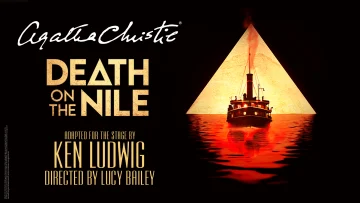
What happens in Death on the Nile?
Ken Ludwig's stage adaptation stays close to the broad outline of Agatha Christie's 1937 novel, while reshaping the structure for theatrical pacing and introducing a framing device at the British Museum.
The British Museum opening
The play opens at an Egyptology exhibition at the British Museum, featuring an ancient sarcophagus due to be returned to Egypt. Among the assembled guests are several characters whose lives will intersect catastrophically on the Nile cruise to come — including Linnet Ridgeway, the young, beautiful and very wealthy English heiress whose recent marriage to Simon Doyle has shocked everyone who knows her.
The honeymoon and Jacqueline
Linnet and Simon arrive aboard the SS Karnak for their Nile honeymoon — and find themselves pursued, again, by Jacqueline de Bellefort, Simon's former fiancée. Jacqueline introduced Simon to Linnet in the first place; Linnet promptly stole him. Now Jacqueline is following them from hotel to hotel, country to country, refusing to let the new couple escape her presence. Among the other passengers are the novelist Salome Otterbourne and her daughter Rosalie, the elderly Egyptologist Atticus Praed and his nephew Ramses, the American lawyer Annabelle Pennington, and Hercule Poirot himself — initially on board for a holiday — and his friend Colonel Race, whose presence may not be entirely accidental.
The murder
The first night aboard ends with a body in a cabin and a bullet in the temple. Poirot — assisted by Race — takes over the investigation. The closed-circle premise of the steamboat means every suspect remains on board; the multi-level set lets the audience see each cabin door, each balcony, each public space as Poirot questions, eliminates and gradually narrows the field. The novel's central trick — and the play preserves it — depends on a misdirection that is one of the most ingenious in the Christie canon.
The dénouement
In traditional Christie fashion, Poirot assembles the surviving passengers in the boat's lounge for the final reveal. The marketing carefully avoids spoiling either the killer or the trick; multiple reviewers noted audible audience reactions at the moment of disclosure. Ken Ludwig's script slightly streamlines the novel's denouement for theatrical clarity, but the central twist remains untouched.
How Death on the Nile became a 2025 touring production
The Christie novel, 1937
Death on the Nile was published in 1937, drawing directly on Agatha Christie's own 1933 honeymoon trip up the Nile with her second husband, archaeologist Max Mallowan. It is widely regarded as one of the strongest of the Poirot novels and has been adapted multiple times: a 1978 Peter Ustinov film, the 2004 ITV series with David Suchet, and the 2022 Kenneth Branagh film. A stage adaptation by Christie herself in the 1940s (Murder on the Nile) substantially rewrote the story and removed Poirot entirely.
The Ken Ludwig / Lucy Bailey / Fiery Angel partnership
The current production is the third Christie play from a long-running creative partnership between American playwright Ken Ludwig, British director Lucy Bailey and producers Fiery Angel. Their And Then There Were None toured the UK successfully; Murder on the Orient Express, the second collaboration, became one of the most commercially successful Christie tours of recent years. Death on the Nile reunites the same writing-direction-production team for a third trip.
Casting and design
Mark Hadfield — best known for theatre work including Into the Woods and screen credits including Belfast, Wallander and Outlander — was announced as Hercule Poirot in spring 2025. Glynis Barber and Bob Barrett joined in August 2025, with Barrett's third Christie tour for the same team. The supporting cast, announced in late summer, includes Libby Alexandra-Cooper as Linnet, Esme Hough as Jacqueline, Nye Occomore as Simon, Camilla Anvar as Rosalie, Helen Katamba as Annabelle Pennington, Howard Gossington as Atticus Praed, Nicholas Prasad as Ramses and Terence Wilton as Septimus Troughton. Set, costume, lighting and sound are by long-standing Lucy Bailey collaborators.
The tour route
The European premiere opened at The Lowry, Salford on 26 September 2025, with national press night the following Thursday at Richmond Theatre. The tour runs through to 23 May 2026 at Theatre Royal Plymouth, taking in over 20 venues across England, Wales, Scotland, Northern Ireland and the Republic of Ireland. As of May 2026, around two weeks of the tour remain.
What's next from the Christie team
The Christie touring circuit appears to be settling into a near-annual pattern from this creative team, with further Ken Ludwig / Lucy Bailey / Fiery Angel productions expected — though no specific successor to Death on the Nile has been announced as of May 2026.