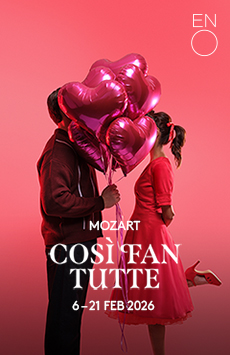
What happens in Così fan tutte?
The original opera is set in Naples in the late eighteenth century. Phelim McDermott's ENO production relocates it to a 1950s Coney Island fairground, but the narrative beats are unchanged from Da Ponte's libretto.
The wager
Two young military officers, Ferrando and Guglielmo, are sitting in a café boasting about the absolute faithfulness of their fiancées — sisters Dorabella and Fiordiligi. An older man, Don Alfonso, listens to their boasting with growing scepticism. He bets them a hundred sequins that within twenty-four hours he can prove that both women, given the right circumstances, will betray them. Ferrando and Guglielmo agree, on the condition that they follow Don Alfonso's instructions exactly.
The fake departure
Don Alfonso brings the men to the sisters to announce that they have been called to war and must leave immediately. After an extended farewell scene, the men depart. Don Alfonso then introduces the women's maid, Despina, into the scheme. Two strangers — actually Ferrando and Guglielmo in disguise, played in the McDermott production with broad theatrical commitment — turn up and begin to court the sisters. At first the women resist; then Despina (also in disguise, as a doctor) revives the disguised men from a pretended suicide attempt by poison.
The betrayal
By the end of the first day, both sisters have agreed to marry the disguised strangers — Dorabella with little resistance, Fiordiligi only after the longer and most musically demanding ordeal of the opera. A wedding contract is drawn up and signed. At the moment of the signing, military music announces the supposed return of the original fiancés. The men reveal themselves. Don Alfonso has won his wager. The opera ends with a four-voice ensemble singing that anyone who can accept the worst about human nature without losing their reason has found philosophical balance — which is the closest the opera comes to a moral.
The musical highlights
The opera contains some of Mozart's most beautiful ensemble writing — Soave sia il vento (a trio at the farewell scene), the act-one quintet, the act-two finale wedding ensemble. Fiordiligi's Come scoglio is one of the most technically demanding soprano arias Mozart wrote. Despina's two aria spots give the maid the opera's comic centre of gravity. The piece is around three hours including interval — substantial, demanding, and one of Mozart's three Da Ponte operas alongside The Marriage of Figaro and Don Giovanni.
How Così fan tutte became a McDermott staple at ENO
Mozart's third Da Ponte opera
Così fan tutte premiered in Vienna in 1790, with libretto by Lorenzo Da Ponte and music by Wolfgang Amadeus Mozart. It was the third and final opera in the Mozart–Da Ponte cycle, following The Marriage of Figaro (1786) and Don Giovanni (1787). Mozart died less than two years after the premiere, aged 35. The opera's reputation has been unstable across two centuries — Victorian audiences regarded the libretto as morally indefensible and the work was rarely staged; twentieth-century revivals reclaimed it as one of Mozart's most musically sophisticated scores; twenty-first-century productions have wrestled openly with its gender politics.
The McDermott production
Phelim McDermott — Artistic Director of the theatre company Improbable, and known to ENO audiences for his stagings of Philip Glass's Akhnaten and Satyagraha — premiered this production at the London Coliseum in May 2014. The Coney Island setting, with Tom Pye's fairground set and a cast that included visible side-show performers throughout, was a co-production with New York's Metropolitan Opera, where it transferred. The Stage called the original staging "elegant and fleet"; the Evening Standard called it "a rollercoaster of a production". The Daily Express called it "a great evening's entertainment".
Revivals
The production has been revived multiple times — 2017, 2019, 2022 and 2026 — with rotating casts. The 2022 revival was conducted by Kerem Hasan; the 2026 revival was led by Dinis Sousa, Principal Conductor of the Royal Northern Sinfonia, who brought a brisk and characterful musical approach. The repeatability of the production is part of its value to ENO: a strong staging that absorbs new casts cleanly and that the company can return to in seasons when the budget for a new Mozart staging is not available.
The 2026 cast
The principal cast was Lucy Crowe (Fiordiligi), Taylor Raven (Dorabella), Joshua Blue (Ferrando), Darwin Prakash (Guglielmo), Andrew Foster-Williams (Don Alfonso) and Ailish Tynan (Despina). On at least one performance during the run, the young Welsh tenor Osian Wyn Bowen — a 2025/26 ENO Harewood Artist — stepped in at very short notice for Ferrando and was widely praised. The Bridgewater Hall, Manchester, also presented two semi-staged concert performances on 27–28 February 2026 with the same cast, conducted by Alexander Joel.
The ROH alternative
London audiences have two regular London productions of Così fan tutte to choose from. The Royal Opera House at Covent Garden mounts Jan Philipp Gloger's 2016 contemporary-setting production every few years — most recently in summer 2024 with Golda Schultz as Fiordiligi. The ENO Coney Island staging at the Coliseum is the more theatrical of the two; the ROH version is the more traditional. Both companies announce their seasons annually.