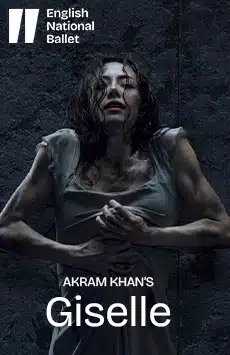
What happens in Akram Khan's Giselle?
The curtain rises on shadowy figures pressing against a vast, forbidding wall. They are the Outcasts: a community of migrant garment factory workers who lost their work when the factory closed. The wall separates them from the Landlords — the factory owners — who control their livelihoods and, by extension, their fates.
Act I — the Outcasts and the Landlords
Among the Outcasts is Giselle, a strong and respected young woman. She is in love with Albrecht, who has joined the community and passes for one of them. Hilarion, a shape-shifting "fixer" who trades with both sides, recognises that Albrecht is in fact a Landlord — and is engaged to one of them, Bathilde.
The Ceremony
The Landlords arrive. The Outcasts are required to perform for them, as exotic entertainment. Giselle recognises a dress worn by Bathilde as garment she herself stitched. Albrecht tries to hide. Hilarion confronts him; Bathilde's father confronts him; Albrecht is forced to choose, and returns to Bathilde and to the Landlord world. Giselle, exposed and abandoned, is overwhelmed. The Outcasts encircle her, dance with her, and when they part, she is dead. Khan stages this collective grief and rage as a single circling movement — one of the production's most striking sequences.
Act II — the ruined factory
The wall lifts. Behind it: a wrecked, abandoned factory where Giselle and her co-workers have laboured — and where many have died. This is the realm of the Wilis: the vengeful ghosts of women killed by the factory's working conditions. Myrtha, their queen, rules them. Hilarion enters to mourn at Giselle's grave; the Wilis surround him and kill him — a brutal, percussive sequence that establishes the stakes.
The reunion
Albrecht arrives, grieving, and confronts the Landlords for their part in Giselle's death. Myrtha summons Giselle from her body to join the Wilis. The lovers find each other on the threshold between life and death. Myrtha commands Giselle to dance Albrecht to his death — the traditional Wili punishment for men who have wronged women. Giselle refuses.
The forgiveness
Breaking the cycle of violence, Giselle forgives Albrecht and releases him into life. The wall returns. The Wilis remain in their factory. The production ends not with romantic dissolution but with a small, hard-won act of refusal — Giselle declining to repeat what was done to her. It is, depending on the viewer, an ending of grief, of grace, or of quietly transmitted political anger.
How Akram Khan rebuilt the 1841 Romantic ballet
The original Giselle
The 1841 Giselle, with music by Adolphe Adam and choreography by Jean Coralli and Jules Perrot, premiered at the Paris Opéra. It is one of the foundational Romantic ballets — a story of a peasant girl who dies of grief when she discovers her noble lover Albrecht is engaged to another woman, and who in Act II joins the Wilis (ghosts of jilted brides) but saves him from being danced to death. It has remained in continuous repertory for nearly two centuries.
The commission
In 2014, English National Ballet's then-artistic director Tamara Rojo invited Akram Khan to make his first full-length ballet. The brief, eventually, was Giselle. Khan worked with dramaturg Ruth Little, designer Tim Yip and composer Vincenzo Lamagna over an extended development period — researching garment factory disasters (most notably the 2013 Rana Plaza collapse in Dhaka, which Khan has cited as a starting point for the migrant-worker framing), revisiting Adam's score, and developing a movement vocabulary that could combine ballet, kathak and contemporary dance.
The 2016 premiere
Akram Khan's Giselle premiered at the Manchester International Festival on 27 September 2016, with Tamara Rojo as Giselle, James Streeter as Albrecht, Cesar Corrales as Hilarion and Stina Quagebeur as Myrtha. The reception was immediate and overwhelming: five-star reviews across the board, an Olivier Award for Outstanding Achievement in Dance, and a National Dance Award for Best Classical Choreography.
International touring
Since 2016 the production has toured to seventeen cities across eleven countries, including Sadler's Wells in London (2017 and 2019), Chicago, Toronto, Taipei, Sydney, Auckland and across the European festival circuit. A 2017 cinema release and a 2020 Marvel Studios-quality high-definition stream on English National Ballet's Ballet on Demand platform have extended its reach further still.
The London Coliseum
The London Coliseum, on St Martin's Lane, is London's largest theatre and the principal home of English National Ballet (along with English National Opera). It seats 2,359. The January 2026 anniversary run was a strictly limited 3-performance season, marking ten years since the production's Manchester premiere. A schools matinee on Friday 16 January 2026 introduced the work to younger audiences for the first time.
About Akram Khan
Akram Khan MBE was born in London in 1974 to Bangladeshi parents. He trained in kathak from age seven under Sri Pratap Pawar, then in contemporary dance at Northern Contemporary Dance School in Leeds. His career as a choreographer has included acclaimed solos and group works for his own Akram Khan Company (founded 2002), collaborations with Sylvie Guillem, Juliette Binoche and Israel Galván, choreography for the 2012 London Olympics opening ceremony, and three full-length works for English National Ballet (Giselle, Creature, and the forthcoming Liminal). He has won two Olivier Awards, a Bessie, an International Society for the Performing Arts Distinguished Artist Award, a South Bank Sky Arts Award, and ten Critics' Circle National Dance Awards.